Zapalasaurus
"Zapala lizard"
- Lived
- 126 to 120 million years ago, Early Cretaceous
- Diet
- Herbivore
- Group
- Sauropods, Rebbachisauridae
- Found in
- Argentina
- Named by
- Salgado et al. 2006
Where its fossils were found
The evidence
Today

125 million years ago
Habitat
It lived on a river floodplain in what is now Argentina. The La Amarga Formation also preserves conifer pollen and dinosaurs such as Amargasaurus and Ligabueino.
Field notes
About Zapalasaurus
What it was like
Zapalasaurus was a rebbachisaur, a long-necked plant eater from a family related to Diplodocus. It is known from part of the backbone, hips and legs.
Its world
It lived in the Early Cretaceous in what is now Argentina. Its bones come from the La Amarga Formation, where it shared the land with the spiny-necked Amargasaurus and the small hunter Ligabueino.
How it was found
Salgado and colleagues named Zapalasaurus in 2006, from a single find.
Field gallery
More views of Zapalasaurus
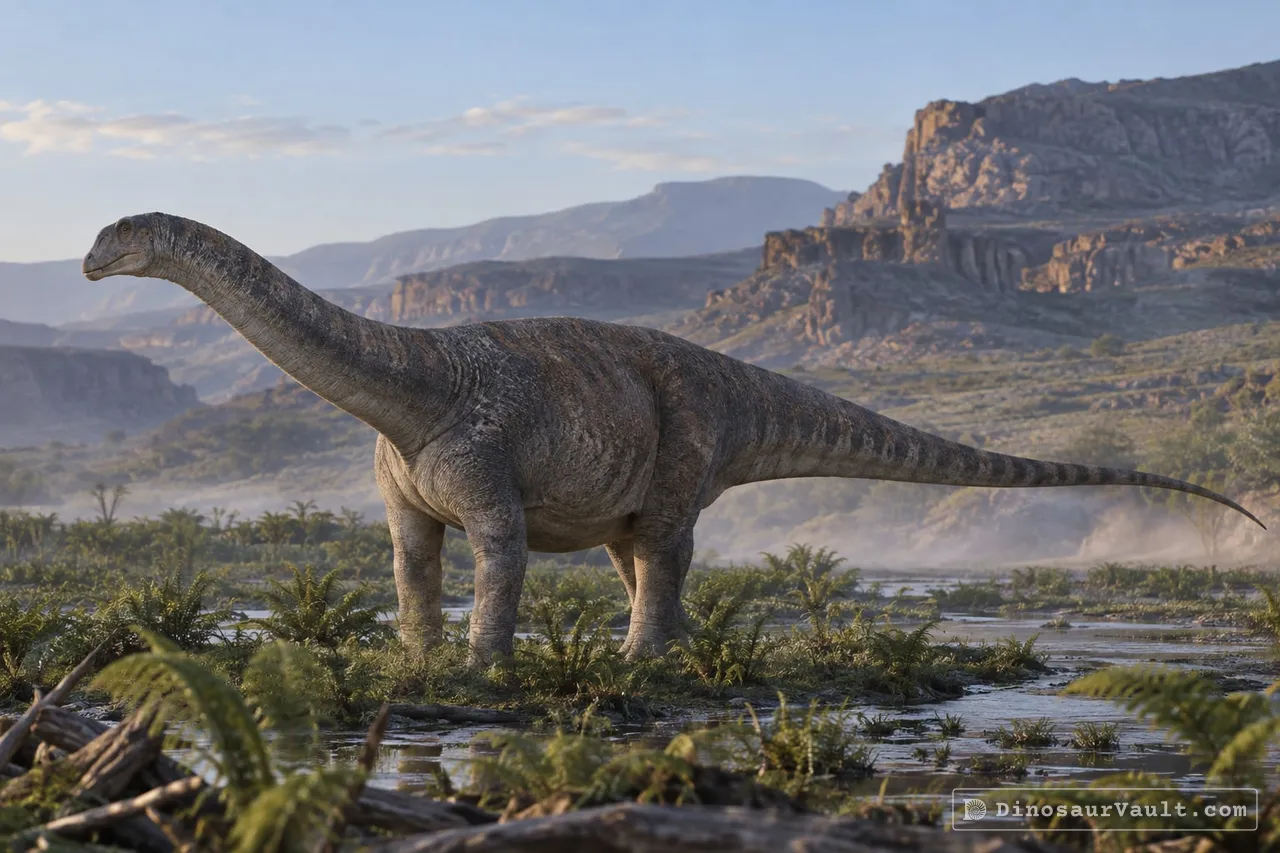
Scenes reconstructed from the available fossil evidence.
Lived alongside
Found in the same rock formations


A rock formation can hold fossils laid down millions of years apart, so not every animal here met Zapalasaurus.
The evidence
The science behind Zapalasaurus
Which parts of the picture come from its own bones, and which come from its relatives.
From its own fossils
- The type skeleton includes a neck vertebra, a series of tail vertebrae, parts of the hips and hind-leg bones.
- The preserved tail vertebrae become longer farther back, and their spines become lower and longer along the series.
- The preserved neck vertebra has a low, rounded spine, while the front tail vertebrae have short spines inclined backward.
Borrowed from relatives
- Its missing face and jaws are restored by comparison with Lavocatisaurus, and its missing trunk and forequarters with Limaysaurus.
- Its missing hand is compared with Apatosaurus and its missing foot with Camarasaurus, as general sauropod comparisons.
Still unknown
- Its skull shape and teeth, and whether the preserved tail vertebrae form a continuous series.
- Its full neck length and body size. Its first describers placed it with weak support outside the later groups of Diplodocus relatives, while recent analyses treat it as an early rebbachisaurid.
- Its skin covering and color.
Discovery timeline
- 2006Named itSalgado, Carvalho & Garrido
- 2011Family treeWHITLOCK
- 2015Family treeWilson & Allain
Key papers
The research behind what we know of Zapalasaurus
Named it
Described the partial skeleton and named Zapalasaurus for its distinctive neck and tail vertebrae.
Zapalasaurus bonapartei, un nuevo dinosaurio saurópodo de La Formación La Amarga (Cretácico Inferior), noroeste de Patagonia, Provincia de Neuquén, Argentina. Geobios 39: 695-707
Read the paper : Zapalasaurus bonapartei, un nuevo dinosaurio saurópodo de La Formación La Amarga (Cretácico Inferior), noroeste de Patagonia, Provincia de Neuquén, Argentina (opens in a new tab)Family tree
Rebuilt the family tree of Diplodocus and its relatives, including the rebbachisaurid branch containing Zapalasaurus.
A phylogenetic analysis of Diplodocoidea (Saurischia: Sauropoda). Zoological Journal of the Linnean Society 161: 872-915
Read the paper : A phylogenetic analysis of Diplodocoidea (Saurischia: Sauropoda) (opens in a new tab)Family tree
Described the skeleton of Rebbachisaurus, a later rebbachisaurid from Morocco.
Osteology ofRebbachisaurus garasbaeLavocat, 1954, a diplodocoid (Dinosauria, Sauropoda) from the early Late Cretaceous–aged Kem Kem beds of southeastern Morocco. Journal of Vertebrate Paleontology 35: e1000701
Read the paper : Osteology ofRebbachisaurus garasbaeLavocat, 1954, a diplodocoid (Dinosauria, Sauropoda) from the early Late Cretaceous–aged Kem Kem beds of southeastern Morocco (opens in a new tab)
Close relatives
Other members of Rebbachisauridae


Sources: Wikidata