Jeyawati
"grinding mouth"
- Lived
- 94 to 90 million years ago, Late Cretaceous
- Diet
- Herbivore
- Group
- Ornithopods
- Found in
- United States
- Named by
- McDonald et al. 2010
Where its fossils were found
The evidence
Today

90 million years ago
Habitat
Forested coastal lowlands near the Western Interior Seaway in what is now New Mexico. Large flowering trees grew here, alongside dinosaurs such as Zuniceratops, Nothronychus and Suskityrannus.
Field notes
About Jeyawati
What it was like
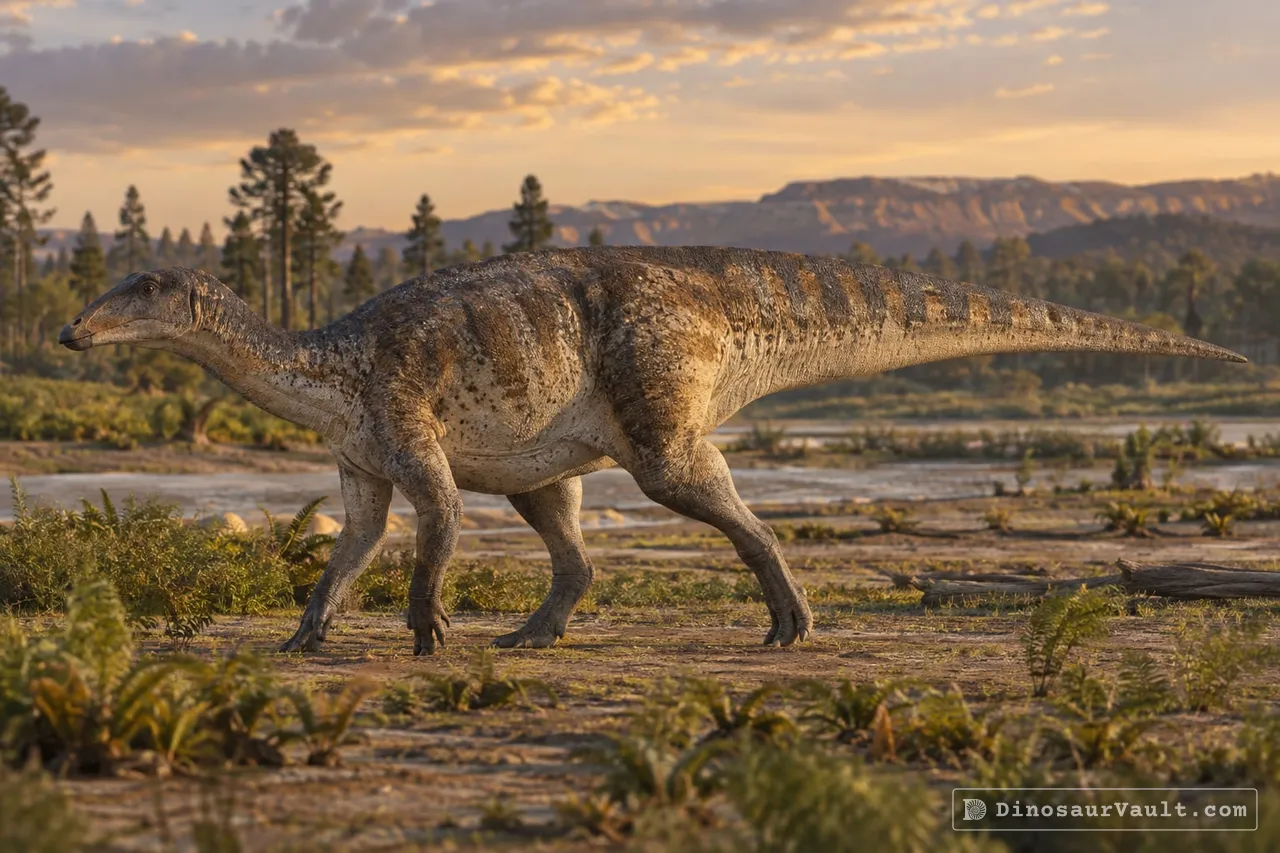
Jeyawati was a plant eater related to the duckbills, with many teeth packed into batteries for grinding plants. It is known from part of a skull. The bone around its eye was rough, which may mean it had a bony brow.
Its world
It lived about 94 to 90 million years ago, in the Late Cretaceous, in what is now New Mexico. It comes from the Moreno Hill Formation, where it shared the land with the therizinosaur Nothronychus, the horned Zuniceratops and the small tyrannosaur Suskityrannus.
How it was found
McDonald and colleagues named Jeyawati in 2010. Its name comes from the language of a local native people.
Field gallery
More views of Jeyawati
Scenes reconstructed from the available fossil evidence.
Lived alongside
Found in the same rock formations


A rock formation can hold fossils laid down millions of years apart, so not every animal here met Jeyawati.
The evidence
The science behind Jeyawati
Which parts of the picture come from its own bones, and which come from its relatives.
From its own fossils
- The known skeleton preserves part of the skull and fragments of the body.
- The bone behind the eye has a rough outer surface and a large opening for nerves and blood vessels.
- The tooth-bearing lower jaw is thin and straight, with a short gap before the tooth row.
Borrowed from relatives
- Eolambia provides comparisons for the missing upper face, limbs, hands, feet and much of the body.
Still unknown
- Its complete body proportions.
- How the rough bone behind its eye shaped its living face.
- Its skin covering and color.
Discovery timeline
- 2010Named itMcdonald †, Wolfe & Kirkland
- 2012Family treeMcDonald
- 2012Family treeMcDonald et al.
- 2019Same rocksNesbitt et al.
Key papers
The research behind what we know of Jeyawati
Named it
Named Jeyawati from an incomplete skeleton with rough bone behind the eye and placed it among early duckbill relatives.
A new basal hadrosauroid (Dinosauria: Ornithopoda) from the Turonian of New Mexico. Journal of Vertebrate Paleontology 30: 799-812
Read the paper : A new basal hadrosauroid (Dinosauria: Ornithopoda) from the Turonian of New Mexico (opens in a new tab)Family tree
Compared early iguanodontians, including Jeyawati, to trace the branches leading toward duck-billed dinosaurs.
Phylogeny of Basal Iguanodonts (Dinosauria: Ornithischia): An Update. PLoS ONE 7: e36745
Read the paper : Phylogeny of Basal Iguanodonts (Dinosauria: Ornithischia): An Update (opens in a new tab)Family tree
Described Eolambia in detail and compared its jaws and neck bones with Jeyawati.
Osteology of the Basal Hadrosauroid Eolambia caroljonesa (Dinosauria: Ornithopoda) from the Cedar Mountain Formation of Utah. PLoS ONE 7: e45712
Read the paper : Osteology of the Basal Hadrosauroid Eolambia caroljonesa (Dinosauria: Ornithopoda) from the Cedar Mountain Formation of Utah (opens in a new tab)Same rocks
Named Suskityrannus, a small tyrannosaur relative from the same formation, showing an early stage in the development of later North American dinosaur communities.
A mid-Cretaceous tyrannosauroid and the origin of North American end-Cretaceous dinosaur assemblages. Nature Ecology & Evolution 3: 892-899
Read the paper : A mid-Cretaceous tyrannosauroid and the origin of North American end-Cretaceous dinosaur assemblages (opens in a new tab)
Close relatives
Other members of Hadrosauroidea


Sources: Wikidata