Nothronychus
NOH-throh-NY-kus
"slothful claw"
- Lived
- 94 to 90 million years ago, Late Cretaceous
- Diet
- Herbivore
- Length
- about 5.3 m (17 ft)
- Group
- Theropods, Therizinosauridae
- Found in
- United States
- Named by
- Kirkland and Wolfe 2001
Size comparison
To scale


Scale in metersOutline: typical theropod shape
Where its fossils were found
The evidence
Today

90 million years ago
Habitat
In New Mexico, it inhabited floodplains with flowering trees and conifers near the Western Interior Seaway. Zuniceratops, Suskityrannus and Jeyawati shared this landscape. The skeleton from Utah was buried offshore in marine mud.
Field notes
About Nothronychus
What it was like
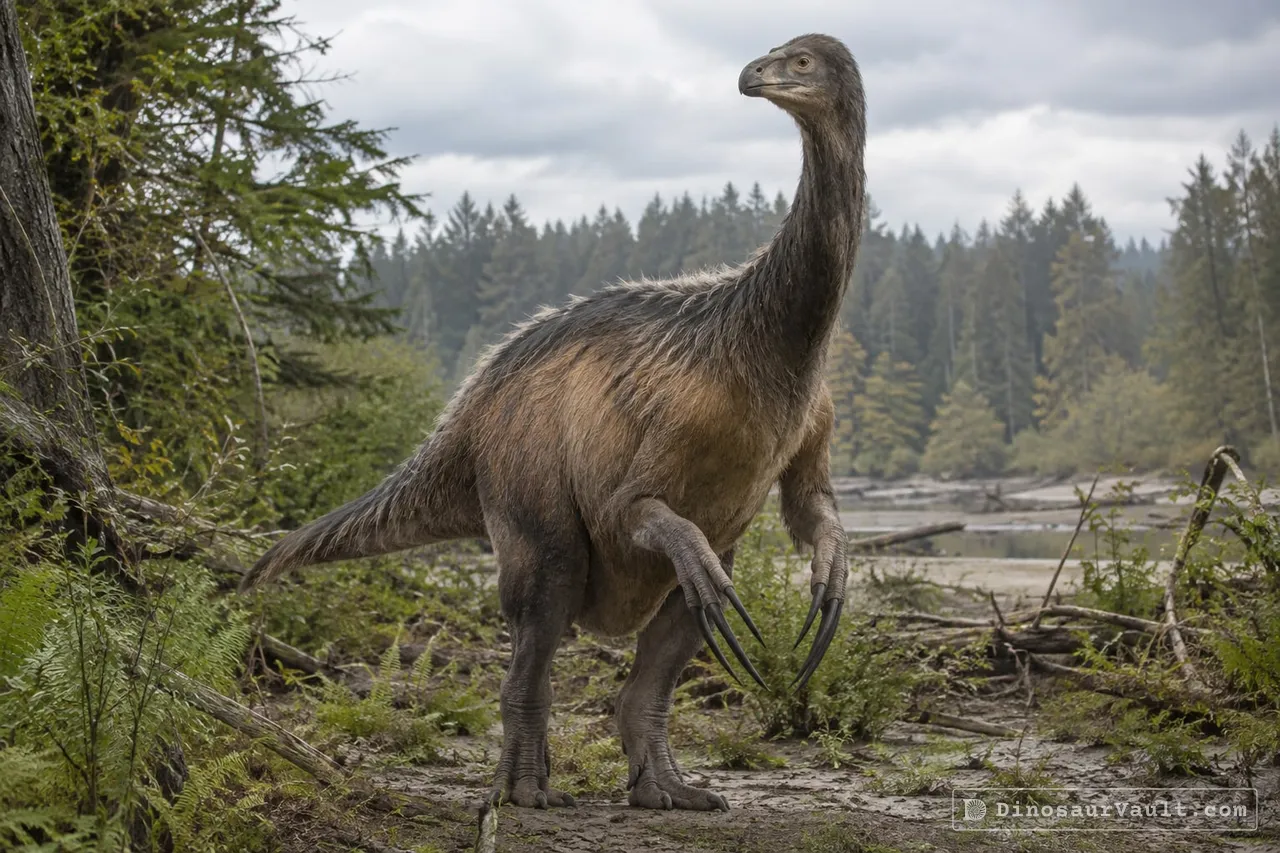
Nothronychus was a therizinosaur, a strange plant-eating relative of meat-eating dinosaurs. It was about 5.3 meters (17 feet) long, with a small head, a long neck, a pot belly, wide hips and long claws on its hands.
It probably used those claws to pull branches toward its mouth. It walked on two legs and was probably covered in simple feathers.
Its world
It lived about 94 to 90 million years ago, in the Late Cretaceous, in what are now New Mexico and Utah. It shared the land with the horned Zuniceratops and the small tyrannosaur Suskityrannus.
One skeleton comes from the Tropic Shale, rocks laid down in a sea, so that animal must have been washed out from shore.
How it was found
Kirkland and Wolfe named Nothronychus in 2001. It was the first therizinosaur found in North America. Two finds are known.
Field gallery
More views of Nothronychus
Scenes reconstructed from the available fossil evidence.
1 of 3
Lived alongside
Found in the same rock formations


A rock formation can hold fossils laid down millions of years apart, so not every animal here met Nothronychus.
The evidence
The science behind Nothronychus
Which parts of the picture come from its own bones, and which come from its relatives.
From its own fossils
- Much of the skeleton of the species graffami preserves a broad trunk, strong hips and substantial arms.
- Its hands had long fingers ending in curved claws, and its feet had four supporting toes.
- The species mckinleyi preserves part of the braincase.
Borrowed from relatives
- Erlikosaurus provides a model for the missing face: a small, elongated head with a beak at the front.
- Simple feathers are inferred from the feathered therizinosaur Beipiaosaurus.
Still unknown
- The shape of its complete face and the extent of its beak.
- The distribution and color of its feathers.
- How it used its hand claws.
Often drawn wrong
- Its palms faced inward rather than turning flat toward the ground.
- The claws were smaller than the huge blades of Therizinosaurus.
Discovery timeline
- 2001Named itKirkland & Wolfe
- 2009New findZanno et al.
- 2009Close relativeXu, Zheng & You
- 2015Full descriptionHedrick et al.
Key papers
The research behind what we know of Nothronychus
Named it
Named Nothronychus from New Mexico, establishing the presence of therizinosaurs in North America.
First definitive therizinosaurid (Dinosauria; Theropoda) from North America. Journal of Vertebrate Paleontology 21: 410-414
Read the paper : First definitive therizinosaurid (Dinosauria; Theropoda) from North America (opens in a new tab)New find
Named the species graffami from a more complete skeleton and examined how plant eating evolved among relatives of meat-eating dinosaurs.
A new North American therizinosaurid and the role of herbivory in ‘predatory’ dinosaur evolution. Proceedings of the Royal Society B: Biological Sciences 276: 3505-3511
Read the paper : A new North American therizinosaurid and the role of herbivory in ‘predatory’ dinosaur evolution (opens in a new tab)Close relative
Described feathers in Beipiaosaurus, supporting the inference that its relative Nothronychus also had a feather covering.
A new feather type in a nonavian theropod and the early evolution of feathers. Proceedings of the National Academy of Sciences 106: 832-834
Read the paper : A new feather type in a nonavian theropod and the early evolution of feathers (opens in a new tab)Full description
Compared both skeletons and showed that crushing after burial explains some differences once used to distinguish the species.
The Slothful Claw: Osteology and Taphonomy of Nothronychus mckinleyi and N. graffami (Dinosauria: Theropoda) and Anatomical Considerations for Derived Therizinosaurids. PLOS ONE 10: e0129449
Read the paper : The Slothful Claw: Osteology and Taphonomy of Nothronychus mckinleyi and N. graffami (Dinosauria: Theropoda) and Anatomical Considerations for Derived Therizinosaurids (opens in a new tab)
Close relatives
Other members of Therizinosauridae


Sources: Wikidata