Zuniceratops
ZOO-nee-SER-a-tops
"Zuni horned face"
Type species Zuniceratops christopheri
- Lived
- 94 to 90 million years ago, Late Cretaceous
- Diet
- Herbivore
- Group
- Ceratopsians
- Found in
- United States
- Named by
- Wolfe and Kirkland 1998
Where its fossils were found
The evidence
Today

90 million years ago
Habitat
Rivers crossed a low plain near a delta, with swampy areas and drier ground. Nothronychus, Suskityrannus and Jeyawati lived in the same region.
Field notes
About Zuniceratops
What it was like
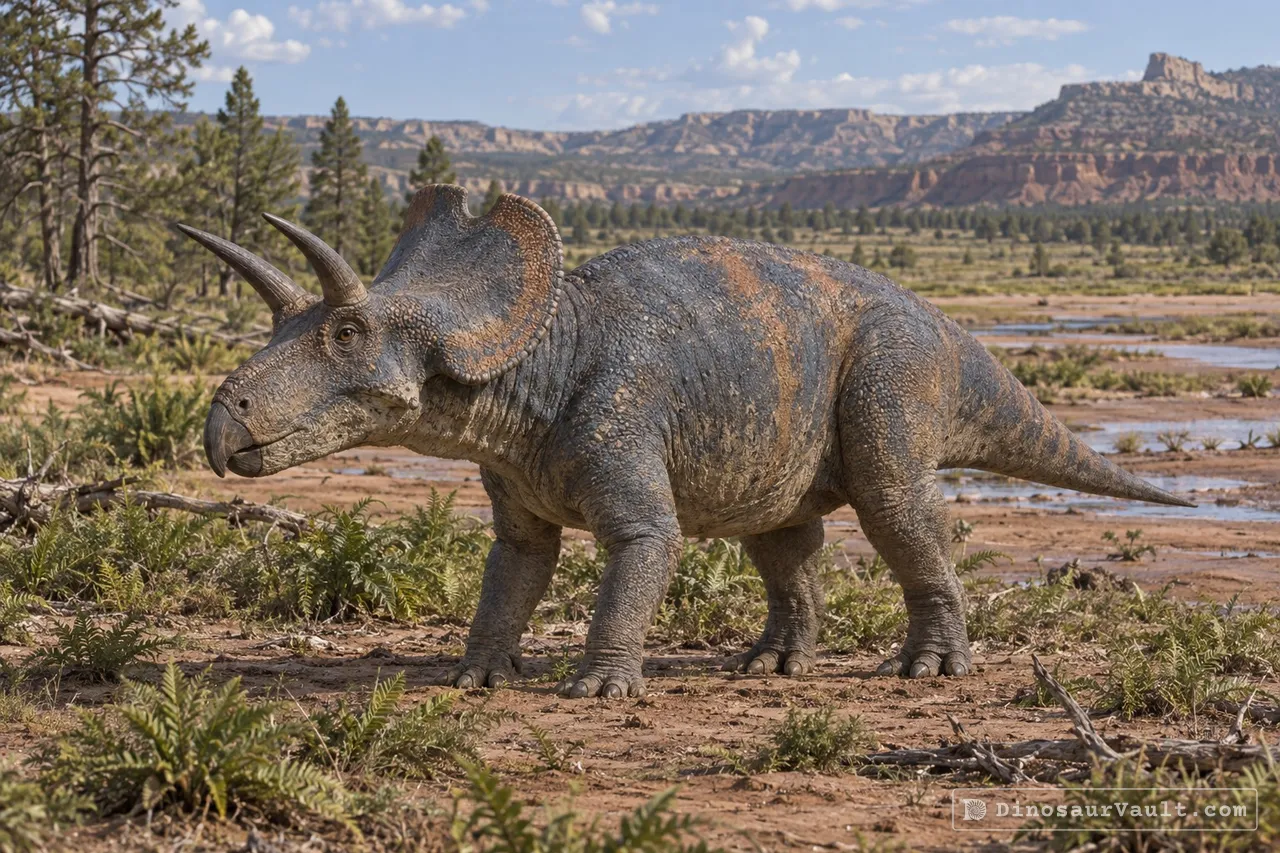
Zuniceratops was an early horned dinosaur, about the size of a large pig. Unlike older relatives, it had two long horns over its eyes, and it had no nose horn. Its frill had holes in it. It is one of the oldest known horned dinosaurs from North America with brow horns.
Its world
It lived about 94 to 90 million years ago, in the Late Cretaceous, in what is now New Mexico. It shared the Moreno Hill Formation with the therizinosaur Nothronychus, the small tyrannosaur Suskityrannus and the plant eater Jeyawati.
How it was found
Wolfe and Kirkland named Zuniceratops in 1998. The type species is Zuniceratops christopheri, after the son of one of its finders, who spotted the first bones as a boy.
Field gallery
More views of Zuniceratops
Scenes reconstructed from the available fossil evidence.
Lived alongside
Found in the same rock formations


A rock formation can hold fossils laid down millions of years apart, so not every animal here met Zuniceratops.
The evidence
The science behind Zuniceratops
Which parts of the picture come from its own bones, and which come from its relatives.
From its own fossils
- Skull bones preserve long brow horns and a snout without a nose horn.
- Jaw fossils include a low, rectangular upper jaw bone and teeth with simpler roots than those of later horned dinosaurs.
- The first skeleton was found as broken pieces lying on the surface, and a nearby bone bed holds bones from several more animals.
Borrowed from relatives
- Missing parts of its body and skin are restored by comparison with other horned dinosaurs such as Protoceratops and Triceratops.
Still unknown
- The full outline and soft covering of its frill. Bones once thought to come from the frill turned out to be hip bones of a therizinosaur.
- Its color.
- Whether it lived in herds or cared for its young.
Discovery timeline
- 1998Named itWolfe & Kirkland
- 2019Same rocksNesbitt et al.
- 2021Fossil sitesCilliers et al.
Key papers
The research behind what we know of Zuniceratops
Named it
Named an early horned dinosaur with brow horns from the Moreno Hill Formation.
Zuniceratops christopheri n. gen. & n. sp., a ceratopsian dinosaur from the Moreno Hill Formation (Cretaceous, Turonian) of west-central New Mexico. S. G. Lucas, J. I. Kirkland, and J. W. Estep (eds.), Lower and Middle Cretaceous Terrestrial Ecosystems, New Mexico Museum of Natural History and Science Bulletin 14:307-317.
No link available
Same rocks
Described Suskityrannus from the same rocks and placed the local dinosaur community between earlier faunas and the later giant-dominated communities.
A mid-Cretaceous tyrannosauroid and the origin of North American end-Cretaceous dinosaur assemblages. Nature Ecology & Evolution 3: 892-899
Read the paper : A mid-Cretaceous tyrannosauroid and the origin of North American end-Cretaceous dinosaur assemblages (opens in a new tab)Fossil sites
Dated mineral grains to refine the age and depositional history of the rocks containing Zuniceratops.
Age constraint for the Moreno Hill Formation (Zuni Basin) by CA-TIMS and LA-ICP-MS detrital zircon geochronology. PeerJ 9: e10948
Read the paper : Age constraint for the Moreno Hill Formation (Zuni Basin) by CA-TIMS and LA-ICP-MS detrital zircon geochronology (opens in a new tab)
Close relatives
Other members of Ceratopsoidea

Sources: Wikidata