Isasicursor
- Lived
- 72 to 66 million years ago, Late Cretaceous
- Diet
- Herbivore
- Group
- Ornithopods
- Found in
- Argentina
- Named by
- Novas et al. 2019
Where its fossils were found
The evidence
Today

70 million years ago
Habitat
Rivers crossed a floodplain with ponds and swamps in the Chorrillo Formation of Argentina. Neighbors included the giant plant eater Nullotitan and the meat eater Maip.
Field notes
About Isasicursor
What it was like
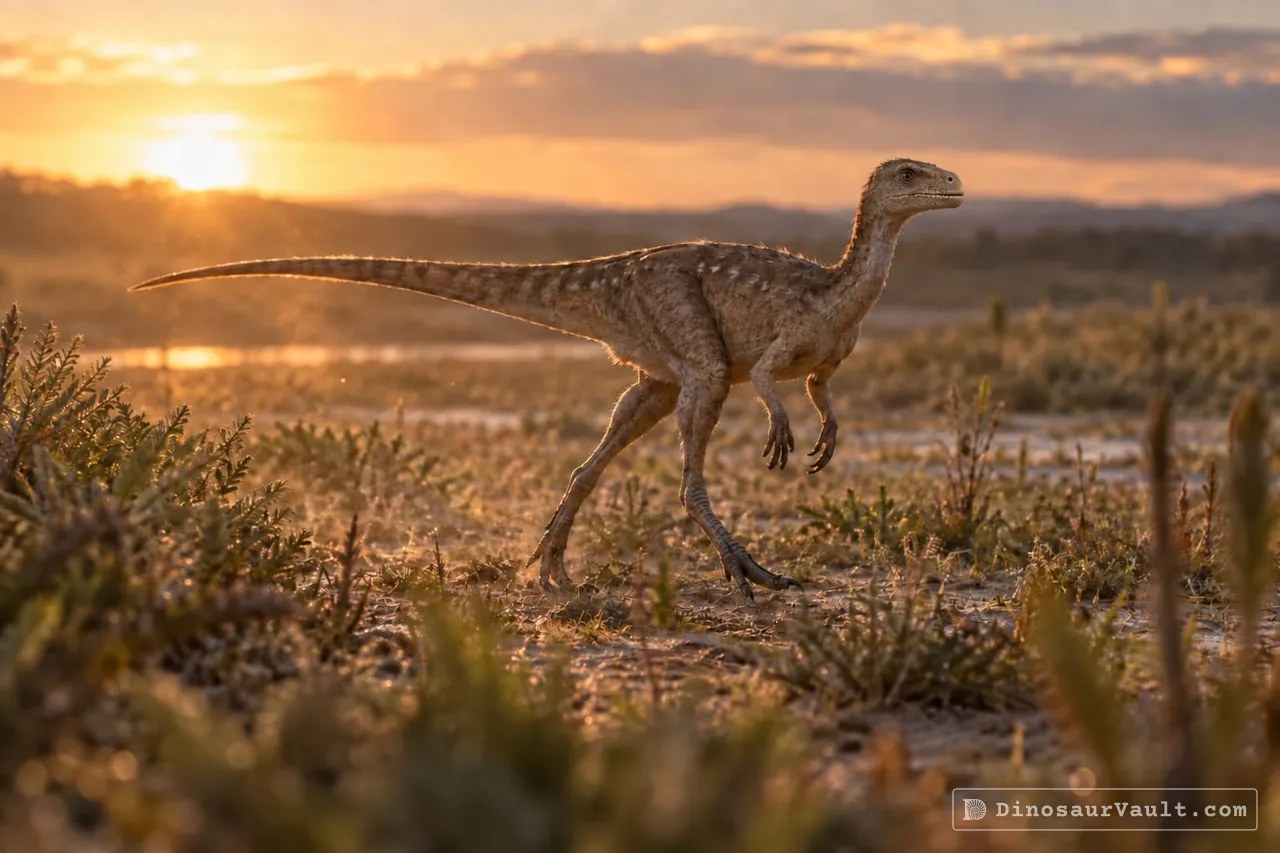
Isasicursor was a small plant eater that walked on two legs, an elasmarian ornithopod. It is known from bones of several animals.
Its world
It lived about 72 to 66 million years ago, near the end of the Cretaceous, in what is now Argentina. It comes from the Chorrillo Formation, where it shared the land with the megaraptor Maip and the titanosaur Nullotitan.
How it was found
Novas and colleagues named Isasicursor in 2019, in honor of a local fossil hunter.
Field gallery
More views of Isasicursor
Scenes reconstructed from the available fossil evidence.
1 of 3
Lived alongside
Found in the same rock formations


A rock formation can hold fossils laid down millions of years apart, so not every animal here met Isasicursor.
The evidence
The science behind Isasicursor
Which parts of the picture come from its own bones, and which come from its relatives.
From its own fossils
- Material assigned to Isasicursor from several individuals includes vertebrae and bones from the shoulders, hips, legs and feet.
- Young animals are represented by thigh, shin and foot bones. Assigned foot claws are pointed, flattened and gently curved inward.
- A partial right upper jaw referred to Isasicursor has a smooth, convex outer surface and an inset row of teeth.
Borrowed from relatives
- The missing beak and front of the lower jaw are restored after Talenkauen, and the missing skull roof and hands after Thescelosaurus.
Still unknown
- Its skin covering and color.
- Whether the animals found together lived in a lasting herd.
- Whether adults cared for their young.
Discovery timeline
- 2019Named itNovas et al.
- 2021Same rocksRozadilla et al.
- 2022New findMoyano-Paz et al.
Key papers
The research behind what we know of Isasicursor
Named it
Named Isasicursor and Nullotitan among a diverse collection of animals and plants from the Chorrillo Formation.
Paleontological discoveries in the Chorrillo Formation (upper Campanian-lower Maastrichtian, Upper Cretaceous), Santa Cruz Province, Patagonia, Argentina. Revista del Museo Argentino de Ciencias Naturales 21: 217-293
Read the paper : Paleontological discoveries in the Chorrillo Formation (upper Campanian-lower Maastrichtian, Upper Cretaceous), Santa Cruz Province, Patagonia, Argentina (opens in a new tab)Same rocks
Reported ankylosaur, hadrosaur and other ornithopod bones, revealing a broader variety of plant eaters in Isasicursor's world.
Ornithischian remains from the Chorrillo Formation (Upper Cretaceous), southern Patagonia, Argentina, and their implications on ornithischian paleobiogeography in the Southern Hemisphere. Cretaceous Research 125: 104881
Read the paper : Ornithischian remains from the Chorrillo Formation (Upper Cretaceous), southern Patagonia, Argentina, and their implications on ornithischian paleobiogeography in the Southern Hemisphere (opens in a new tab)New find
Described river deposits and a partial upper jaw referred to Isasicursor, along with additional limb bones.
The uppermost Cretaceous continental deposits at the southern end of Patagonia, the Chorrillo Formation case study (Austral-Magallanes Basin): Sedimentology, fossil content and regional implications. Cretaceous Research 130: 105059
Read the paper : The uppermost Cretaceous continental deposits at the southern end of Patagonia, the Chorrillo Formation case study (Austral-Magallanes Basin): Sedimentology, fossil content and regional implications (opens in a new tab)
Close relatives
Other members of Elasmaria


Sources: Wikidata