Nullotitan
"Nullo's titan"
Type species Nullotitan glaciaris
- Lived
- 72 to 66 million years ago, Late Cretaceous
- Diet
- Herbivore
- Group
- Sauropods
- Found in
- Argentina
- Named by
- Novas et al. 2019
Where its fossils were found
The evidence
Today

70 million years ago
Habitat
Rivers crossed a broad floodplain with freshwater wetlands in Late Cretaceous Argentina. Water ferns, water-clovers and water lilies grew in the wetlands. Other dinosaurs included Isasicursor, Maip and Kank.
Field notes
About Nullotitan
What it was like
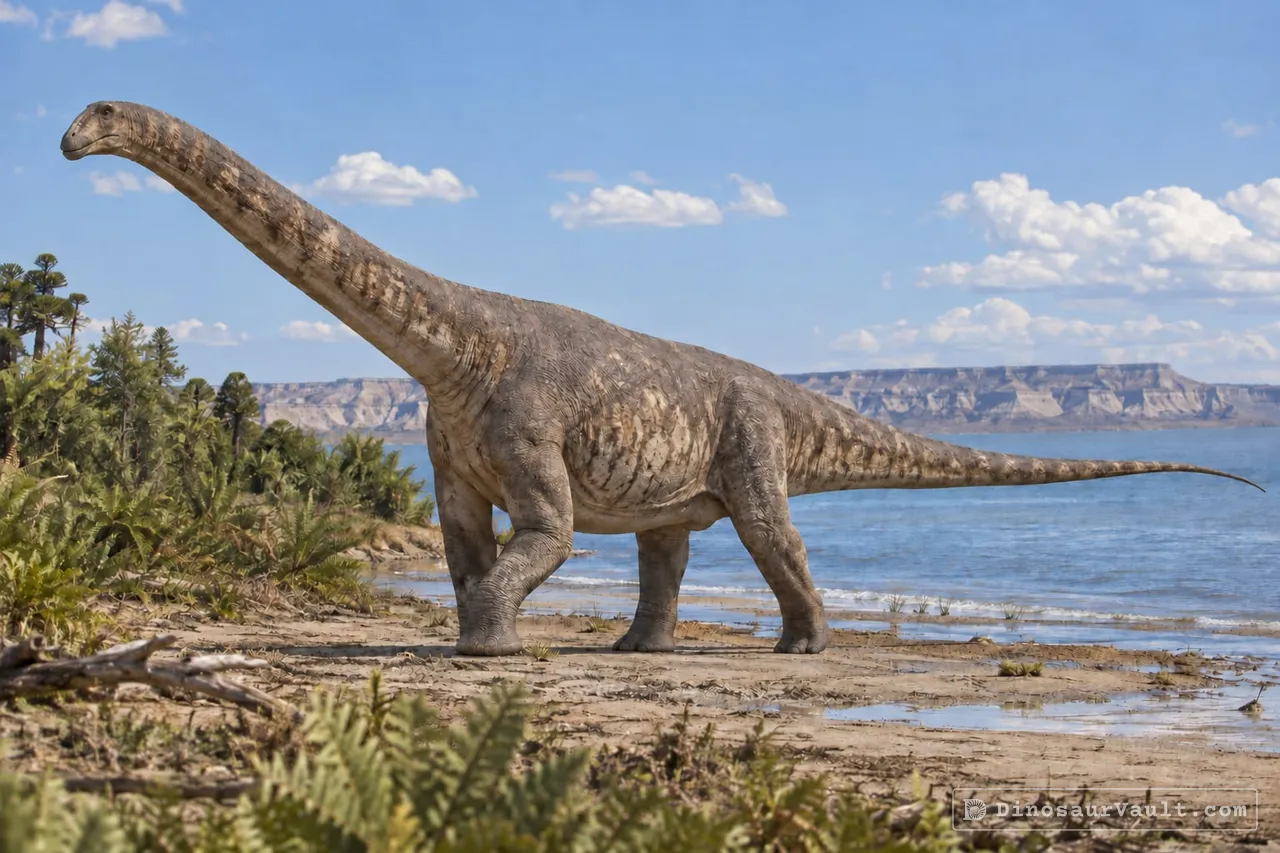
Nullotitan was a titanosaur, a long-necked plant eater. It is known from bones of several individuals, including parts of the backbone and limbs.
Its world
It lived about 72 to 66 million years ago, at the end of the Late Cretaceous, in the far south of what is now Argentina. Its bones come from the Chorrillo Formation, where it lived alongside the plant eater Isasicursor and the big predator Maip.
How it was found
Novas and colleagues named it in 2019. The type species is Nullotitan glaciaris.
Field gallery
More views of Nullotitan
Scenes reconstructed from the available fossil evidence.
1 of 2
Lived alongside
Found in the same rock formations


A rock formation can hold fossils laid down millions of years apart, so not every animal here met Nullotitan.
The evidence
The science behind Nullotitan
Which parts of the picture come from its own bones, and which come from its relatives.
From its own fossils
- Bones from several individuals include neck and tail vertebrae, ribs, part of a shoulder blade and limb bones.
- The tail bones have deep hollows along their sides.
- Its outer lower-leg bone has a strongly curved shaft.
Borrowed from relatives
- The missing parts of the body are restored from more complete titanosaurs such as Dreadnoughtus and Patagotitan.
Still unknown
- The shape of its skull and the full length of its neck.
- Its skin covering and color.
- Whether it traveled in herds.
Discovery timeline
- 2019Named itNovas et al.
- 2022Its worldMoyano-Paz et al.
- 2022Its worldVera et al.
Key papers
The research behind what we know of Nullotitan
Named it
Named Nullotitan from vertebrae and limb bones and described Isasicursor and other animals from the same rocks.
Paleontological discoveries in the Chorrillo Formation (upper Campanian-lower Maastrichtian, Upper Cretaceous), Santa Cruz Province, Patagonia, Argentina. Revista del Museo Argentino de Ciencias Naturales 21: 217-293
Read the paper : Paleontological discoveries in the Chorrillo Formation (upper Campanian-lower Maastrichtian, Upper Cretaceous), Santa Cruz Province, Patagonia, Argentina (opens in a new tab)Its world
Reconstructed the Chorrillo Formation as a river system with extensive muddy floodplains and described its plants and animals.
The uppermost Cretaceous continental deposits at the southern end of Patagonia, the Chorrillo Formation case study (Austral-Magallanes Basin): Sedimentology, fossil content and regional implications. Cretaceous Research 130: 105059
Read the paper : The uppermost Cretaceous continental deposits at the southern end of Patagonia, the Chorrillo Formation case study (Austral-Magallanes Basin): Sedimentology, fossil content and regional implications (opens in a new tab)Its world
Identified a freshwater wetland plant community including water ferns, water-clovers and water lilies in the Chorrillo Formation.
Paleobotany of the uppermost Cretaceous Chorrillo Formation, Santa Cruz Province, Argentina: insights in a freshwater floral community. Cretaceous Research 138: 105296
Read the paper : Paleobotany of the uppermost Cretaceous Chorrillo Formation, Santa Cruz Province, Argentina: insights in a freshwater floral community (opens in a new tab)
Close relatives
Other members of Lithostrotia


Sources: Wikidata