Kank
Type species Kank australis
- Lived
- 72 to 66 million years ago, Late Cretaceous
- Diet
- Carnivore
- Group
- Theropods, Unenlagiidae
- Found in
- Argentina
- Named by
- Motta et al. 2026
Where its fossils were found
The evidence
Today

70 million years ago
Habitat
Rivers and freshwater wetlands spread across a floodplain in Late Cretaceous Argentina. Water ferns, water-clovers and water lilies grew there. Other dinosaurs included Maip, Nullotitan and Isasicursor.
Field notes
About Kank
What it was like
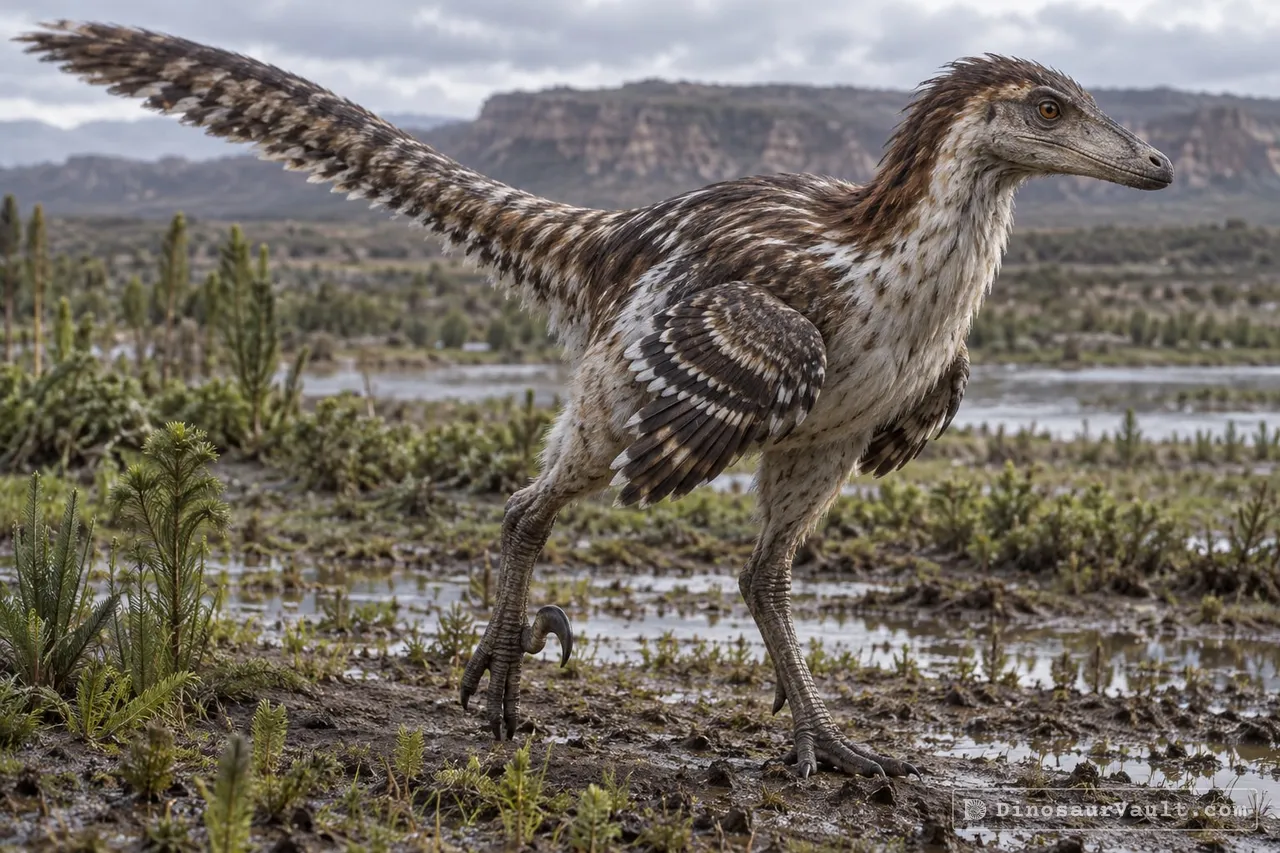
Kank was an unenlagiid, a feathered theropod related to Unenlagia. It is known from part of the skeleton.
Its world
It lived about 72 to 66 million years ago, near the end of the Cretaceous, in what is now Argentina. It comes from the Chorrillo Formation, where it shared the land with the megaraptor Maip, the titanosaur Nullotitan and the small plant eater Isasicursor.
How it was found
Motta and colleagues named Kank in 2026. The type species is Kank australis.
Field gallery
More views of Kank
Scenes reconstructed from the available fossil evidence.
1 of 3
Lived alongside
Found in the same rock formations


A rock formation can hold fossils laid down millions of years apart, so not every animal here met Kank.
The evidence
The science behind Kank
Which parts of the picture come from its own bones, and which come from its relatives.
From its own fossils
- The type specimen is a neck vertebra with many air spaces and prominent muscle attachments.
- Other vertebrae, isolated toe bones and shed teeth have been referred to Kank.
- A referred bone from the enlarged-claw toe has unusually small joint surfaces, and referred claw bones are robust, compressed blades.
Borrowed from relatives
- Its missing skull, arms, trunk and tail are restored by comparison with Buitreraptor.
- A feather covering is inferred by comparison with feathered birdlike theropods such as Zhenyuanlong.
Still unknown
- Its full body proportions, feather pattern and range of movement in the enlarged-claw toe.
- Whether it specialized in catching fish.
- Its color.
Discovery timeline
- 2022Its worldMoyano-Paz et al.
- 2022Its worldVera et al.
- 2026Named itMotta et al.
Key papers
The research behind what we know of Kank
Its world
Reconstructed the Chorrillo Formation as a river system with extensive muddy floodplains and described its plants and animals.
The uppermost Cretaceous continental deposits at the southern end of Patagonia, the Chorrillo Formation case study (Austral-Magallanes Basin): Sedimentology, fossil content and regional implications. Cretaceous Research 130: 105059
Read the paper : The uppermost Cretaceous continental deposits at the southern end of Patagonia, the Chorrillo Formation case study (Austral-Magallanes Basin): Sedimentology, fossil content and regional implications (opens in a new tab)Its world
Identified a freshwater wetland plant community including water ferns, water-clovers and water lilies in the Chorrillo Formation.
Paleobotany of the uppermost Cretaceous Chorrillo Formation, Santa Cruz Province, Argentina: insights in a freshwater floral community. Cretaceous Research 138: 105296
Read the paper : Paleobotany of the uppermost Cretaceous Chorrillo Formation, Santa Cruz Province, Argentina: insights in a freshwater floral community (opens in a new tab)Named it
Named Kank from fragmentary remains with distinctive neck and toe bones and placed it among the unenlagiids.
New unenlagiid from the Chorrillo Formation (Late Cretaceous, Maastrichtian), SW Patagonia, Argentina. Journal of Vertebrate Paleontology 46
Read the paper : New unenlagiid from the Chorrillo Formation (Late Cretaceous, Maastrichtian), SW Patagonia, Argentina (opens in a new tab)
Sources: Wikidata