Dryptosaurus
DRIP-toh-SORE-us
"tearing lizard"
- Lived
- 113 to 66 million years ago, Early Cretaceous to Late Cretaceous
- Diet
- Carnivore
- Group
- Theropods
- Found in
- United States
- Named by
- Marsh 1877
Where its fossils were found
The evidence
Today

90 million years ago
Habitat
It probably lived on wooded coastal land near the deposits of the New Egypt Formation in New Jersey. Across Late Cretaceous Appalachia, other dinosaurs included Hadrosaurus and Lophorhothon.
Field notes
About Dryptosaurus
What it was like
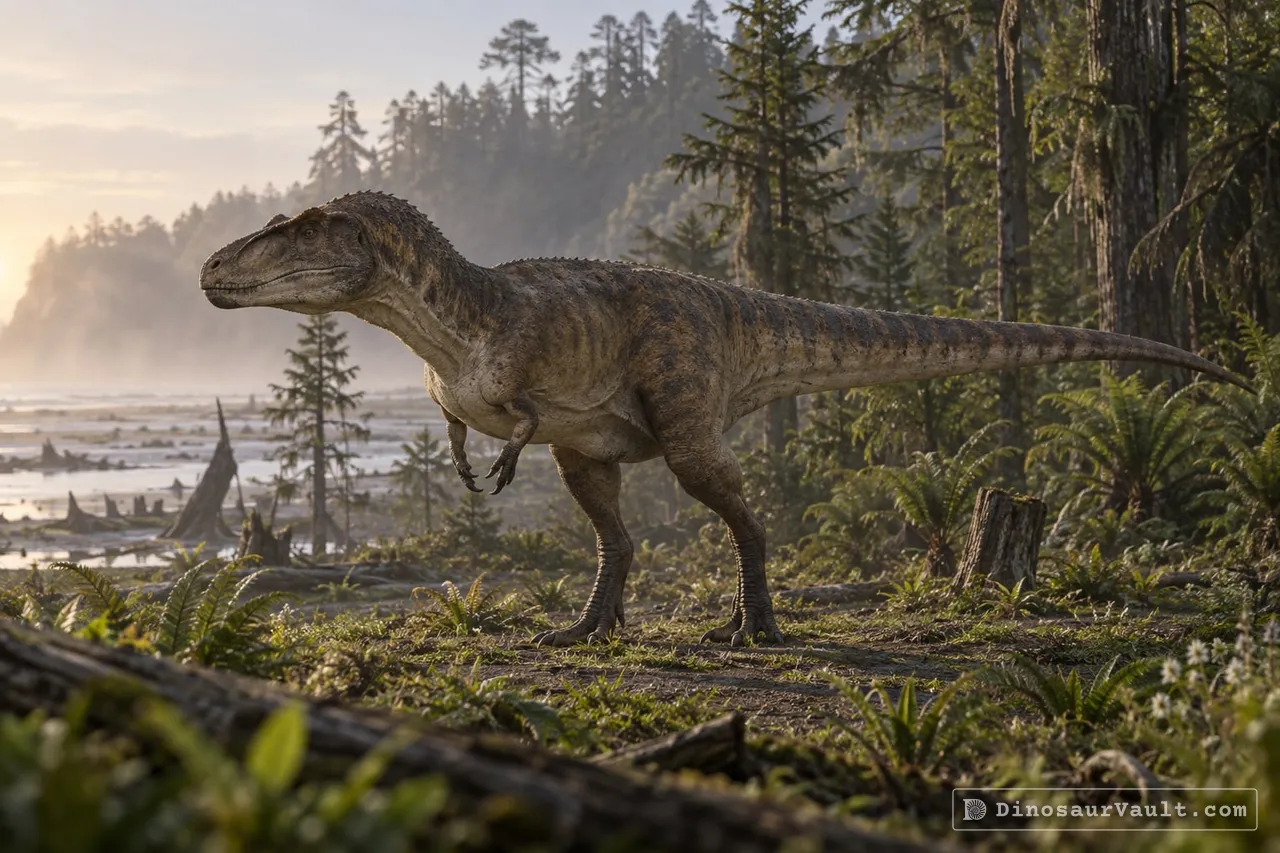
Dryptosaurus was an early relative of the tyrannosaurs, but unlike its later cousins Tyrannosaurus and Tarbosaurus, it kept large forelimbs tipped with big, curved claws rather than tiny arms. It walked on two legs and had sharp, blade-like teeth suited to slicing flesh. Its incomplete skeleton leaves its total length uncertain.
Because only a fragmentary skeleton is known, much of its exact appearance is pieced together by comparing it with better-known relatives.
Its world
Fossils linked to Dryptosaurus span a wide stretch of time, from about 113 to 66 million years ago, covering the Early and Late Cretaceous, though the most complete remains come from the Late Cretaceous of New Jersey, with other fragmentary fossils reported as far away as Texas. Its bones come from the Merchantville, New Egypt, and Paluxy formations.
In New Jersey it lived alongside the plant eater Tenontosaurus and the sauropods Cedarosaurus and Astrophocaudia, in a coastal setting where sharks and other marine animals are also found in the same rocks.
How it was found
Marsh named Dryptosaurus in 1877, based on fossils dug up by fertilizer miners in New Jersey. Only about three fossil finds are linked to the genus, and because they are so incomplete, Dryptosaurus remains one of the more mysterious dinosaurs known from the eastern United States.
Field gallery
More views of Dryptosaurus
Scenes reconstructed from the available fossil evidence.
1 of 7
Lived alongside
Found in the same rock formations


A rock formation can hold fossils laid down millions of years apart, so not every animal here met Dryptosaurus.
The evidence
The science behind Dryptosaurus
Which parts of the picture come from its own bones, and which come from its relatives.
From its own fossils
- A partial skeleton preserves pieces of the jaws, backbone, limbs and hips.
- The upper arm was short, but the hand was enlarged and carried a large curved claw.
- Its teeth were sharp and blade-like, suited to slicing flesh.
Borrowed from relatives
- Missing parts of the skull and body are restored by comparison with other tyrannosauroids, including Appalachiosaurus.
- Lips covering the teeth follow comparisons with large theropods such as Tyrannosaurus.
Still unknown
- The complete skull shape and the number of functional fingers.
- Its color and how much of its skin carried scales or filaments.
- How it hunted and used its enlarged hands.
Often drawn wrong
- Tiny hands like those of Tyrannosaurus miss its unusual combination of a short upper arm and a large hand.
- Its palms faced inward rather than down toward the ground.
Discovery timeline
- 1877Named itMarsh
- 2011Full descriptionBrusatte, Benson & Norell
- 2016Family treeBrusatte & Carr
Key papers
The research behind what we know of Dryptosaurus
Named it
Introduced the name Dryptosaurus for a large meat-eating dinosaur from New Jersey.
Notice of a new and gigantic dinosaur, Titanosaurus. American Journal of Science s3-14: 87-88
Read the paper : Notice of a new and gigantic dinosaur, Titanosaurus (opens in a new tab)Full description
Restudied the original bones and identified its unusual combination of a short upper arm and an enlarged hand.
The Anatomy ofDryptosaurus aquilunguis(Dinosauria: Theropoda) and a Review of Its Tyrannosauroid Affinities. American Museum Novitates 3717: 1-53
Read the paper : The Anatomy ofDryptosaurus aquilunguis(Dinosauria: Theropoda) and a Review of Its Tyrannosauroid Affinities (opens in a new tab)Family tree
Compared tyrannosauroid skeletons and explored where Dryptosaurus and Appalachiosaurus fit among the relatives of Tyrannosaurus.
The phylogeny and evolutionary history of tyrannosauroid dinosaurs. Scientific Reports 6
Read the paper : The phylogeny and evolutionary history of tyrannosauroid dinosaurs (opens in a new tab)
Close relatives
Other members of Tyrannosauroidea


Sources: Wikidata