Stokesosaurus
"Stokes's lizard"
Type species Stokesosaurus clevelandi
- Lived
- Late Jurassic
- Diet
- Carnivore
- Group
- Theropods
- Found in
- United States
- Named by
- Madsen 1974
Where its fossils were found
The evidence
Fossil record
Cleveland-Lloyd Dinosaur Quarry, Utah, United States
Late Jurassic
The securely identified type is a hip bone from the Morrison Formation. Other referrals remain uncertain. A date for the type quarry does not establish the full duration of the genus.
Today

Habitat
The Morrison landscape had river channels, floodplains and seasonal dry spells, with conifers and ferns. Allosaurus, Stegosaurus and Diplodocus lived in the same region.
Field notes
About Stokesosaurus
What it was like
Stokesosaurus was a small, early relative of Tyrannosaurus, securely identified from a hip bone. Its missing body parts are reconstructed by comparison with other early tyrannosauroids.
Its world
Stokesosaurus is securely known from a hip bone found in the Late Jurassic Morrison Formation of Utah. Other fossils have been assigned to it, but those identifications are uncertain.
How it was found
Madsen named Stokesosaurus in 1974. The type species is Stokesosaurus clevelandi.
Field gallery
More views of Stokesosaurus
Scenes reconstructed from the available fossil evidence.
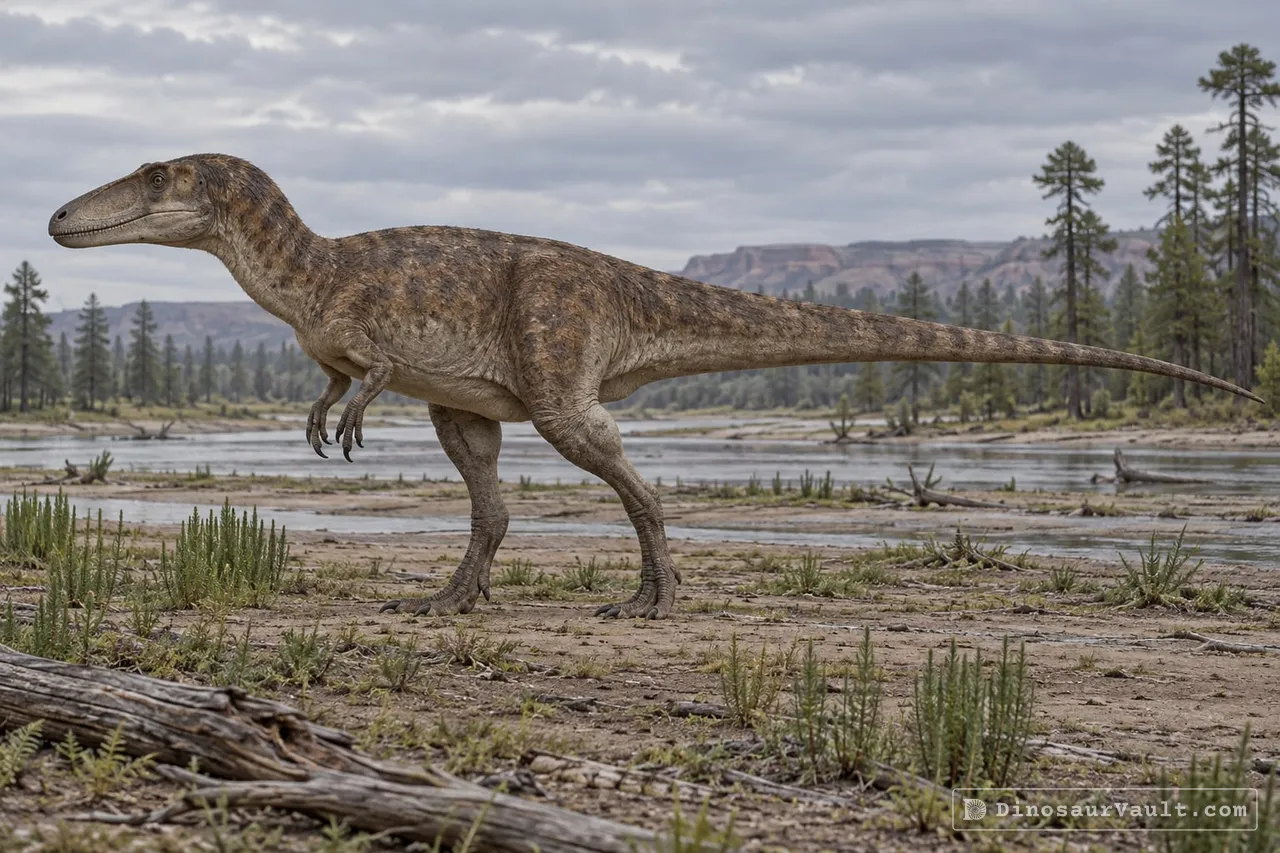
1 of 3
The evidence
The science behind Stokesosaurus
Which parts of the picture come from its own bones, and which come from its relatives.
From its own fossils
- A left hip bone is the secure basis for identifying Stokesosaurus.
- A tall ridge on the outer face of that bone helps distinguish it from other early tyrannosauroids.
Borrowed from relatives
- The missing head and long arms are modeled on early tyrannosauroids such as Eotyrannus.
- Dilong had simple feather filaments, so Stokesosaurus may have worn a similar covering.
- Juratyrant provides a comparison for the backbone, pelvis and hind limbs.
Still unknown
- The shape of its skull and its exact body proportions.
- Whether it had feathers, and where they grew.
- Its color and how it grew.
Often drawn wrong
- A huge, deep skull and tiny arms like those of Tyrannosaurus give it the proportions of a much later relative.
- Its palms should face inward rather than downward.
Discovery timeline
- 1974Named itMadsen
- 2004Close relativeXu et al.
- 2012Family treeBrusatte & Benson
Key papers
The research behind what we know of Stokesosaurus
Named it
Named a small Jurassic predator from distinctive hip bones found in Utah.
A new theropod dinosaur from the Upper Jurassic of Utah. Journal of Paleontology 48: 27-31
No link available
Close relative
Described Dilong with long arms and simple feather filaments, a comparison for the missing body covering of Stokesosaurus.
Basal tyrannosauroids from China and evidence for protofeathers in tyrannosauroids. Nature 431: 680-684
Read the paper : Basal tyrannosauroids from China and evidence for protofeathers in tyrannosauroids (opens in a new tab)Family tree
Separated the British skeleton as Juratyrant and narrowed the fossils securely assigned to Stokesosaurus.
The systematics of Late Jurassic tyrannosauroids (Dinosauria: Theropoda) from Europe and North America. Acta Palaeontologica Polonica
Read the paper : The systematics of Late Jurassic tyrannosauroids (Dinosauria: Theropoda) from Europe and North America (opens in a new tab)
Close relatives
Other members of Tyrannosauroidea


Sources: Wikidata