Raptorex
RAP-tor-ex
"robber king"
Type species Raptorex kriegsteini
- Lived
- Cretaceous
- Diet
- Carnivore
- Group
- Theropods
- Named by
- Sereno et al. 2009
Where its fossils were found
The evidence
Fossil record
Mongolia (proposed), Nemegt Formation (proposed)
Probably Late Cretaceous; exact age unresolved
The skeleton passed through dealers without a reliable excavation record. Later studies favor a Mongolian origin, but neither an exact site nor a numerical age is established.
No finds with map coordinates are recorded yet.
Habitat
If the skeleton came from the Late Cretaceous rocks proposed in later studies, its home may have been a landscape of winding rivers in Mongolia, with Tarbosaurus and Alioramus.
Field notes
About Raptorex
What it was like
Raptorex was a small tyrannosaur known from a single young skeleton. It had the big head and short arms of its larger relatives in a much smaller body.
When it was named, it was thought to show that the tyrannosaur body plan came before large size. Later studies challenged that interpretation. A recent comparison argues that Raptorex is most likely a young Tarbosaurus, although its original excavation site remains unknown.
Its world
Where and when it lived is uncertain. The fossil passed through dealers without a reliable excavation record. Later studies suggest that it came from Late Cretaceous rocks in Mongolia, possibly the Nemegt Formation.
How it was found
Sereno and colleagues named Raptorex in 2009. The type species is Raptorex kriegsteini.
Field gallery
More views of Raptorex
Scenes reconstructed from the available fossil evidence.
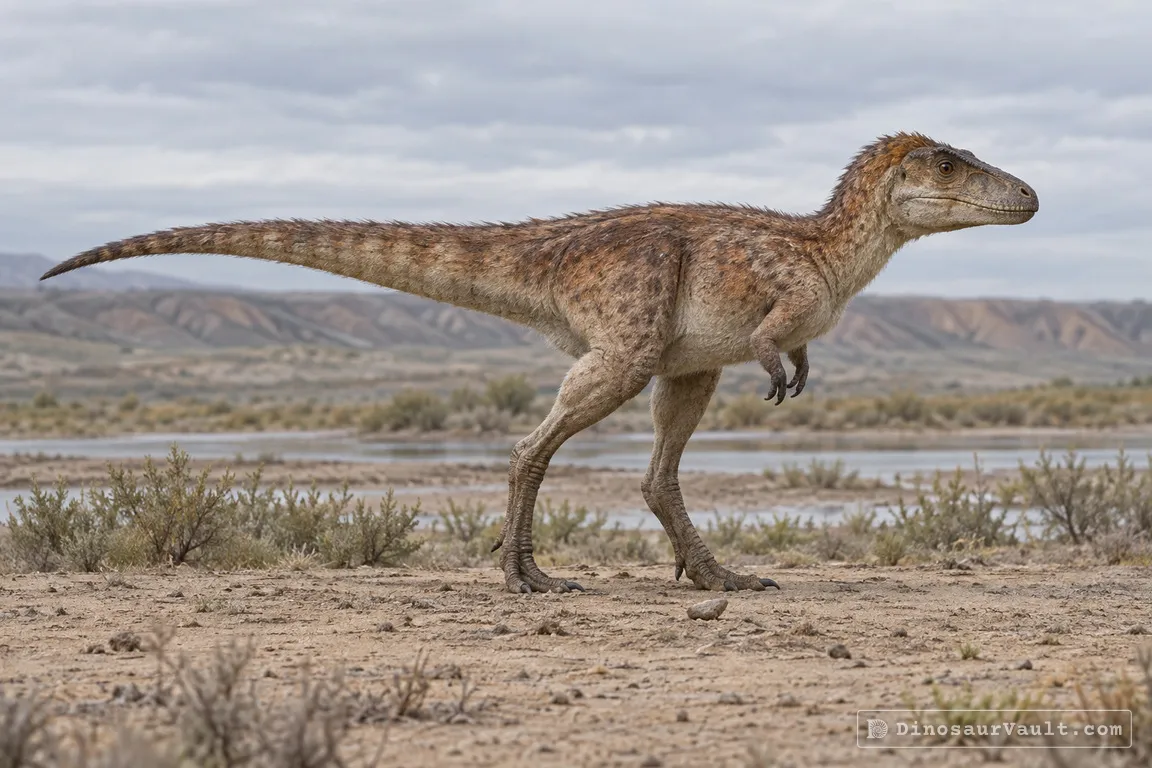
The evidence
The science behind Raptorex
Which parts of the picture come from its own bones, and which come from its relatives.
From its own fossils
- A nearly complete skeleton has a large head, short arms and long hind legs.
- The hands have two working fingers, like those of larger tyrannosaurs.
Borrowed from relatives
- Most of the skeleton is known from its own bones; Tarbosaurus provides a comparison for how the skull changed during growth.
Still unknown
- Whether Raptorex is a separate genus or a young Tarbosaurus.
- Exactly where the skeleton was dug up and how old its rocks are.
- Its skin covering and color.
Discovery timeline
- 2009Named itSereno et al.
- 2011Growing upFowler et al.
- 2011Close relativeTsuihiji et al.
- 2026Identity debatedRaun et al.
Key papers
The research behind what we know of Raptorex
Named it
Named a small tyrannosaur and proposed that its large head and short arms evolved before giant body size.
Tyrannosaurid Skeletal Design First Evolved at Small Body Size. Science 326: 418-422
Read the paper : Tyrannosaurid Skeletal Design First Evolved at Small Body Size (opens in a new tab)Growing up
Reexamined its bones and associated fossils, finding a juvenile and challenging the proposed Early Cretaceous age.
Reanalysis of “Raptorex kriegsteini”: A Juvenile Tyrannosaurid Dinosaur from Mongolia. PLoS ONE 6: e21376
Read the paper : Reanalysis of “Raptorex kriegsteini”: A Juvenile Tyrannosaurid Dinosaur from Mongolia (opens in a new tab)Close relative
Described a young Tarbosaurus skull with weaker jaws than adults, providing a comparison for the disputed Raptorex skeleton.
Cranial osteology of a juvenile specimen ofTarbosaurus bataar(Theropoda, Tyrannosauridae) from the Nemegt Formation (Upper Cretaceous) of Bugin Tsav, Mongolia. Journal of Vertebrate Paleontology 31: 497-517
Read the paper : Cranial osteology of a juvenile specimen ofTarbosaurus bataar(Theropoda, Tyrannosauridae) from the Nemegt Formation (Upper Cretaceous) of Bugin Tsav, Mongolia (opens in a new tab)Identity debated
Compared young Asian tyrannosaur skulls and argued that Raptorex is likely a young Tarbosaurus.
Taxonomic reassessment of juvenile tyrannosaurine specimens from Asia reveal large biogeographic ranges in tyrannosaurids. Cretaceous Research 186: 106412
Read the paper : Taxonomic reassessment of juvenile tyrannosaurine specimens from Asia reveal large biogeographic ranges in tyrannosaurids (opens in a new tab)
Close relatives
Other members of Tyrannosauroidea


Sources: Wikidata