Astrophocaudia
"twisted tail"
Type species Astrophocaudia slaughteri
- Lived
- 113 to 110 million years ago, Early Cretaceous
- Diet
- Herbivore
- Group
- Sauropods
- Found in
- United States
- Named by
- D'Emic 2013
Where its fossils were found
The evidence
Today

110 million years ago
Habitat
Rivers crossed a coastal plain in what is now Texas. Tenontosaurus and Cedarosaurus are also recorded from the Paluxy Formation.
Field notes
About Astrophocaudia
What it was like
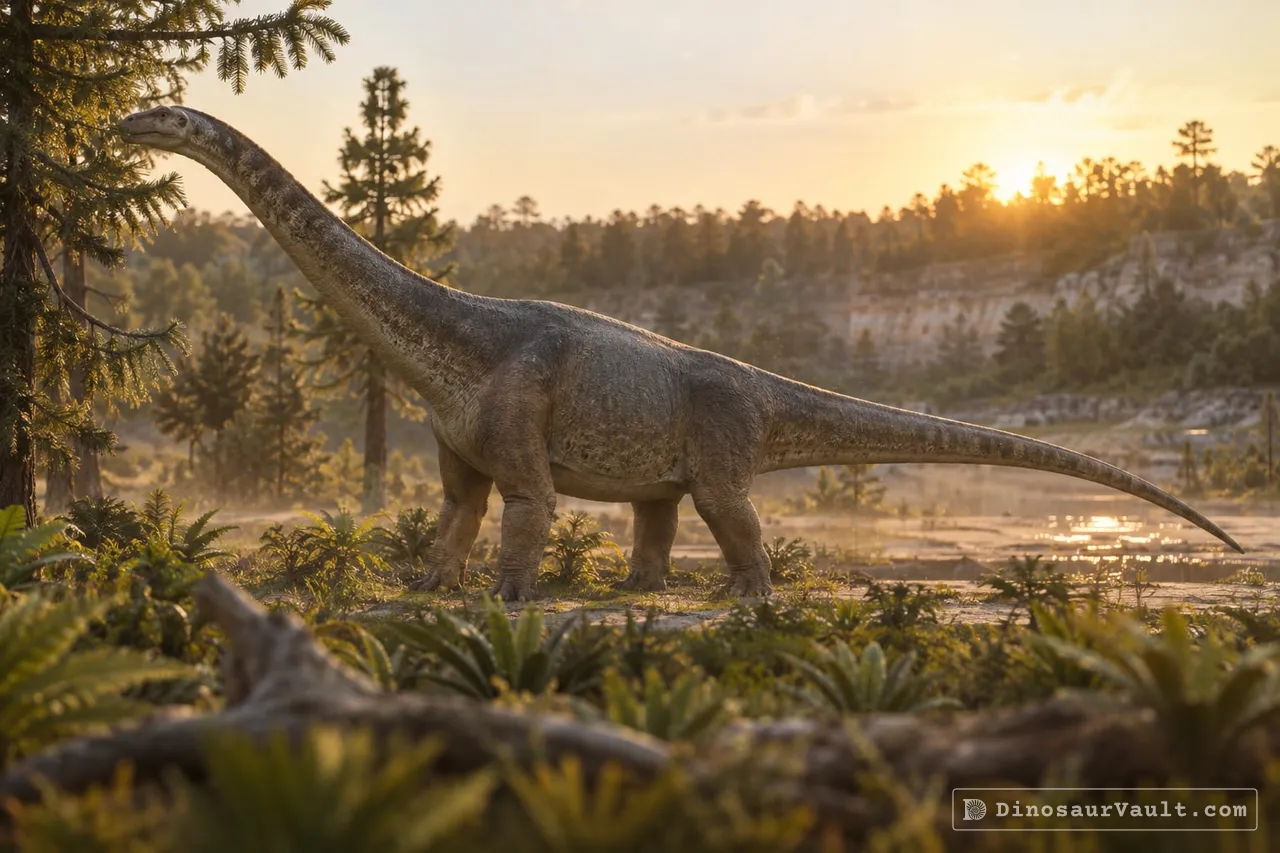
Astrophocaudia was a long-necked sauropod, a relative of the titanosaurs. It is known from neck and tail vertebrae, ribs, bones from beneath the tail, a shoulder blade, part of a hip bone and a tooth.
Its world
It lived in the Early Cretaceous in what is now Texas. Its bones come from the Paluxy Formation, where the long-necked Cedarosaurus and the plant eater Tenontosaurus also lived.
How it was found
D'Emic named it in 2013. The type species is Astrophocaudia slaughteri.
Field gallery
More views of Astrophocaudia
Scenes reconstructed from the available fossil evidence.
1 of 3
Lived alongside
Found in the same rock formations


A rock formation can hold fossils laid down millions of years apart, so not every animal here met Astrophocaudia.
The evidence
The science behind Astrophocaudia
Which parts of the picture come from its own bones, and which come from its relatives.
From its own fossils
- The type specimen, probably one animal from a single quarry, includes a tooth, neck and tail vertebrae, ribs, chevrons, a shoulder blade and part of a hip bone. No skull or limb bones are known.
- The front and middle tail vertebrae have extra interlocking joints that probably helped brace the tail.
- The spines on the front and middle tail vertebrae stand nearly upright, and the tail vertebrae farther back are rounded in cross section.
Borrowed from relatives
- The missing head is restored after Euhelopus, a relative known from a skull.
- The body, legs and feet follow Mnyamawamtuka, and the hands follow Camarasaurus and Apatosaurus.
Still unknown
- The shape of its skull and the exact length of its neck.
- Its full body size.
- Its exact place in the family tree. One study linked it with Brontomerus, while a later analysis left it out because its position was too unstable.
Discovery timeline
- 2012Family treeD'EMIC
- 2013Named itD’Emic
- 2013Family treeMannion et al.
- 2026Family treeMannion & Carvalho
Key papers
The research behind what we know of Astrophocaudia
Family tree
Revised the early family tree of the sauropod group that includes Astrophocaudia, separating brachiosaurids from the branch leading to titanosaurs.
The early evolution of titanosauriform sauropod dinosaurs. Zoological Journal of the Linnean Society 166: 624-671
Read the paper : The early evolution of titanosauriform sauropod dinosaurs (opens in a new tab)Named it
Separated Astrophocaudia from older sauropod names using its unusual tail joints, and placed it among relatives of titanosaurs.
Revision of the sauropod dinosaurs of the Lower Cretaceous Trinity Group, southern USA, with the description of a new genus. Journal of Systematic Palaeontology 11: 707-726
Read the paper : Revision of the sauropod dinosaurs of the Lower Cretaceous Trinity Group, southern USA, with the description of a new genus (opens in a new tab)Family tree
Compared early titanosauriforms and supported a relationship between Astrophocaudia and Brontomerus in some analyses.
Osteology of the Late Jurassic Portuguese sauropod dinosaurLusotitan atalaiensis(Macronaria) and the evolutionary history of basal titanosauriforms. Zoological Journal of the Linnean Society 168: 98-206
Read the paper : Osteology of the Late Jurassic Portuguese sauropod dinosaurLusotitan atalaiensis(Macronaria) and the evolutionary history of basal titanosauriforms (opens in a new tab)Family tree
Restudied Triunfosaurus and the early spread of titanosaurs and their relatives, leaving Astrophocaudia out of the analysis because its position was unstable.
Re-evaluation of the Early Cretaceous titanosauriform sauropod dinosaur Triunfosaurus leonardii from the Triunfo Basin, Brazil: implications for the initial radiations of Somphospondyli and Titanosauria. Zoological Journal of the Linnean Society 207
Read the paper : Re-evaluation of the Early Cretaceous titanosauriform sauropod dinosaur Triunfosaurus leonardii from the Triunfo Basin, Brazil: implications for the initial radiations of Somphospondyli and Titanosauria (opens in a new tab)
Close relatives
Other members of Somphospondyli


Sources: Wikidata