Appalachiosaurus
AP-uh-LAY-chee-oh-SORE-us
"Appalachian lizard"
- Lived
- 86 to 66 million years ago, Late Cretaceous
- Diet
- Carnivore
- Group
- Theropods
- Found in
- United States
- Named by
- Carr et al. 2005
Where its fossils were found
The evidence
Today

75 million years ago
Habitat
It probably lived on coastal land in Appalachia, east of the Western Interior Seaway. Other dinosaurs recorded from eastern North America include Saurornitholestes and Dryptosaurus.
Field notes
About Appalachiosaurus
What it was like
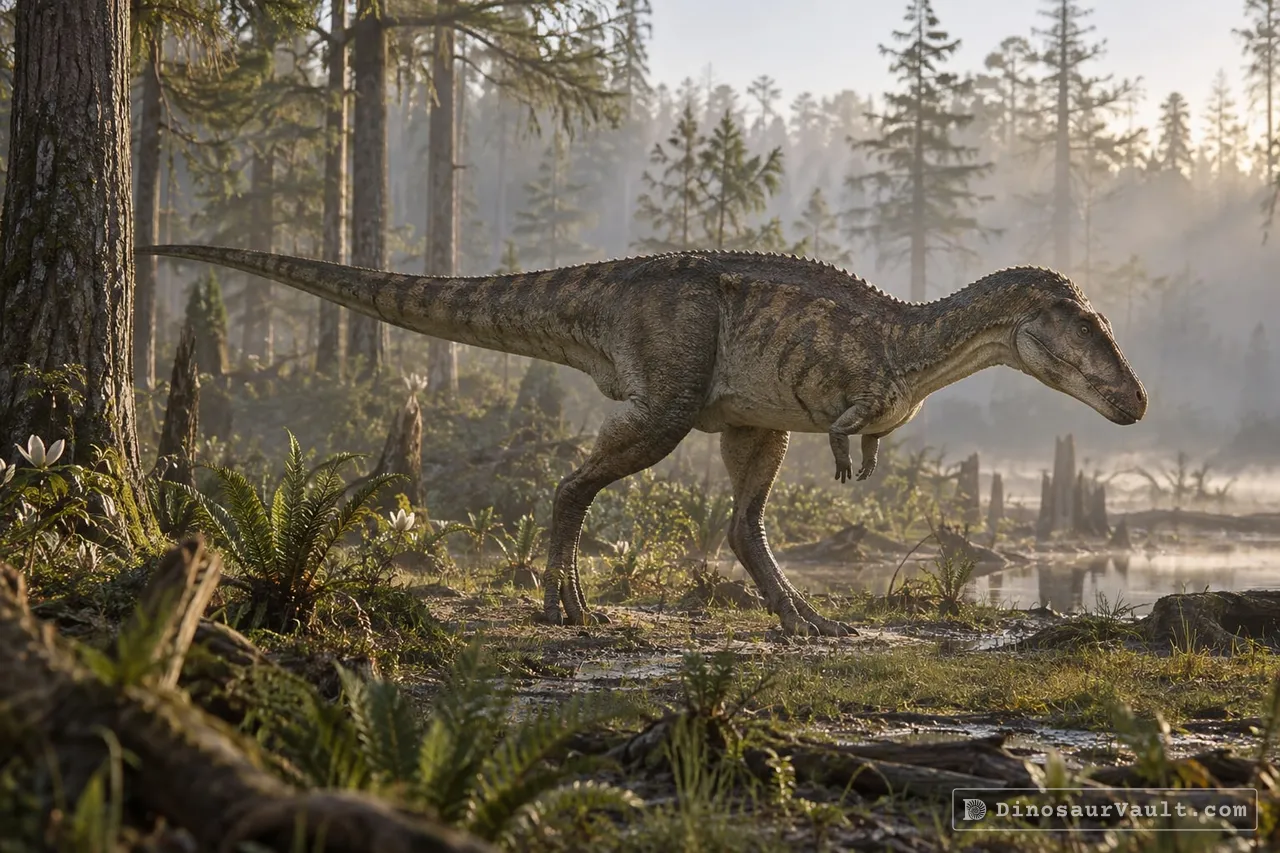
Appalachiosaurus was a bipedal, carnivorous tyrannosauroid, an early cousin of Tyrannosaurus, though far smaller and more lightly built. Only a juvenile skeleton has been found, so its adult size is uncertain, though it was likely bigger than the young individual known so far.
Like other early tyrannosauroids, it probably had a narrower skull and longer arms than later giants such as Tyrannosaurus, features that became reduced as the tyrannosaur lineage grew larger over the Late Cretaceous.
Its world
Appalachiosaurus lived from about 86 to 66 million years ago, in the Late Cretaceous, in what is now the southeastern United States. Its bones come from Alabama, Georgia, and South Carolina, including the Demopolis Chalk and Blufftown formations.
This region was once part of Appalachia, an island landmass separated from the rest of North America by a shallow sea. Fewer dinosaur fossils have been found here than farther west on the continent, but about six finds of Appalachiosaurus are known, along with fossils of the small predator Saurornitholestes.
How it was found
Carr and colleagues named Appalachiosaurus in 2005. Its relatives include Dryptosaurus, Dilong, and Raptorex, along with other early tyrannosauroids such as Eotyrannus and Xiongguanlong, showing that the group had already spread widely before Tyrannosaurus and its close relatives grew to their enormous later sizes.
Field gallery
More views of Appalachiosaurus
Scenes reconstructed from the available fossil evidence.
1 of 7
Lived alongside
Found in the same rock formations

A rock formation can hold fossils laid down millions of years apart, so not every animal here met Appalachiosaurus.
The evidence
The science behind Appalachiosaurus
Which parts of the picture come from its own bones, and which come from its relatives.
From its own fossils
- A partial skeleton preserves an elongated skull with low bumps along the nose.
- The naming skeleton belonged to an animal that was still growing.
- Its bones were buried in the marine sediments of the Demopolis Chalk.
Borrowed from relatives
- Other tyrannosauroids help restore the missing arms and hands.
- Lips covering the teeth follow comparisons with Tyrannosaurus and other large theropods.
Still unknown
- Its adult size and full arm proportions.
- How many fingers its hands carried.
- Its skin color and precise habitat on land.
Often drawn wrong
- Marine burial should not turn it into a swimming predator.
Discovery timeline
- 2005Named itCarr, Williamson & Schwimmer
- 2011Close relativeBrusatte, Benson & Norell
- 2023Close relativeCullen et al.
Key papers
The research behind what we know of Appalachiosaurus
Named it
Named Appalachiosaurus from an immature partial skeleton with an elongated skull and low nasal bumps in Alabama.
A new genus and species of tyrannosauroid from the Late Cretaceous (Middle Campanian) Demopolis Formation of Alabama. Journal of Vertebrate Paleontology 25: 119-143
Read the paper : A new genus and species of tyrannosauroid from the Late Cretaceous (Middle Campanian) Demopolis Formation of Alabama (opens in a new tab)Close relative
Described Dryptosaurus and showed that arm reduction varied among early tyrannosauroids, a useful comparison for the incomplete arms of Appalachiosaurus.
The Anatomy ofDryptosaurus aquilunguis(Dinosauria: Theropoda) and a Review of Its Tyrannosauroid Affinities. American Museum Novitates 3717: 1-53
Read the paper : The Anatomy ofDryptosaurus aquilunguis(Dinosauria: Theropoda) and a Review of Its Tyrannosauroid Affinities (opens in a new tab)Close relative
Tooth wear and skull comparisons support lips covering the teeth of large theropods when their mouths closed.
Theropod dinosaur facial reconstruction and the importance of soft tissues in paleobiology. Science 379: 1348-1352
Read the paper : Theropod dinosaur facial reconstruction and the importance of soft tissues in paleobiology (opens in a new tab)
Close relatives
Other members of Tyrannosauroidea


Sources: Wikidata