Lohuecotitan
- Lived
- 84 to 66 million years ago, Late Cretaceous
- Diet
- Herbivore
- Group
- Sauropods
- Found in
- Spain
- Named by
- Díez Díaz et al. 2016
Where its fossils were found
The evidence
Today

75 million years ago
Habitat
A muddy floodplain near the coast was crossed by river channels and flooded at times. Qunkasaura, Ampelosaurus and Rhabdodon occur in the Villalba de la Sierra Formation.
Field notes
About Lohuecotitan
What it was like
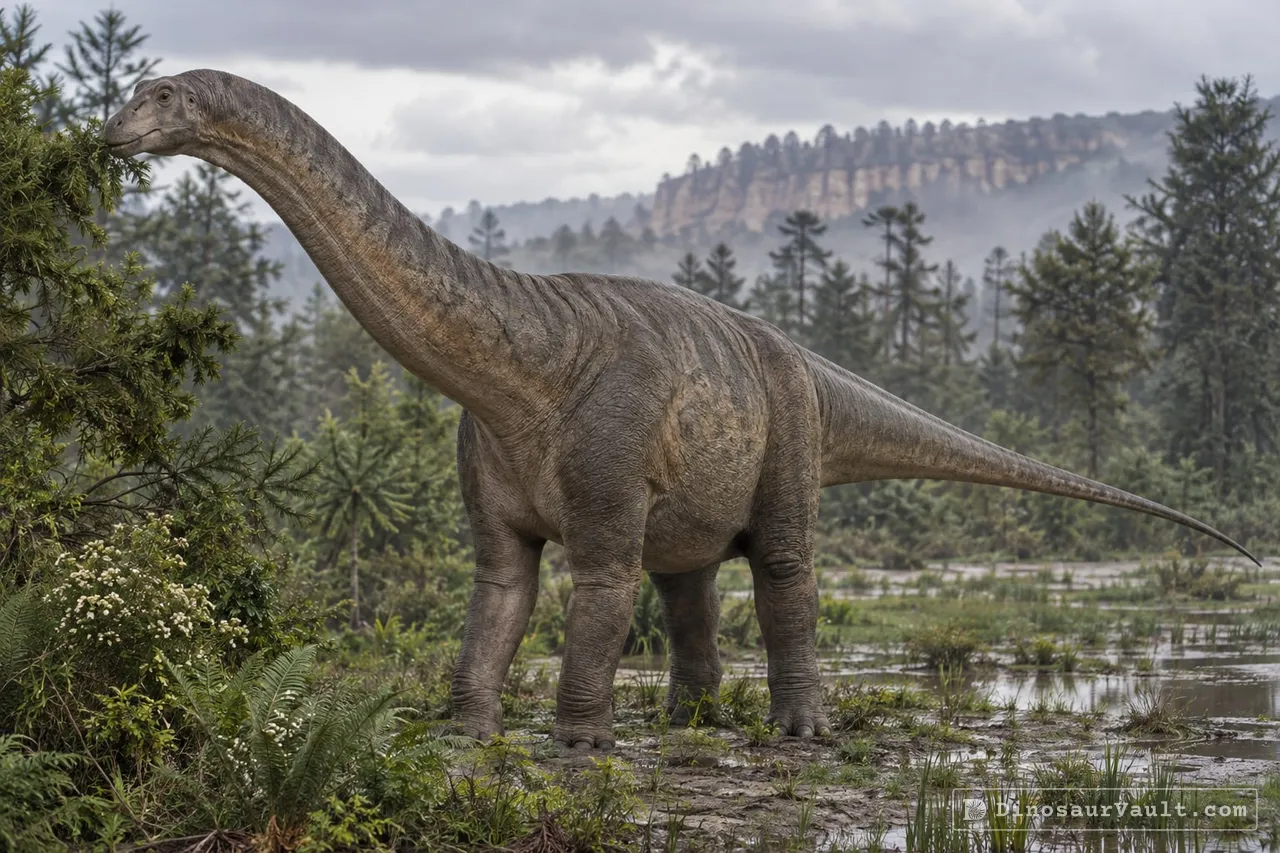
Lohuecotitan was a titanosaur, a long-necked plant eater. It is known from part of one skeleton.
Its world
It lived in the Late Cretaceous, in what is now Spain. It comes from the Villalba de la Sierra Formation, where it shared the land with Rhabdodon and the titanosaurs Ampelosaurus and Qunkasaura.
How it was found
Díez Díaz and colleagues named Lohuecotitan in 2016. Its species name honors a character from a famous Spanish novel.
Field gallery
More views of Lohuecotitan
Scenes reconstructed from the available fossil evidence.
1 of 3
Lived alongside
Found in the same rock formations


A rock formation can hold fossils laid down millions of years apart, so not every animal here met Lohuecotitan.
The evidence
The science behind Lohuecotitan
Which parts of the picture come from its own bones, and which come from its relatives.
From its own fossils
- A partial skeleton, found with its bones lying close together, preserves vertebrae, ribs, hip bones and limb bones, including the thigh bone, shin, fibula and an ulna from the forearm.
- The spines of its front tail vertebrae have a forked outline when viewed from the side.
- Its limb bones are robust rather than very slender, matching one of the distinct limb shapes among the titanosaurs at its site. A bump on the fibula is one of the features that set it apart.
Borrowed from relatives
- Its skull is unknown, so restorations follow Tapuiasaurus, a titanosaur with a known skull.
- Restorations of the hands and feet follow other sauropods: Camarasaurus and Apatosaurus for the hand, Mnyamawamtuka for the foot.
Still unknown
- The shape of its skull and jaws.
- Whether an upper arm bone and a radius from other skeletons at the site belong to Lohuecotitan. Its type skeleton lacks both.
- Its exact place among titanosaurs. One recent study puts it closest to Paludititan.
Discovery timeline
- 2016Named itDíez Díaz et al.
- 2022Same rocksPáramo et al.
- 2024Family treeMocho et al.
Key papers
The research behind what we know of Lohuecotitan
Named it
Named a titanosaur from a partial skeleton with distinctive bony ridges and spines on its back and tail vertebrae.
A new titanosaur (Dinosauria, Sauropoda) from the Upper Cretaceous of Lo Hueco (Cuenca, Spain). Cretaceous Research 68: 49-60
Read the paper : A new titanosaur (Dinosauria, Sauropoda) from the Upper Cretaceous of Lo Hueco (Cuenca, Spain) (opens in a new tab)Same rocks
Compared hindlimb bones and recognized distinct titanosaur limb shapes, including the form represented by Lohuecotitan.
3D geometric morphometrics of the hind limb in the titanosaur sauropods from Lo Hueco (Cuenca, Spain). Cretaceous Research 134: 105147
Read the paper : 3D geometric morphometrics of the hind limb in the titanosaur sauropods from Lo Hueco (Cuenca, Spain) (opens in a new tab)Family tree
Named Qunkasaura from the same site and placed Lohuecotitan in a separate titanosaur lineage, closest to Paludititan.
A Spanish saltasauroid titanosaur reveals Europe as a melting pot of endemic and immigrant sauropods in the Late Cretaceous. Communications Biology 7
Read the paper : A Spanish saltasauroid titanosaur reveals Europe as a melting pot of endemic and immigrant sauropods in the Late Cretaceous (opens in a new tab)
Close relatives
Other members of Eutitanosauria


Sources: Wikidata