Patagotitan
pat-AG-oh-TIE-tan
"giant of Patagonia"
- Lived
- 113 to 101 million years ago, Early Cretaceous
- Diet
- Herbivore
- Group
- Sauropods
- Found in
- Argentina
- Named by
- Carballido et al. 2017
Where its fossils were found
The evidence
Today

105 million years ago
Habitat
It lived on a forested floodplain crossed by rivers in the Cerro Barcino Formation. The region also supported Tyrannotitan, Genyodectes and Chubutisaurus.
Field notes
About Patagotitan
What it was like
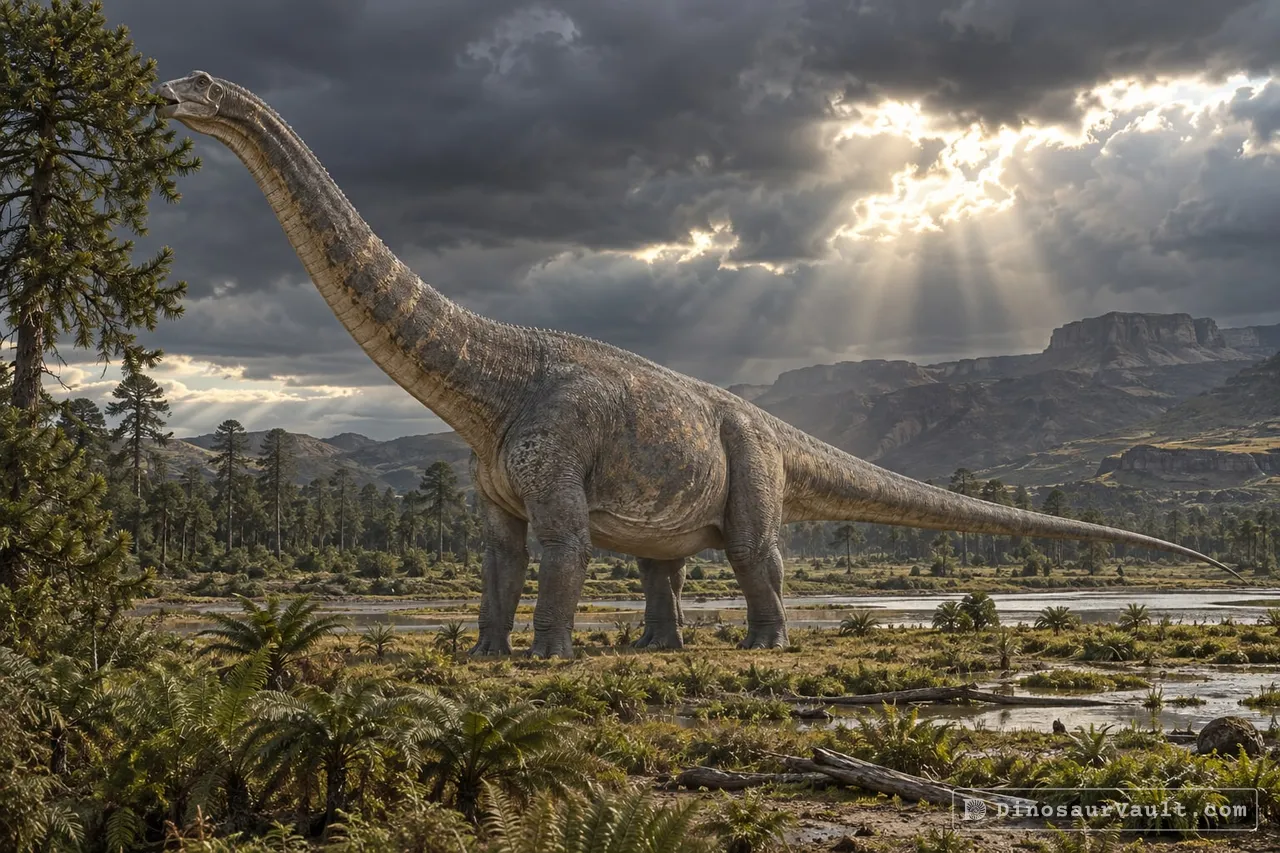
Patagotitan was an enormous, long-necked plant eater and one of the largest known land animals. Its exact size is still debated among scientists, since estimates have changed as more of the skeleton has been studied, but it was built like other giant titanosaurs, with thick, pillar-like legs, a long neck, and an even longer tail.
Its skeleton includes reinforced joints in the back that probably helped support its enormous weight, a feature that made it stand out even among other giant titanosaurs. Like its relatives, it probably moved in a slow, steady way, spending much of its time feeding on plants from tall trees.
Its world
Patagotitan lived from about 113 to 101 million years ago, during the Early Cretaceous, in what is now Argentina. Its only known fossils come from the Cerro Barcino Formation, where it lived on a forested floodplain.
It shared its world with the meat-eating Tyrannotitan and Genyodectes, as well as the smaller plant eater Chubutisaurus.
How it was found
Carballido and colleagues named Patagotitan in 2017, based on bones recovered from a single site in Argentina. Its closest relatives include Argentinosaurus and Dreadnoughtus, other giant titanosaurs from South America, and together they represent some of the largest animals ever known to have walked on Earth.
Field gallery
More views of Patagotitan
Scenes reconstructed from the available fossil evidence.
1 of 7
Lived alongside
Found in the same rock formations


A rock formation can hold fossils laid down millions of years apart, so not every animal here met Patagotitan.
The evidence
The science behind Patagotitan
Which parts of the picture come from its own bones, and which come from its relatives.
From its own fossils
- Several huge individuals preserve much of the backbone, ribs, shoulder girdle, hips and limbs.
- The back vertebrae have extra joints that probably helped brace the trunk.
- Its limb bones show broad muscle attachments and thick shafts that supported an enormous body.
Borrowed from relatives
- The head is restored by comparison with titanosaurs that preserve skulls, such as Rapetosaurus.
- Missing parts of the feet are restored from other titanosaurs, including Epachthosaurus.
Still unknown
- Its exact length and weight.
- Its skin color and pattern.
- The proportions of its hatchlings and small juveniles.
Often drawn wrong
- Its front feet should be compact columns of upright finger bones, rather than spreading hands lined with large claws.
Discovery timeline
- 2017Named itCarballido et al.
- 2019Close relativesRIGA et al.
- 2020Full descriptionOtero, Carballido & Moreno
- 2025PostureDempsey et al.
Key papers
The research behind what we know of Patagotitan
Named it
Named Patagotitan from several giant skeletons and linked it with a branch of exceptionally large titanosaurs.
A new giant titanosaur sheds light on body mass evolution among sauropod dinosaurs. Proceedings of the Royal Society B: Biological Sciences 284: 20171219
Read the paper : A new giant titanosaur sheds light on body mass evolution among sauropod dinosaurs (opens in a new tab)Close relatives
Compared titanosaur limbs and feet, including Patagotitan, to trace changes in weight-bearing anatomy and family relationships.
An overview of the appendicular skeletal anatomy of South American titanosaurian sauropods, with definition of a newly recognized clade. Anais da Academia Brasileira de Ciências 91
Read the paper : An overview of the appendicular skeletal anatomy of South American titanosaurian sauropods, with definition of a newly recognized clade (opens in a new tab)Full description
Described the shoulder girdle, hips and limbs in detail, identifying distinctive ridges and muscle attachments that help distinguish Patagotitan.
The Appendicular Osteology ofPatagotitan Mayorum(Dinosauria, Sauropoda). Journal of Vertebrate Paleontology 40: e1793158
Read the paper : The Appendicular Osteology ofPatagotitan Mayorum(Dinosauria, Sauropoda) (opens in a new tab)Posture
Whole-body models using living reptile anatomy placed Patagotitan at the heavy end of dinosaur size estimates and examined how its mass was distributed.
New perspectives on body size and shape evolution in dinosaurs. Biological Reviews 100: 1829-1860
Read the paper : New perspectives on body size and shape evolution in dinosaurs (opens in a new tab)
Close relatives
Other members of Eutitanosauria


Sources: Wikidata