Rebbachisaurus
- Lived
- 106 to 94 million years ago, Early Cretaceous to Late Cretaceous
- Diet
- Herbivore
- Length
- about 20 m (66 ft)
- Group
- Sauropods, Rebbachisauridae
- Found in
- Morocco
- Named by
- Lavocat 1954
Size comparison
To scale


Scale in metersOutline: typical sauropod shape
Where its fossils were found
The evidence
Today

100 million years ago
Habitat
Rivers crossed a low plain and fed a delta in what is now Morocco. Spinosaurus and Deltadromeus lived in this river world.
Field notes
About Rebbachisaurus
What it was like
Rebbachisaurus was a sauropod, a long-necked plant eater about 20 meters (66 feet) long. Its back had tall spines, and some reconstructions give it a ridge or low sail. It gives its name to the rebbachisaurids, a family with wide, squared-off snouts.
Its world
It lived in the Cretaceous, in what is now Morocco. It comes from the Gara Sbaa Formation, a river world shared with the huge predator Spinosaurus and the slender hunter Deltadromeus.
How it was found
Lavocat named Rebbachisaurus in 1954. It is known from a partial skeleton, and its name comes from the tribe living near where it was found.
Field gallery
More views of Rebbachisaurus
Scenes reconstructed from the available fossil evidence.
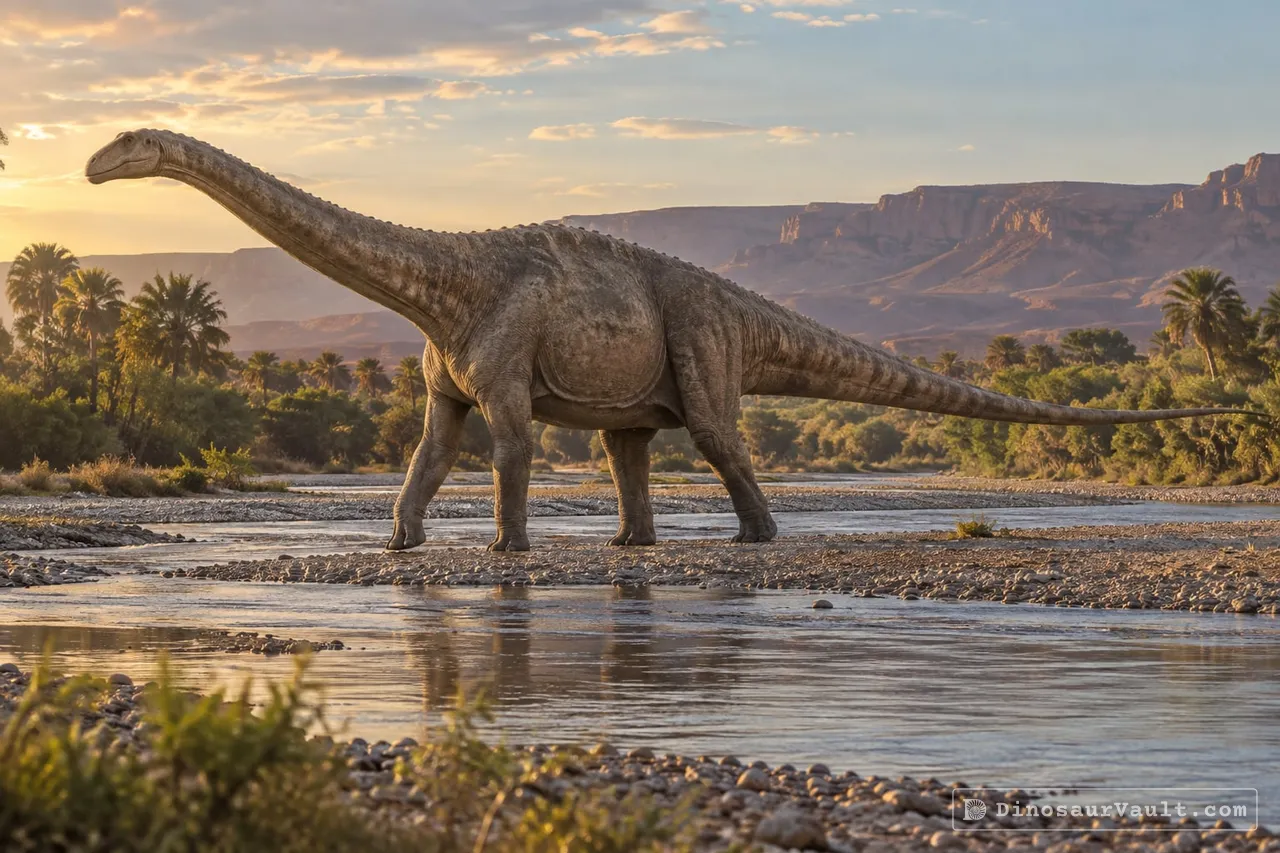
1 of 3
Lived alongside
Found in the same rock formations


A rock formation can hold fossils laid down millions of years apart, so not every animal here met Rebbachisaurus.
The evidence
The science behind Rebbachisaurus
Which parts of the picture come from its own bones, and which come from its relatives.
From its own fossils
- The type specimen is a partial skeleton with back and tail vertebrae, ribs, a shoulder blade, an upper arm bone and part of the pelvis.
- The back vertebrae are very tall.
Borrowed from relatives
- The missing front of the skull is restored by comparison with Lavocatisaurus, and the back of the skull with Limaysaurus.
- Missing parts of the neck are restored by comparison with Limaysaurus and Lavocatisaurus.
Still unknown
- The shape of its head and the full length of its neck.
- Whether its tall back spines supported a ridge or a sail.
- Its skin texture and color.
Discovery timeline
- 1954Named itLavocat
- 2015Full descriptionWilson & Allain
- 2020Its worldIbrahim et al.
Key papers
The research behind what we know of Rebbachisaurus
Named it
Named Rebbachisaurus from a partial skeleton with tall back vertebrae and a broad shoulder blade.
Sur les dinosauriens du Continental Intercalaire des Kem-Kem de la Daoura [On the dinosaurs from the Continental Intercalaire of the Kem Kem of the Doura]. Congrés Géologique International, Comptes Rendus de la Dix-Neuvième Session, Section 13 15: 65-68
No link available
Full description
Described the original skeleton in detail and placed Rebbachisaurus close to Nigersaurus and Demandasaurus.
Osteology ofRebbachisaurus garasbaeLavocat, 1954, a diplodocoid (Dinosauria, Sauropoda) from the early Late Cretaceous–aged Kem Kem beds of southeastern Morocco. Journal of Vertebrate Paleontology 35: e1000701
Read the paper : Osteology ofRebbachisaurus garasbaeLavocat, 1954, a diplodocoid (Dinosauria, Sauropoda) from the early Late Cretaceous–aged Kem Kem beds of southeastern Morocco (opens in a new tab)Its world
Reconstructed the river and delta setting and reviewed Rebbachisaurus alongside the region's other animals.
Geology and paleontology of the Upper Cretaceous Kem Kem Group of eastern Morocco. ZooKeys 928: 1-216
Read the paper : Geology and paleontology of the Upper Cretaceous Kem Kem Group of eastern Morocco (opens in a new tab)
Close relatives
Other members of Rebbachisauridae


Sources: Wikidata