Demandasaurus
"Demanda lizard"
- Lived
- 126 to 120 million years ago, Early Cretaceous
- Diet
- Herbivore
- Group
- Sauropods, Rebbachisauridae
- Found in
- Spain
- Named by
- Torcida Fernández-Baldor et al. 2011
Where its fossils were found
The evidence
Today

125 million years ago
Habitat
Braided rivers crossed broad floodplains in what is now Spain. Other dinosaurs from the Castrillo de la Reina Formation include Europatitan and Foskeia.
Field notes
About Demandasaurus
What it was like
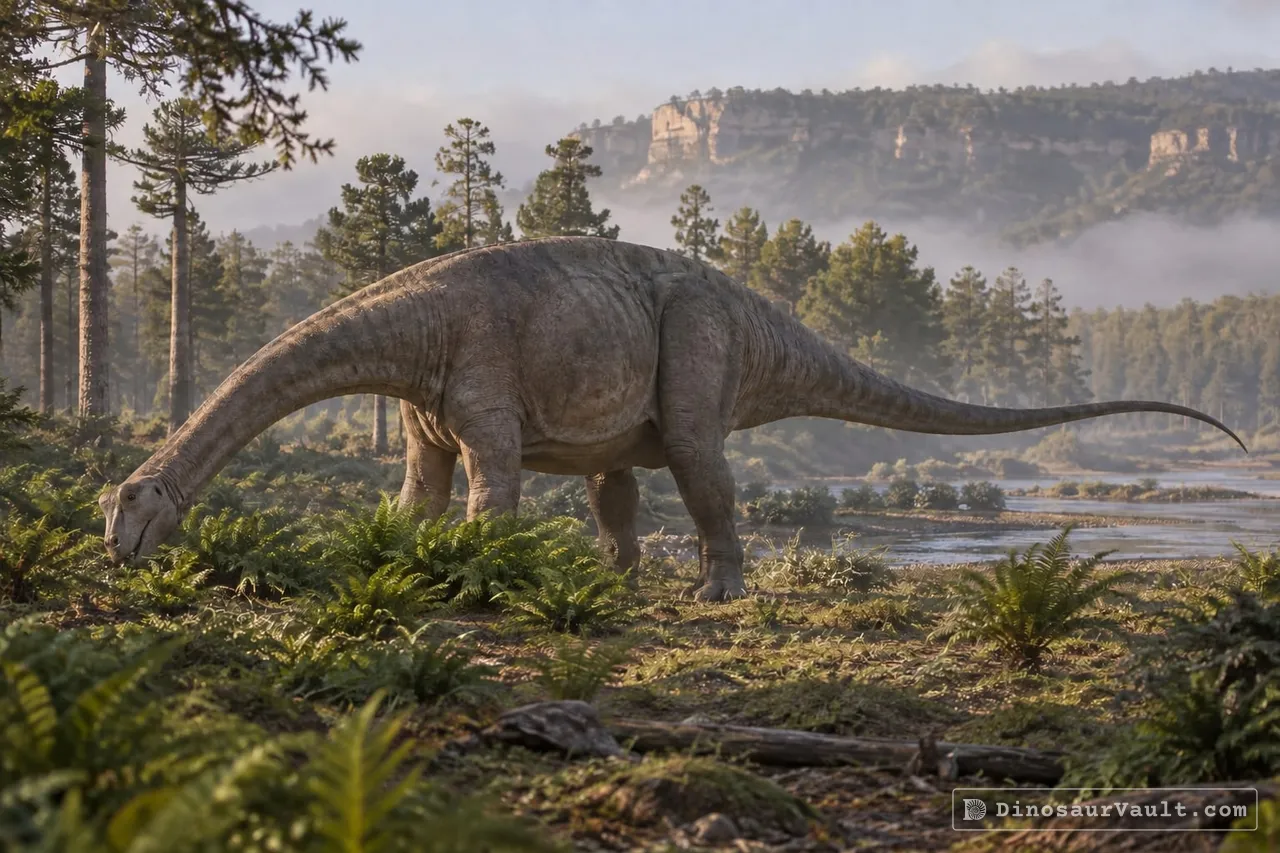
Demandasaurus was a rebbachisaur, a long-necked plant eater from a family related to Diplodocus. It is known from part of the skeleton and a few teeth and skull bones.
The study that named it proposed a link to Nigersaurus from Africa, but the relationship was weakly supported. Its closest relative remains unsettled.
Its world
It lived in the Early Cretaceous in what is now northern Spain. Its bones come from the Castrillo de la Reina Formation, where it shared the land with the titanosaur relative Europatitan.
How it was found
Torcida Fernández-Baldor and colleagues named Demandasaurus in 2011.
Field gallery
More views of Demandasaurus
Scenes reconstructed from the available fossil evidence.
Lived alongside
Found in the same rock formations


A rock formation can hold fossils laid down millions of years apart, so not every animal here met Demandasaurus.
The evidence
The science behind Demandasaurus
Which parts of the picture come from its own bones, and which come from its relatives.
From its own fossils
- The associated type skeleton preserves jaw bones, teeth, neck and back vertebrae, tail vertebrae, hip bones and a thigh bone. The thigh bone is slender and slightly curved.
- The narrow teeth have lengthwise ridges on both sides of their crowns. The front of the lower jaw has a rounded bottom corner.
- A later report describes two more vertebral bodies from the front of the back, assigned to Demandasaurus.
Borrowed from relatives
- Missing parts of the skull can be compared with Lavocatisaurus, and the trunk and forequarters with Limaysaurus.
- Apatosaurus supplies a broad comparison for the missing hands, and Camarasaurus for the feet.
Still unknown
- The complete shape of its skull and the length of its neck. The naming study's link to Nigersaurus was weakly supported, and its closest relative is not settled.
- Its skin covering and color.
- Whether it lived in herds.
Discovery timeline
- 2003Full descriptionSuberbiola et al.
- 2011Named itFernández-Baldor et al.
- 2015Family treeFanti et al.
Key papers
The research behind what we know of Demandasaurus
Full description
Described the tail, hip and thigh bones before the animal received its name, recognizing a rebbachisaur in Spain.
First rebbachisaurid dinosaur (Sauropoda, Diplodocoidea) from the early Cretaceous of Spain : palaeobiogeographical implications. Bulletin de la Société Géologique de France 174: 471-479
Read the paper : First rebbachisaurid dinosaur (Sauropoda, Diplodocoidea) from the early Cretaceous of Spain : palaeobiogeographical implications (opens in a new tab)Named it
Named the dinosaur from its partial skeleton; its family-tree analysis weakly linked it to Nigersaurus.
Demandasaurus darwini, a New Rebbachisaurid Sauropod from the Early Cretaceous of the Iberian Peninsula. Acta Palaeontologica Polonica 56: 535-552
Read the paper : Demandasaurus darwini, a New Rebbachisaurid Sauropod from the Early Cretaceous of the Iberian Peninsula (opens in a new tab)Family tree
Placed Demandasaurus among close relatives of Rebbachisaurus and Tataouinea and explored how this branch spread between Africa and Europe.
New Information on Tataouinea hannibalis from the Early Cretaceous of Tunisia and Implications for the Tempo and Mode of Rebbachisaurid Sauropod Evolution. PLOS ONE 10: e0123475
Read the paper : New Information on Tataouinea hannibalis from the Early Cretaceous of Tunisia and Implications for the Tempo and Mode of Rebbachisaurid Sauropod Evolution (opens in a new tab)
Close relatives
Other members of Rebbachisauridae


Sources: Wikidata