Agustinia
Type species Agustinia ligabuei
- Lived
- 113 to 101 million years ago, Early Cretaceous
- Diet
- Herbivore
- Group
- Sauropods, Rebbachisauridae
- Found in
- Argentina
- Named by
- Bonaparte 1999
Where its fossils were found
The evidence
Today

105 million years ago
Habitat
Rivers and lakes crossed its part of Argentina. The Lohan Cura Formation also preserves the sauropods Ligabuesaurus and Comahuesaurus.
Field notes
About Agustinia
What it was like
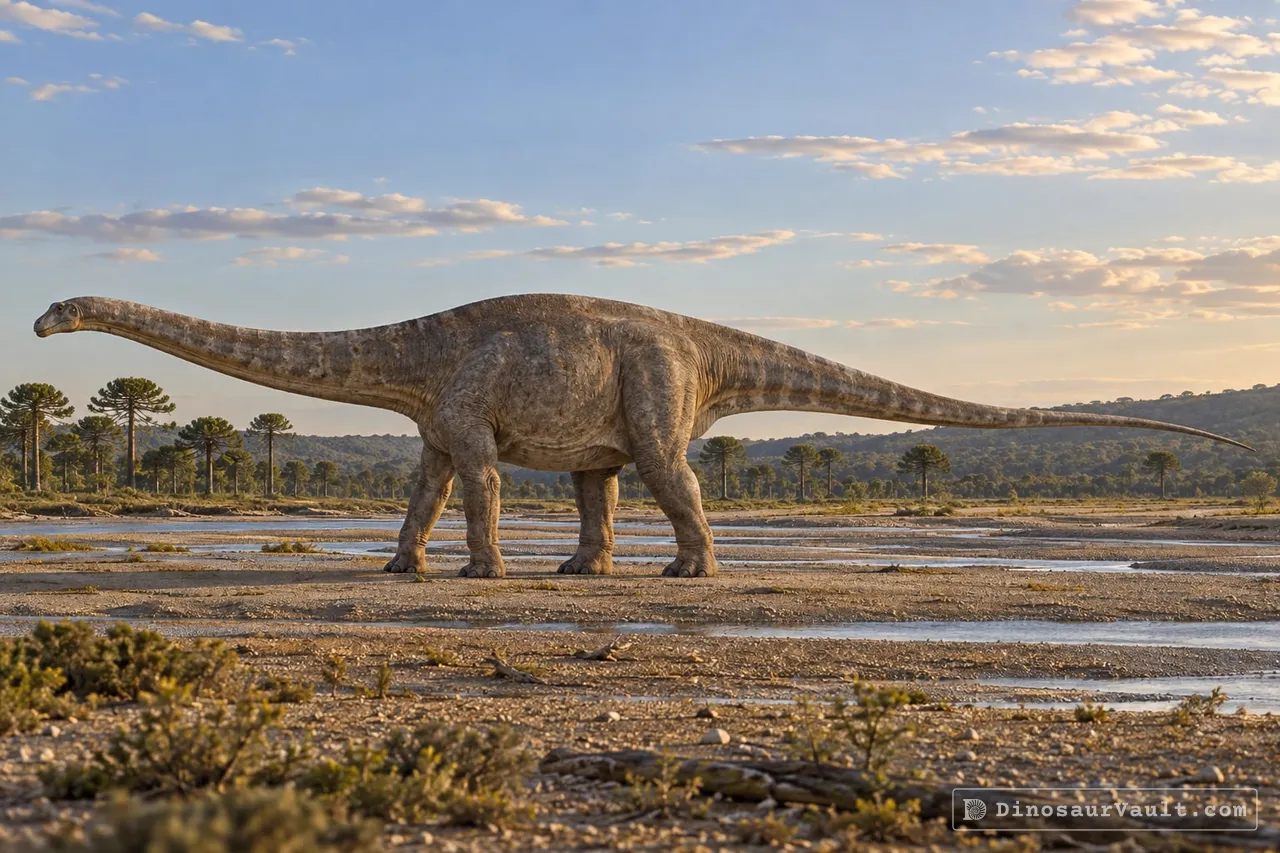
Agustinia was a long-necked plant eater known from a few bones of the back, hips and legs. When first described, some flat and spiky bones were thought to be armor running down its back. Later studies suggest these may be broken ribs or hip bones instead.
Its world
It lived in the Early Cretaceous in what is now Argentina. Its bones come from the Lohan Cura Formation, where it lived alongside the sauropods Ligabuesaurus and Comahuesaurus.
How it was found
Bonaparte named Agustinia in 1999 from one find. The type species is Agustinia ligabuei. The name honors the young man who found the bones.
Field gallery
More views of Agustinia
Scenes reconstructed from the available fossil evidence.
Lived alongside
Found in the same rock formations


A rock formation can hold fossils laid down millions of years apart, so not every animal here met Agustinia.
The evidence
The science behind Agustinia
Which parts of the picture come from its own bones, and which come from its relatives.
From its own fossils
- Bones of the backbone, hips and limbs come from a single animal.
- Microscopic study showed that the supposed armor lacked the tissue structure of bony skin plates.
- A revised description placed it among the rebbachisaurids, a branch of long-necked plant eaters.
Borrowed from relatives
- The missing head and much of the body are restored using Lavocatisaurus as a comparison.
- The feet follow the broader sauropod pattern seen in Apatosaurus and Camarasaurus, with weight-bearing pads and inner toes carrying claws.
Still unknown
- The exact shape of its head and the proportions of its neck.
- Its skin covering and color.
- The number and arrangement of claws on its hands and feet.
Often drawn wrong
- The elaborate rows of spines in older pictures were based on bones later identified as ribs and possible hip fragments.
Discovery timeline
- 1999Named itBonaparte
- 2016SkinBellardini & Cerda
- 2022Full descriptionBellardini et al.
Key papers
The research behind what we know of Agustinia
Named it
Named Agustinia from a partial skeleton and interpreted unusual bones as armor along its back.
An armoured sauropod from the Aptian of northern Patagonia, Argentina. Y. Tomida, T. H. Rich, and P. Vickers-Rich (eds.), Proceedings of the Second Gondwanan Dinosaur Symposium, National Science Museum Monographs 15:1-12.
No link available
Skin
Examined the supposed armor under a microscope and identified ribs and possible hip fragments rather than bony skin plates.
Bone histology sheds light on the nature of the “dermal armor” of the enigmatic sauropod dinosaur Agustinia ligabuei Bonaparte, 1999. The Science of Nature 104
Read the paper : Bone histology sheds light on the nature of the “dermal armor” of the enigmatic sauropod dinosaur Agustinia ligabuei Bonaparte, 1999 (opens in a new tab)Full description
Redescribed the skeleton, revised the features distinguishing Agustinia and placed it among early rebbachisaurids.
Revisiting the Early Cretaceous sauropodAgustinia ligabuei(Dinosauria: Diplodocoidea) from southern Neuquén Basin (Patagonia, Argentina), with implications on the early evolution of rebbachisaurids. Historical Biology 35: 2408-2434
Read the paper : Revisiting the Early Cretaceous sauropodAgustinia ligabuei(Dinosauria: Diplodocoidea) from southern Neuquén Basin (Patagonia, Argentina), with implications on the early evolution of rebbachisaurids (opens in a new tab)
Close relatives
Other members of Rebbachisauridae


Sources: Wikidata