Ypupiara
"one who lives in the water"
- Lived
- 72 to 66 million years ago, Late Cretaceous
- Diet
- Carnivore
- Group
- Theropods, Dromaeosauridae
- Found in
- Brazil
- Named by
- Brum et al. 2021
Where its fossils were found
The evidence
Today

70 million years ago
Habitat
A dry landscape crossed by branching rivers in what is now Brazil. The Serra da Galga Formation also contains the titanosaurs Baurutitan, Uberabatitan and Caieiria.
Field notes
About Ypupiara
What it was like
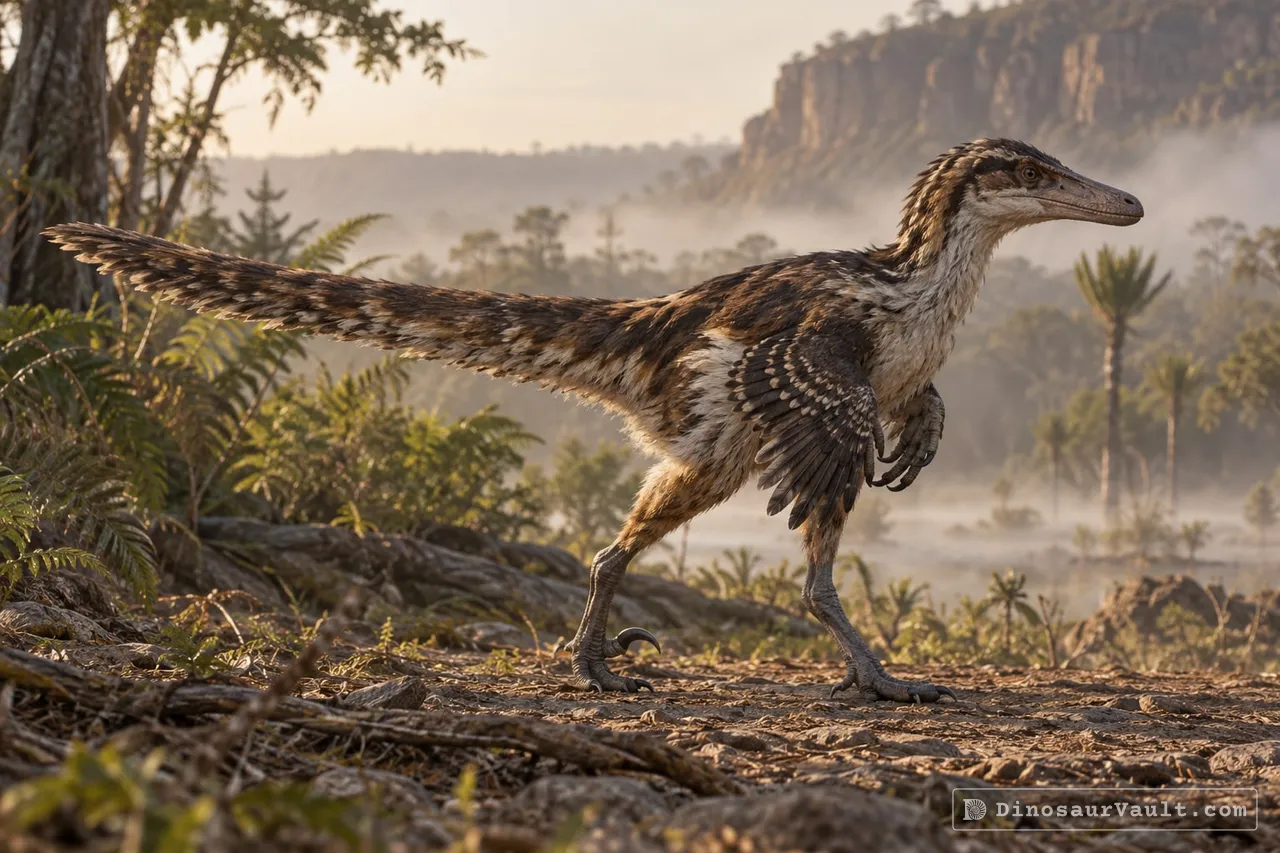
Ypupiara was a feathered predator related to the raptors. It is known from parts of the jaws and teeth. Its long, low snout suggests it may have caught fish, like some of its southern relatives.
Its world
It lived about 72 to 66 million years ago, at the end of the Late Cretaceous, in what is now Brazil. Its bones come from the Serra da Galga Formation, where it shared the land with titanosaurs such as Uberabatitan and Baurutitan.
How it was found
Brum and colleagues named it in 2021. Its only fossil was destroyed in a museum fire before it was named, so it is known from earlier descriptions and pictures.
Field gallery
More views of Ypupiara
Scenes reconstructed from the available fossil evidence.
Lived alongside
Found in the same rock formations


A rock formation can hold fossils laid down millions of years apart, so not every animal here met Ypupiara.
The evidence
The science behind Ypupiara
Which parts of the picture come from its own bones, and which come from its relatives.
From its own fossils
- Parts of the upper and lower jaws preserve teeth.
- The upper teeth were widely spaced, with grooves along their crowns and no serrated cutting edges.
Borrowed from relatives
- The missing body is restored using Austroraptor and Buitreraptor, its southern relatives.
- It probably had feathers, like the related Velociraptor, whose arm bones preserve feather attachment bumps.
Still unknown
- Its body size and the proportions of its arms and legs.
- How much of its diet was fish.
- Its feather arrangement and color.
Discovery timeline
- 2007Close relativeTurner, Makovicky & Norell
- 2008Close relativeNovas et al.
- 2020Its worldSoares et al.
- 2021Named itBrum et al.
Key papers
The research behind what we know of Ypupiara
Close relative
Found feather attachment bumps on a Velociraptor forearm, supporting feathered restorations of related raptors.
Feather quill knobs in the dinosaur Velociraptor. Science 317: 1721
Read the paper : Feather quill knobs in the dinosaur Velociraptor (opens in a new tab)Close relative
Described Austroraptor, a southern relative with a long, low snout, conical teeth and unusually short arms.
A bizarre Cretaceous theropod dinosaur from Patagonia and the evolution of Gondwanan dromaeosaurids. Proceedings of the Royal Society B: Biological Sciences 276: 1101-1107
Read the paper : A bizarre Cretaceous theropod dinosaur from Patagonia and the evolution of Gondwanan dromaeosaurids (opens in a new tab)Its world
Showed that the Serra da Galga Formation records a branching river system that developed under a semiarid climate.
Sedimentology of a distributive fluvial system: The Serra da Galga Formation, a new lithostratigraphic unit (Upper Cretaceous, Bauru Basin, Brazil). Geological Journal 56: 951-975
Read the paper : Sedimentology of a distributive fluvial system: The Serra da Galga Formation, a new lithostratigraphic unit (Upper Cretaceous, Bauru Basin, Brazil) (opens in a new tab)Named it
Named Ypupiara from jaw fragments and teeth, linked it to Austroraptor, and suggested that fish formed part of its diet.
A new unenlagiine (Theropoda, Dromaeosauridae) from the Upper Cretaceous of Brazil. Papers in Palaeontology 7: 2075-2099
Read the paper : A new unenlagiine (Theropoda, Dromaeosauridae) from the Upper Cretaceous of Brazil (opens in a new tab)
Close relatives
Other members of Dromaeosauridae


Sources: Wikidata