Baurutitan
"Bauru titan"
- Lived
- 72 to 66 million years ago, Late Cretaceous
- Diet
- Herbivore
- Group
- Sauropods
- Found in
- Brazil
- Named by
- Kellner et al. 2005
Where its fossils were found
The evidence
Today

70 million years ago
Habitat
It lived on a semiarid plain where rivers split into smaller channels. Other dinosaurs from the Serra da Galga Formation include Uberabatitan, Caieiria and Ypupiara.
Field notes
About Baurutitan
What it was like
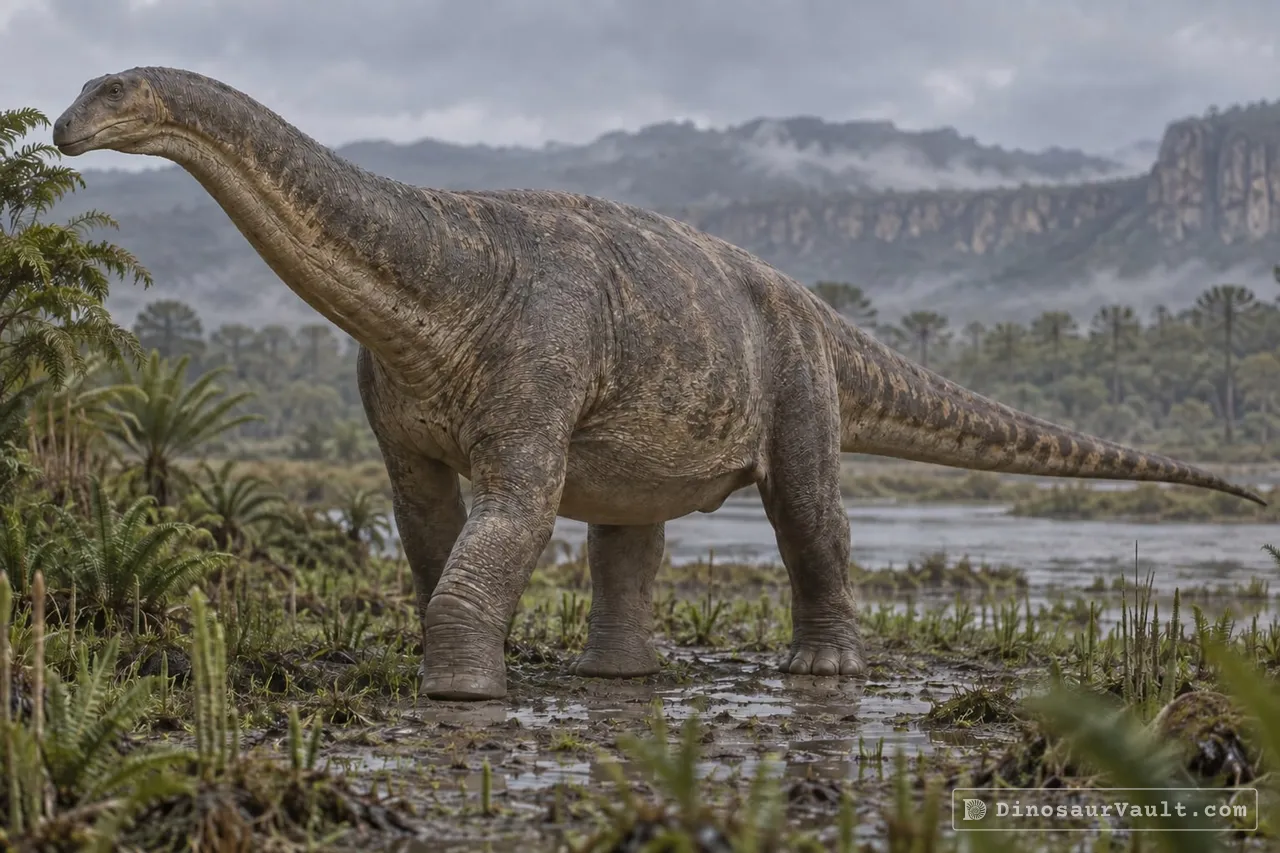
Baurutitan was a titanosaur, a long-necked, four-legged plant eater. It is known from part of the backbone and tail.
Its world
It lived about 72 to 66 million years ago, at the end of the Late Cretaceous, in what is now southeastern Brazil. Its bones come from the Serra da Galga Formation, where it shared the land with the titanosaurs Aeolosaurus and Uberabatitan.
How it was found
Kellner and colleagues named Baurutitan in 2005. The bones had been found decades earlier.
Field gallery
More views of Baurutitan
Scenes reconstructed from the available fossil evidence.
1 of 3
Lived alongside
Found in the same rock formations


A rock formation can hold fossils laid down millions of years apart, so not every animal here met Baurutitan.
The evidence
The science behind Baurutitan
Which parts of the picture come from its own bones, and which come from its relatives.
From its own fossils
- The original fossil preserves the last vertebra of the hip region and a long connected section of the tail.
- The tail vertebrae have distinctive bony projections and nearly square front faces.
- Later finds assigned to Baurutitan add neck and trunk vertebrae and limb bones.
Borrowed from relatives
- Missing parts of the limbs are restored by comparison with better-known titanosaurs, such as Uberabatitan.
Still unknown
- The shape of its skull and teeth.
- Its skin color and the arrangement of any body armor.
- The exact length and posture of its neck.
Discovery timeline
- 2005Named itKellner, Campos & Trotta
- 2020Its worldSoares et al.
- 2022New findSilva Junior et al.
Key papers
The research behind what we know of Baurutitan
Named it
Named Baurutitan from a connected tail section with distinctive vertebrae.
Description of a titanosaurid caudal series from the Bauru Group, Late Cretaceous of Brazil. Arquivos do Museu Nacional, Rio de Janeiro 63: 529-564
No link available
Its world
Showed that the fossil-bearing rocks formed in a branching river system under a semiarid climate.
Sedimentology of a distributive fluvial system: The Serra da Galga Formation, a new lithostratigraphic unit (Upper Cretaceous, Bauru Basin, Brazil). Geological Journal 56: 951-975
Read the paper : Sedimentology of a distributive fluvial system: The Serra da Galga Formation, a new lithostratigraphic unit (Upper Cretaceous, Bauru Basin, Brazil) (opens in a new tab)New find
Described more Baurutitan bones, proposed merging another genus with it and identified a separate tail skeleton as Caieiria.
New specimens of Baurutitan britoi and a taxonomic reassessment of the titanosaur dinosaur fauna (Sauropoda) from the Serra da Galga Formation (Late Cretaceous) of Brazil. PeerJ 10: e14333
Read the paper : New specimens of Baurutitan britoi and a taxonomic reassessment of the titanosaur dinosaur fauna (Sauropoda) from the Serra da Galga Formation (Late Cretaceous) of Brazil (opens in a new tab)
Close relatives
Other members of Aeolosaurini


Sources: Wikidata