Pyroraptor
PY-roh-RAP-tor
"fire thief"
- Lived
- 84 to 72 million years ago, Late Cretaceous
- Diet
- Carnivore
- Group
- Theropods, Dromaeosauridae
- Found in
- France
- Named by
- Allain and Taquet 2000
Where its fossils were found
The evidence
Today

80 million years ago
Habitat
It lived in a region of rivers and lakes in what is now France, on one of the islands of Cretaceous Europe.
Field notes
About Pyroraptor
What it was like
Pyroraptor was a small, feathered dromaeosaurid, part of the same group of dinosaurs as Velociraptor and Deinonychus. Like its relatives, it likely carried an enlarged, curved claw on each foot for gripping prey. Its fragmentary remains leave its full body length uncertain.
It probably hunted small animals, using speed and sharp claws rather than size to catch its meals.
Its world
Pyroraptor lived from about 84 to 72 million years ago, in the Late Cretaceous, in what is now France. At the time, this part of Europe was broken up into islands surrounded by shallow seas, so Pyroraptor likely shared its home with a smaller mix of dinosaurs than animals living on larger landmasses.
How it was found
Only a single partial skeleton of Pyroraptor is known, discovered after a wildfire had burned away vegetation covering the rock. Allain and Taquet named it in 2000, choosing a name that nods to how it was found. Because so little of the skeleton survives, much about the size and appearance of Pyroraptor is still estimated by comparing it to better-known relatives such as Utahraptor, Microraptor, and Dromaeosaurus.
Field gallery
More views of Pyroraptor
Scenes reconstructed from the available fossil evidence.
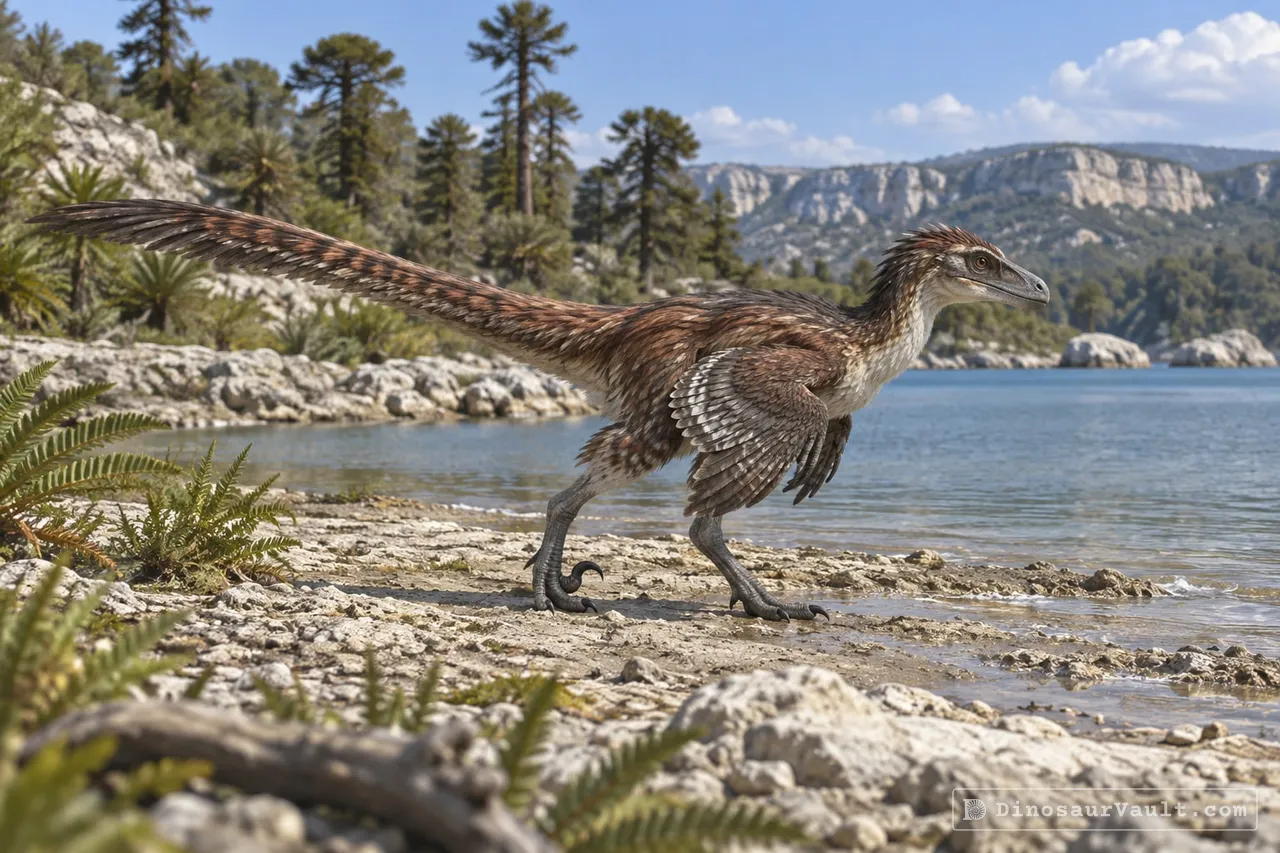
1 of 7
The evidence
The science behind Pyroraptor
Which parts of the picture come from its own bones, and which come from its relatives.
From its own fossils
- Scattered teeth, vertebrae and bones from the arms and feet are known.
- An enlarged curved claw on the second toe is preserved.
Borrowed from relatives
- The missing skull and much of the body are restored by comparison with Velociraptor and Deinonychus.
- Feathers on the body and arms are inferred from feathered relatives such as Microraptor and Velociraptor.
Still unknown
- The shape of its skull and its exact adult size.
- The length, pattern and color of its feathers.
- How its young grew and whether adults cared for them.
Often drawn wrong
- A penguin-like body built for diving has no fossil support.
- Its grasping hands should face inward rather than palm down.
Discovery timeline
- 2000Named itAllain & Taquet
- 2007Close relativeTurner, Makovicky & Norell
- 2023Close relativeCullen et al.
Key papers
The research behind what we know of Pyroraptor
Named it
Named a small clawed predator from fragmentary bones found in France.
A new genus of Dromaeosauridae (Dinosauria, Theropoda) from the Upper Cretaceous of France. Journal of Vertebrate Paleontology 20: 404-407
Read the paper : A new genus of Dromaeosauridae (Dinosauria, Theropoda) from the Upper Cretaceous of France (opens in a new tab)Close relative
Attachment bumps on a Velociraptor forearm show that this relative carried large arm feathers.
Feather quill knobs in the dinosaur Velociraptor. Science 317: 1721
Read the paper : Feather quill knobs in the dinosaur Velociraptor (opens in a new tab)Close relative
Comparisons of teeth and skulls support lips covering the teeth when theropod mouths were closed.
Theropod dinosaur facial reconstruction and the importance of soft tissues in paleobiology. Science 379: 1348-1352
Read the paper : Theropod dinosaur facial reconstruction and the importance of soft tissues in paleobiology (opens in a new tab)
Close relatives
Other members of Dromaeosauridae


Sources: Wikidata