Uberabatitan
"Uberaba titan"
- Lived
- 72 to 66 million years ago, Late Cretaceous
- Diet
- Herbivore
- Group
- Sauropods
- Found in
- Brazil
- Named by
- Salgado and Carvalho 2008
Where its fossils were found
The evidence
Today

70 million years ago
Habitat
Rivers spread across a broad plain in the Serra da Galga Formation of Brazil. Neighbors included Baurutitan, Caieiria and Ypupiara.
Field notes
About Uberabatitan
What it was like
Uberabatitan was a titanosaur, a long-necked plant eater. It is known from bones of several individuals, including backbones, hips and limbs. It was one of the larger titanosaurs from Brazil.
Its world
It lived about 72 to 66 million years ago, at the end of the Late Cretaceous, in what is now Brazil. Its bones come from the Serra da Galga Formation, where it shared the land with the titanosaurs Aeolosaurus and Baurutitan and the predator Ypupiara.
How it was found
Salgado and Carvalho named it in 2008. It is named after a nearby city.
Field gallery
More views of Uberabatitan
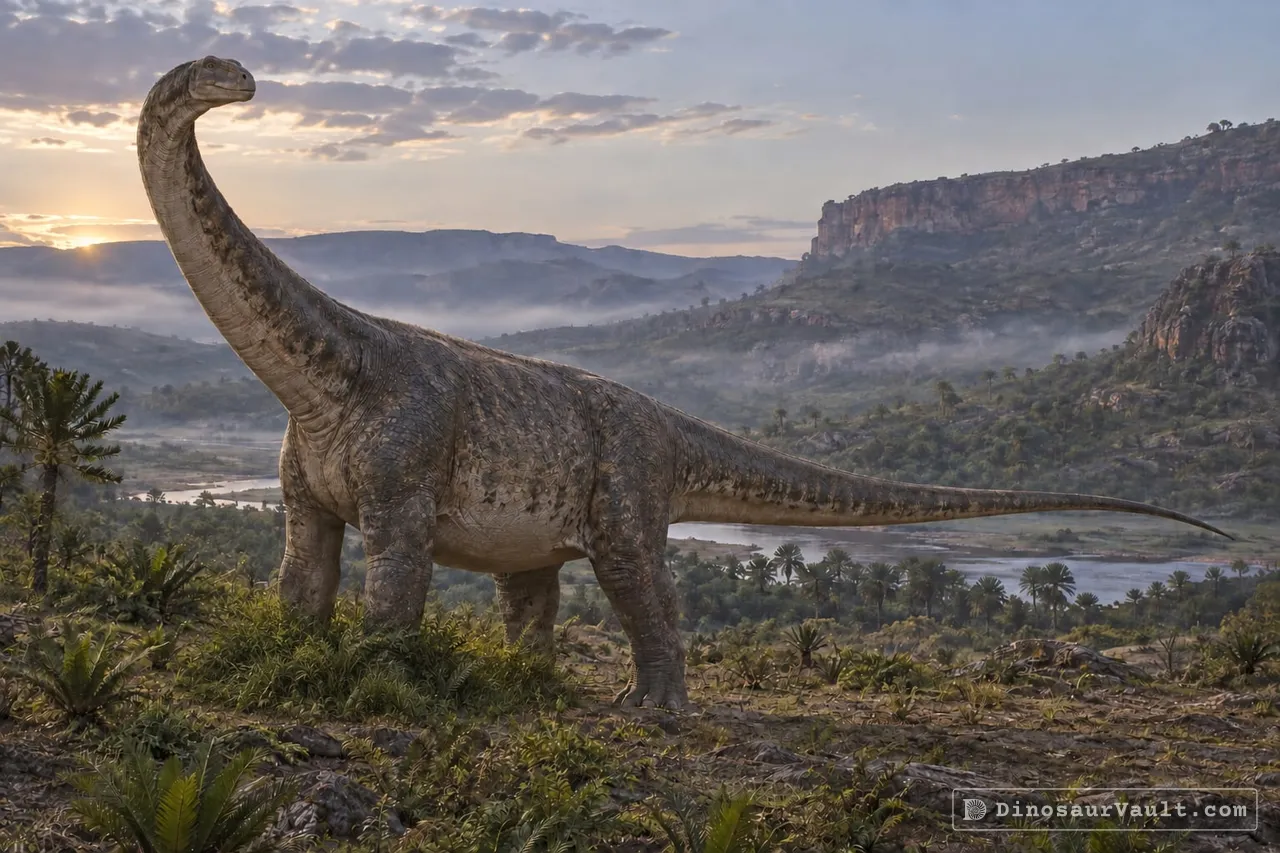
Scenes reconstructed from the available fossil evidence.
1 of 3
Lived alongside
Found in the same rock formations


A rock formation can hold fossils laid down millions of years apart, so not every animal here met Uberabatitan.
The evidence
The science behind Uberabatitan
Which parts of the picture come from its own bones, and which come from its relatives.
From its own fossils
- The revised type specimen consists of a shin bone, fibula and ankle bone. Separate neck, back, tail, hip and limb bones from several individuals are tentatively assigned to it.
- The ankle bone has a raised crest beside the surface that meets the shin bone.
- Microscopic sections of bones assigned to Uberabatitan show rapid early growth followed by pauses later in life.
Borrowed from relatives
- Its missing skull is compared with Tapuiasaurus.
- Missing parts of the hands and feet are compared with Mendozasaurus.
Still unknown
- The shape of its skull.
- Its skin color and markings.
- Whether it traveled in herds.
Discovery timeline
- 2008Named itSALGADO & DE SOUZA CARVALHO
- 2019Full descriptionSILVA et al.
- 2023Growing upWindholz et al.
Key papers
The research behind what we know of Uberabatitan
Named it
Named a titanosaur from the bones of several individuals buried in coarse sandstone in Brazil.
UBERABATITAN RIBEIROI, A NEW TITANOSAUR FROM THE MARÍLIA FORMATION (BAURU GROUP, UPPER CRETACEOUS), MINAS GERAIS, BRAZIL. Palaeontology 51: 881-901
Read the paper : UBERABATITAN RIBEIROI, A NEW TITANOSAUR FROM THE MARÍLIA FORMATION (BAURU GROUP, UPPER CRETACEOUS), MINAS GERAIS, BRAZIL (opens in a new tab)Full description
Revised the type to lower hindlimb bones, tentatively assigned other material and identified a distinctive crest on the ankle bone.
Osteology and systematics of Uberabatitan ribeiroi (Dinosauria; Sauropoda): a Late Cretaceous titanosaur from Minas Gerais, Brazil. Zootaxa 4577
Read the paper : Osteology and systematics of Uberabatitan ribeiroi (Dinosauria; Sauropoda): a Late Cretaceous titanosaur from Minas Gerais, Brazil (opens in a new tab)Growing up
Bone sections showed fast early growth, later interruptions and differences in maturity among the sampled animals.
Osteohistology of Uberabatitan ribeiroi (Dinosauria, Sauropoda) provides insight into the life history of titanosaurs. Historical Biology 36: 2284-2294
Read the paper : Osteohistology of Uberabatitan ribeiroi (Dinosauria, Sauropoda) provides insight into the life history of titanosaurs (opens in a new tab)
Close relatives
Other members of Rinconsauria


Sources: Wikidata