Malawisaurus
"Malawi lizard"
- Lived
- 121 to 113 million years ago, Early Cretaceous
- Diet
- Herbivore
- Length
- about 9 m (30 ft)
- Group
- Sauropods
- Found in
- Malawi
- Named by
- Jacobs et al. 1993
Size comparison
To scale


Scale in metersOutline: typical sauropod shape
Where its fossils were found
The evidence
Today

115 million years ago
Habitat
Rivers laid down sand and mud in what is now Malawi. The other titanosaur Karongasaurus lived in the same region.
Field notes
About Malawisaurus
What it was like
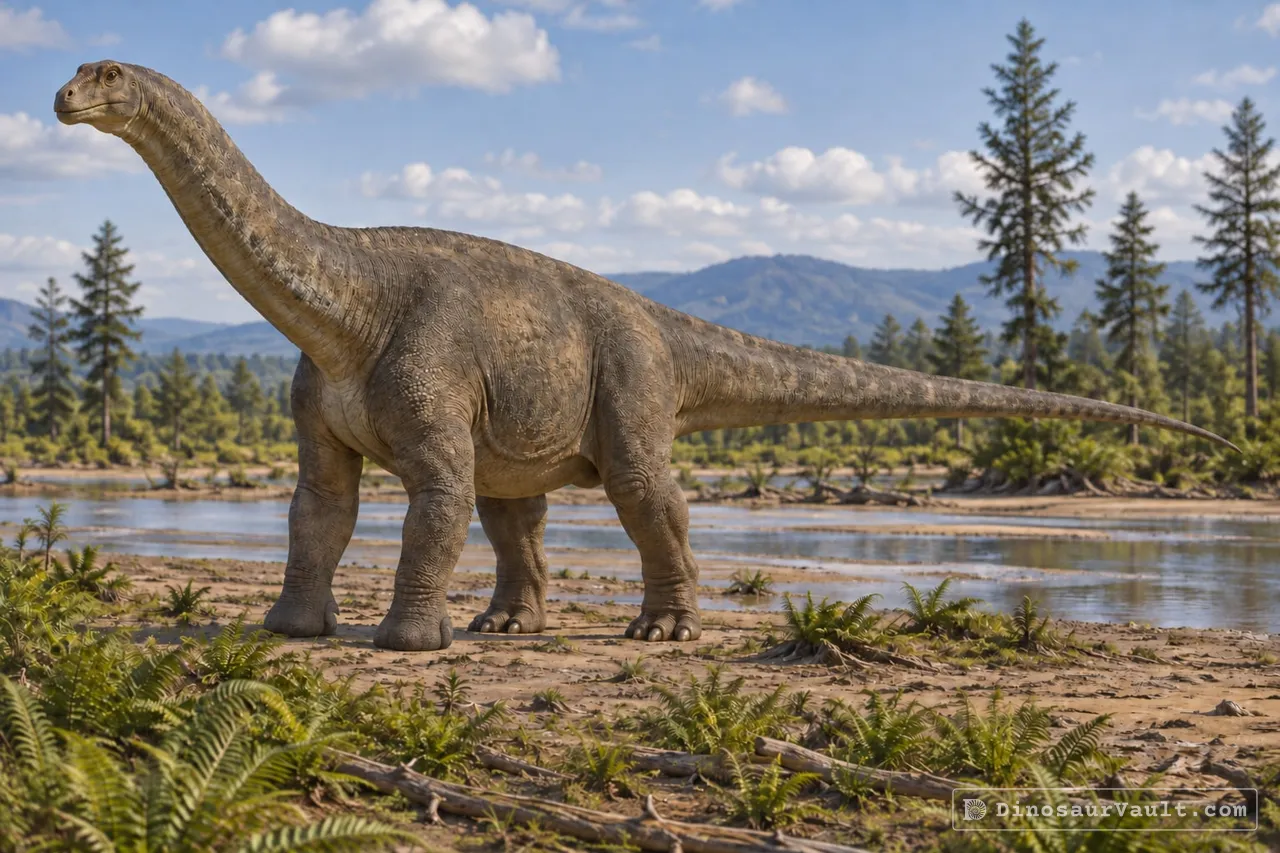
Malawisaurus was a titanosaur, a long-necked, four-legged plant eater, about 9 meters (30 feet) long. Skull bones have been assigned to it, but a recent re-evaluation questions whether they belong with the specimen that defines the genus.
A bony plate has also been assigned to it, but whether this armor belonged to Malawisaurus remains uncertain.
Its world
It lived in the Early Cretaceous in what is now Malawi, in southern Africa. Its bones come from the Dinosaur Beds, where it shared the land with another titanosaur, Karongasaurus.
How it was found
Jacobs and colleagues named Malawisaurus in 1993 for bones that had first been placed in another genus. Six finds are known.
Field gallery
More views of Malawisaurus
Scenes reconstructed from the available fossil evidence.
Lived alongside
Found in the same rock formations

A rock formation can hold fossils laid down millions of years apart, so not every animal here met Malawisaurus.
The evidence
The science behind Malawisaurus
Which parts of the picture come from its own bones, and which come from its relatives.
From its own fossils
- The type specimen preserves a front tail vertebra, a right shoulder blade, paired breastbones and a right pubic bone.
- Skull, jaw, vertebra and limb bones from several individuals and quarries have been referred to Malawisaurus, and a recent re-evaluation questions whether the skull belongs with the type.
- An oval bony plate was described among the material referred to Malawisaurus.
Borrowed from relatives
- Its missing skull is compared with Tapuiasaurus; missing vertebrae and limbs are compared with Mnyamawamtuka.
- Futalognkosaurus supplies comparisons for missing neck joints, and Camarasaurus and Apatosaurus for missing wrist joints.
Still unknown
- Which referred skull, limb and armor fossils belong to it. How any armor was arranged.
- Its color and skin pattern.
- Which plants it ate.
Discovery timeline
- 1993Named itJacobs et al.
- 2009Family treeD'Emic, Wilson & Chatterjee
- 2019SkullAndrzejewski et al.
Key papers
The research behind what we know of Malawisaurus
Named it
Established a distinct titanosaur from bones found in Malawi, with tail vertebrae and skull and tooth material referred to it.
New material of an Early Cretaceous titanosaurid sauropod dinosaur from Malawi. Palaeontology 36: 523-534
No link available
Family tree
Compared titanosaur armor across the world and found that bony plate shapes were shared by different groups.
The titanosaur (Dinosauria: Sauropoda) osteoderm record: review and first definitive specimen from India. Journal of Vertebrate Paleontology 29: 165-177
Read the paper : The titanosaur (Dinosauria: Sauropoda) osteoderm record: review and first definitive specimen from India (opens in a new tab)Skull
Reconstructed a referred braincase's brain cavity and inner ear, finding titanosaur features and adaptations for sensing head movement.
The braincase of Malawisaurus dixeyi (Sauropoda: Titanosauria): A 3D reconstruction of the brain endocast and inner ear. PLOS ONE 14: e0211423
Read the paper : The braincase of Malawisaurus dixeyi (Sauropoda: Titanosauria): A 3D reconstruction of the brain endocast and inner ear (opens in a new tab)
Close relatives
Other members of Lithostrotia


Sources: Wikidata