Trinisaura
"Trini's lizard"
- Lived
- 84 to 72 million years ago, Late Cretaceous
- Diet
- Herbivore
- Group
- Ornithopods
- Found in
- Antarctica
- Named by
- Coria et al. 2013
Where its fossils were found
The evidence
Today

80 million years ago
Habitat
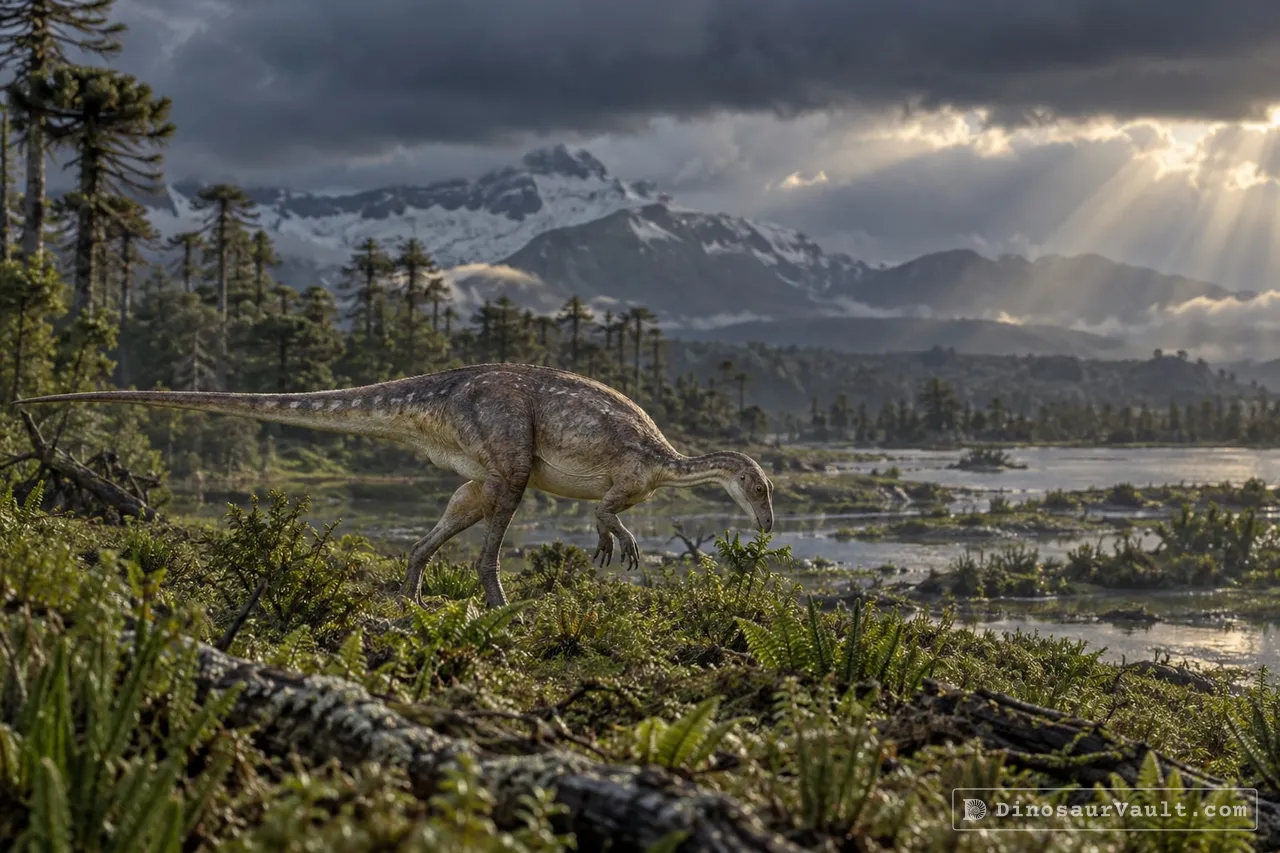
It lived in forested Antarctica during the Late Cretaceous, when the continent was warmer than today. Other dinosaurs from the region include Antarctopelta, Morrosaurus and Imperobator.
Field notes
About Trinisaura
What it was like
Trinisaura was a small, two-legged plant eater often grouped with the elasmarians, southern ornithopods whose relationships remain uncertain. It is known from a partial skeleton.
Its world
It lived in the Late Cretaceous in Antarctica. The land was forested and much warmer than today. Its bones come from the Snow Hill Island Formation, and other dinosaurs from the region include the plant eater Morrosaurus, the armored Antarctopelta and the hunter Imperobator.
How it was found
Coria and colleagues named it in 2013. The name honors the first Argentine woman geologist to work in Antarctica.
Field gallery
More views of Trinisaura
Scenes reconstructed from the available fossil evidence.
1 of 2
Lived alongside
Found in the same rock formations


A rock formation can hold fossils laid down millions of years apart, so not every animal here met Trinisaura.
The evidence
The science behind Trinisaura
Which parts of the picture come from its own bones, and which come from its relatives.
From its own fossils
- A single partial skeleton, found scattered, preserves backbone, shoulder, arm, hip and hindlimb bones.
- Its shoulder blade carried a spike-shaped projection, and the slender upper arm bone bowed outward with only a small muscle crest.
- The hip bones were low and long, and the sturdy thigh bone bowed forward.
Borrowed from relatives
- The missing skull and neck are restored by comparison with related small ornithopods such as Talenkauen.
Still unknown
- Its skull and neck, since neither is among the bones of the skeleton it was named from, and its body covering.
- Its place in the family tree. It has been grouped with southern ornithopods called elasmarians, but one analysis instead placed it with Talenkauen, Anabisetia and Kangnasaurus in a different southern group.
- How it survived the dark polar winter.
Discovery timeline
- 2013Named itCoria et al.
- 2016Family treeRozadilla et al.
- 2020Growing upGarcia-Marsà et al.
- 2022Family treePoole
Key papers
The research behind what we know of Trinisaura
Named it
Described a partial skeleton with distinctive shoulder and arm bones and compared it with small South American ornithopods.
A new ornithopod (Dinosauria; Ornithischia) from Antarctica. Cretaceous Research 41: 186-193
Read the paper : A new ornithopod (Dinosauria; Ornithischia) from Antarctica (opens in a new tab)Family tree
Named Morrosaurus and grouped Antarctic and South American ornithopods into a shared southern lineage.
A new ornithopod (Dinosauria, Ornithischia) from the Upper Cretaceous of Antarctica and its palaeobiogeographical implications. Cretaceous Research 57: 311-324
Read the paper : A new ornithopod (Dinosauria, Ornithischia) from the Upper Cretaceous of Antarctica and its palaeobiogeographical implications (opens in a new tab)Growing up
Microscopic bone structure showed fast growth with pauses and indicated that the known Trinisaura had not reached full adult size.
Biological implications of the bone microstructure of the Antarctic ornithopods Trinisaura and Morrosaurus (Dinosauria, Ornithischia). Cretaceous Research 116: 104605
Read the paper : Biological implications of the bone microstructure of the Antarctic ornithopods Trinisaura and Morrosaurus (Dinosauria, Ornithischia) (opens in a new tab)Family tree
A large family-tree study of iguanodontians in which different methods gave different homes for Trinisaura, one linking it with Talenkauen and Anabisetia.
Phylogeny of iguanodontian dinosaurs and the evolution of quadrupedality. Palaeontologia Electronica
Read the paper : Phylogeny of iguanodontian dinosaurs and the evolution of quadrupedality (opens in a new tab)
Close relatives
Other members of Elasmaria


Sources: Wikidata