Antarctopelta
ant-ARK-toh-PEL-tuh
"Antarctic shield"
- Lived
- 84 to 72 million years ago, Late Cretaceous
- Diet
- Herbivore
- Length
- about 4 m (13 ft)
- Group
- Ankylosaurs
- Found in
- Antarctica
- Named by
- Salgado and Gasparini 2006
Size comparison
To scale

Scale in metersOutline: typical ankylosaur shape
Where its fossils were found
The evidence
Today

80 million years ago
Habitat
It lived on forested land in a much warmer Antarctica. Trinisaura, Morrosaurus and Imperobator are also known from the Snow Hill Island Formation.
Field notes
About Antarctopelta
What it was like
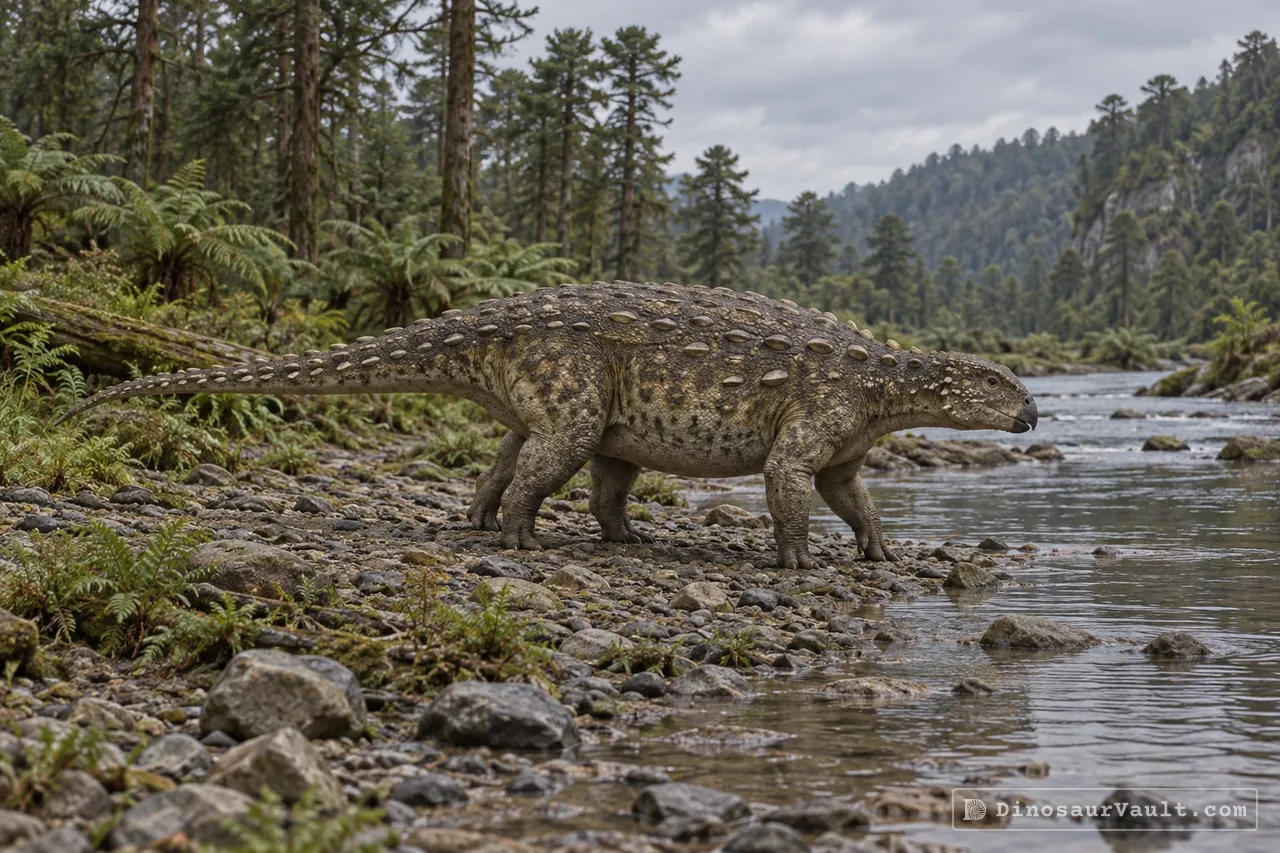
Antarctopelta was an armored plant eater about 4 meters (13 feet) long. It walked on four legs and carried bony plates in its skin, like other ankylosaurs. It is now placed in a small group of southern ankylosaurs that includes Stegouros and Kunbarrasaurus.
Its world
It lived about 84 to 72 million years ago, in the Late Cretaceous, on land that is now part of Antarctica. The continent was much warmer then and had forests. Its bones come from the Snow Hill Island Formation, where Trinisaura, Morrosaurus and Imperobator have also been found.
How it was found
Its single skeleton was the first dinosaur found in Antarctica, though Salgado and Gasparini did not name it until 2006.
Field gallery
More views of Antarctopelta
Scenes reconstructed from the available fossil evidence.
1 of 3
Lived alongside
Found in the same rock formations


A rock formation can hold fossils laid down millions of years apart, so not every animal here met Antarctopelta.
The evidence
The science behind Antarctopelta
Which parts of the picture come from its own bones, and which come from its relatives.
From its own fossils
- A partial skeleton preserves a lower jaw with teeth, pieces of the backbone and limbs, and bony armor.
- Large, flattened armor plates belonged to the tail; some were once mistaken for skull bones.
- Small oval armor plates and pieces of armor from over the hips show how parts of its body were protected.
Borrowed from relatives
- Stegouros guides the restoration of its lightly armored body and broad, flattened tail weapon.
- The missing upper head and beak are restored using Kunbarrasaurus and Stegouros.
Still unknown
- The full outline of the tail weapon and the order of its armor plates.
- The shape of the upper skull and the arrangement of armor across the whole body.
- Its color.
Often drawn wrong
- Its tail armor was flattened and expanded sideways, rather than forming the rounded club of Ankylosaurus.
- It belonged in a forested Antarctica, rather than a landscape covered by modern polar ice.
Discovery timeline
- 2006Named itSalgado & Gasparini
- 2021Family treeSoto-Acuña et al.
Key papers
The research behind what we know of Antarctopelta
Named it
Named an armored plant eater from the first dinosaur skeleton discovered in Antarctica.
Reappraisal of an ankylosaurian dinosaur from the Upper Cretaceous of James Ross Island (Antarctica). Geodiversitas 28: 119-135
No link available
Family tree
Described Stegouros and grouped it with Antarctopelta and Kunbarrasaurus in an early branch of southern armored dinosaurs.
Bizarre tail weaponry in a transitional ankylosaur from subantarctic Chile. Nature 600: 259-263
Read the paper : Bizarre tail weaponry in a transitional ankylosaur from subantarctic Chile (opens in a new tab)
Close relatives
Other members of Parankylosauria


Sources: Wikidata