Timimus
Type species Timimus hermani
- Lived
- 113 to 110 million years ago, Early Cretaceous
- Diet
- Carnivore
- Group
- Theropods
- Found in
- Australia
- Named by
- Rich and Vickers-Rich 1994
Where its fossils were found
The evidence
Today

110 million years ago
Habitat
River channels crossed a polar landscape with conifers and ferns, and winters brought long periods of darkness. Leaellynasaura and Atlascopcosaurus lived in the same region.
Field notes
About Timimus
What it was like
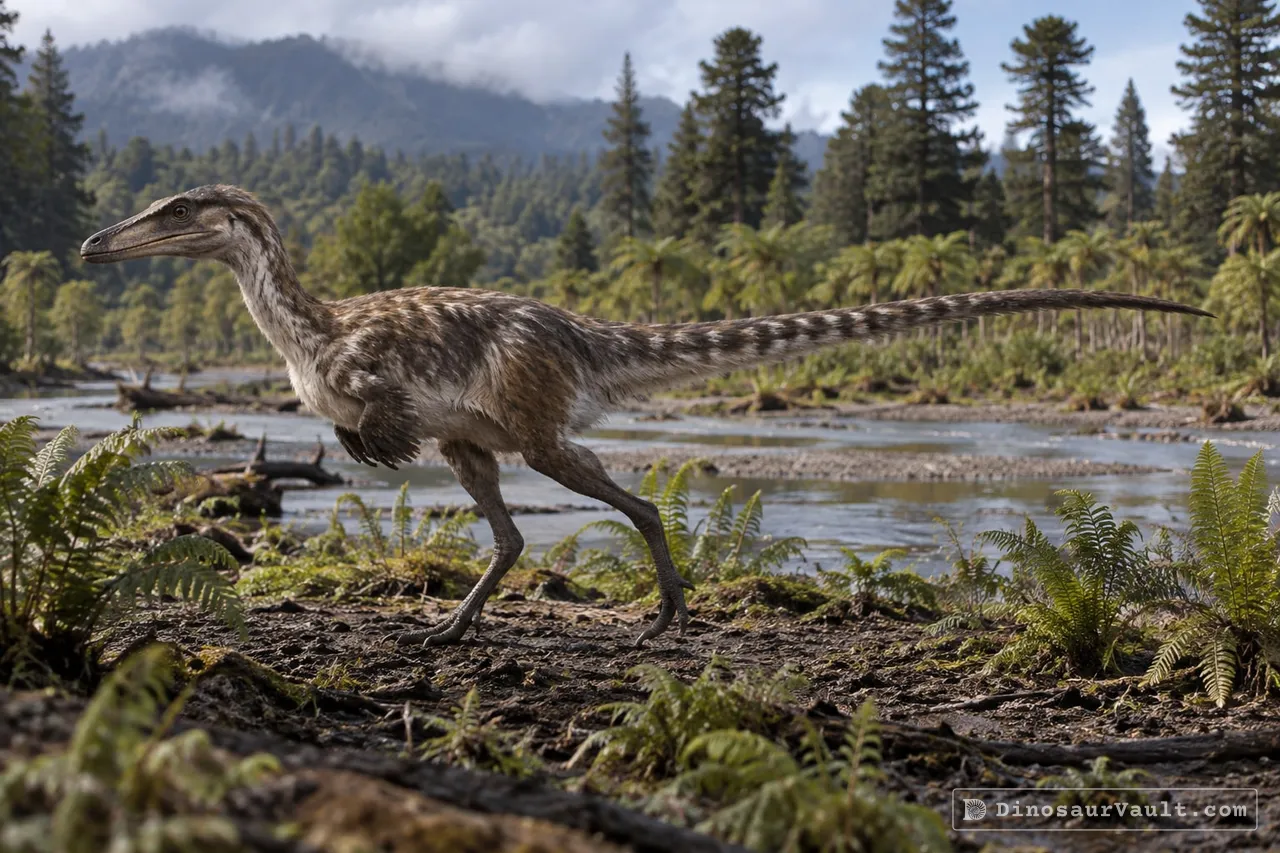
Timimus was a small theropod known from thigh bones. It was first described as an ostrich-like ornithomimosaur, but later studies suggest it may have been an early relative of the tyrannosaurs.
Its world
It lived about 113 to 110 million years ago, in the Early Cretaceous, in Australia. The land then lay close to the pole, with long dark winters. Its bones come from the Eumeralla Formation, where it lived alongside the small plant eaters Leaellynasaura and Atlascopcosaurus.
How it was found
Rich and Vickers-Rich named Timimus in 1994. The type species is Timimus hermani. The name honors members of the family who led the digs.
Field gallery
More views of Timimus
Scenes reconstructed from the available fossil evidence.
1 of 3
Lived alongside
Found in the same rock formations


A rock formation can hold fossils laid down millions of years apart, so not every animal here met Timimus.
The evidence
The science behind Timimus
Which parts of the picture come from its own bones, and which come from its relatives.
From its own fossils
- The thigh bone used to name Timimus is unusually long and slender.
- Features of the thigh bone have led later studies to place it among early tyrannosauroids.
Borrowed from relatives
- Dilong and Eotyrannus provide possible models for its missing head, body and grasping hands.
- A covering of simple filaments is a possibility based on early tyrannosauroids such as Dilong.
Still unknown
- Its exact place in the theropod family tree.
- The shape of its skull, hands and feet.
- Its size, color and body covering.
Discovery timeline
- 1994Named itRich & Vickers-Rich
- 2012Family treeBenson et al.
- 2018Family treeDelcourt & Grillo
Key papers
The research behind what we know of Timimus
Named it
Named Timimus from thigh bones and first interpreted it as an ostrich-like dinosaur.
Neoceratopsians and ornithomimosaurs: dinosaurs of Gondwana origin? National Geographic Research and Exploration 10: 129-131
No link available
Family tree
Reexamined the thigh bone, suggested tyrannosauroid relationships, and questioned whether the smaller bone belonged to Timimus.
Theropod Fauna from Southern Australia Indicates High Polar Diversity and Climate-Driven Dinosaur Provinciality. PLoS ONE 7: e37122
Read the paper : Theropod Fauna from Southern Australia Indicates High Polar Diversity and Climate-Driven Dinosaur Provinciality (opens in a new tab)Family tree
Included Timimus in a family-tree analysis that supported its placement among early tyrannosauroids.
Tyrannosauroids from the Southern Hemisphere: Implications for biogeography, evolution, and taxonomy. Palaeogeography, Palaeoclimatology, Palaeoecology 511: 379-387
Read the paper : Tyrannosauroids from the Southern Hemisphere: Implications for biogeography, evolution, and taxonomy (opens in a new tab)
Close relatives
Other members of Tyrannosauroidea


Sources: Wikidata