Tataouinea
"Tataouine"
- Lived
- 113 to 101 million years ago, Early Cretaceous
- Diet
- Herbivore
- Group
- Sauropods, Rebbachisauridae
- Found in
- Tunisia
- Named by
- Fanti et al. 2013
Where its fossils were found
The evidence
Today

105 million years ago
Habitat
Sandy rivers flowed into a broad estuary in southern Tunisia, with patches of rooted vegetation along shallow banks. Spinosaurus, Carcharodontosaurus and Ouranosaurus are also reported from the region.
Field notes
About Tataouinea
What it was like
Tataouinea was a rebbachisaur, a long-necked plant eater from a family related to Diplodocus. It is known from part of the backbone, hips and tail.
Its hip bones were full of air spaces, which made them lighter, like the bones of birds.
Its world
It lived in the Early Cretaceous in what is now southern Tunisia. Its bones come from the Aïn el Guettar Formation.
How it was found
Fanti and colleagues named Tataouinea in 2013, from a single find. Its species name honors a famous general from ancient North Africa.
Field gallery
More views of Tataouinea
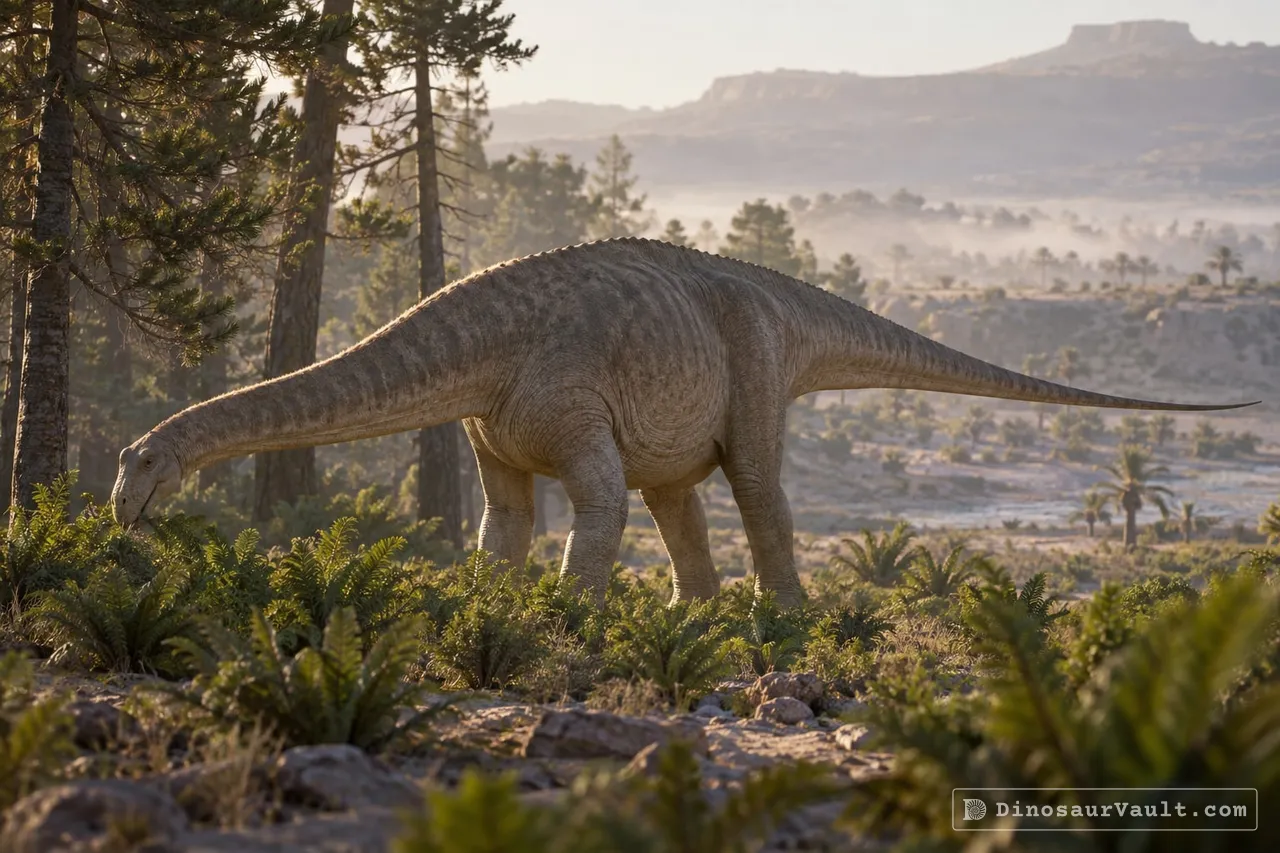
Scenes reconstructed from the available fossil evidence.
Lived alongside
Found in the same rock formations


A rock formation can hold fossils laid down millions of years apart, so not every animal here met Tataouinea.
The evidence
The science behind Tataouinea
Which parts of the picture come from its own bones, and which come from its relatives.
From its own fossils
- The type skeleton includes the fused backbone at the hips, hip bones and an articulated stretch of tail.
- Openings in the hip bones lead into internal air spaces.
- The original description reported air spaces extending farther into some bones on the left side than on the right.
Borrowed from relatives
- Lavocatisaurus provides a comparison for the missing head and neck, while Limaysaurus helps with the missing trunk, limbs and far end of the tail.
Still unknown
- The shape of its skull and teeth, and its skin color and markings.
- The full length and proportions of its neck.
- Experts disagree over whether openings in its tail bones were air spaces or damage from collapse and deformation.
Discovery timeline
- 2013Named itFanti et al.
- 2015Full descriptionFanti et al.
- 2026Inside the bonesBeeston et al.
Key papers
The research behind what we know of Tataouinea
Named it
Named Tataouinea from an articulated skeleton whose hollow hip bones strongly support the presence of abdominal air sacs.
A new sauropod dinosaur from the Early Cretaceous of Tunisia with extreme avian-like pneumatization. Nature Communications 4
Read the paper : A new sauropod dinosaur from the Early Cretaceous of Tunisia with extreme avian-like pneumatization (opens in a new tab)Full description
Described additional tail bones, uneven air spaces on opposite sides of the skeleton, and the sandy estuary where it was buried.
New Information on Tataouinea hannibalis from the Early Cretaceous of Tunisia and Implications for the Tempo and Mode of Rebbachisaurid Sauropod Evolution. PLOS ONE 10: e0123475
Read the paper : New Information on Tataouinea hannibalis from the Early Cretaceous of Tunisia and Implications for the Tempo and Mode of Rebbachisaurid Sauropod Evolution (opens in a new tab)Inside the bones
Reinterpreted supposed air-space openings in Tataouinea tail bones as damage from collapse and deformation.
Computed tomography reveals multiple origins of extreme caudal vertebral pneumaticity in sauropod dinosaurs. Journal of Anatomy
Read the paper : Computed tomography reveals multiple origins of extreme caudal vertebral pneumaticity in sauropod dinosaurs (opens in a new tab)
Close relatives
Other members of Rebbachisauridae


Sources: Wikidata