Shamosaurus
"desert lizard"
Type species Shamosaurus scutatus
- Lived
- 121 to 101 million years ago, Early Cretaceous
- Diet
- Herbivore
- Group
- Ankylosaurs, Ankylosauridae
- Found in
- Mongolia
- Named by
- Tumanova 1983
Where its fossils were found
The evidence
Today

110 million years ago
Habitat
It lived on land in Early Cretaceous Mongolia. Psittacosaurus and Mongolostegus are also recorded from the Dzunbain Formation.
Field notes
About Shamosaurus
What it was like
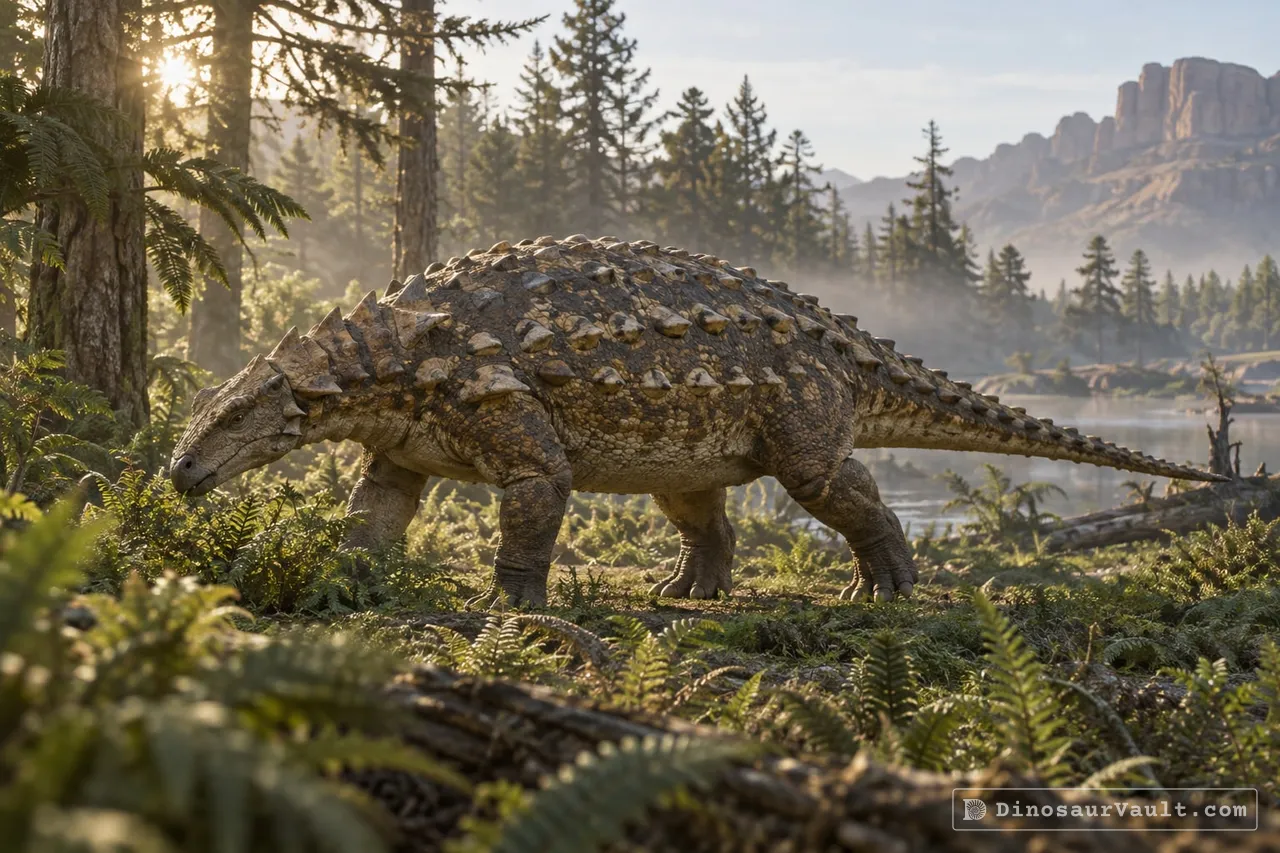
Shamosaurus was an early ankylosaur, an armored plant eater with a long, narrow skull and bony plates on its back. It is known from a skull and parts of the skeleton.
Its world
It lived in the Early Cretaceous in what is now Mongolia. Its bones come from the Dzunbain Formation, where it shared the land with the small horned Psittacosaurus.
How it was found
Tumanova named it in 1983. The type species is Shamosaurus scutatus.
Field gallery
More views of Shamosaurus
Scenes reconstructed from the available fossil evidence.
1 of 3
Lived alongside
Found in the same rock formations


A rock formation can hold fossils laid down millions of years apart, so not every animal here met Shamosaurus.
The evidence
The science behind Shamosaurus
Which parts of the picture come from its own bones, and which come from its relatives.
From its own fossils
- A skull and parts of the skeleton show an armored plant eater with a narrow snout.
- Bony armor protected its body.
Borrowed from relatives
- Gobisaurus has a closely similar skull and helps guide comparisons of the head.
- Missing parts of its body are restored from other ankylosaurs, with a broad trunk and short, weight-bearing legs.
Still unknown
- The complete arrangement of its body armor.
- The shape of the end of its tail.
- Its color.
Discovery timeline
- 1983Named itTumanova
- 2001Close relativeVickaryous et al.
- 2015Family treeArbour & Currie
Key papers
The research behind what we know of Shamosaurus
Named it
Named an early armored dinosaur from Mongolia, based on a skull and parts of its skeleton.
Pervyy ankilozavr iz nizhnego mela Mongolii [The first ankylosaurs from the Lower Cretaceous of Mongolia]. In L. P. Tatarinov, R. Barsbold, E. Vorobyeva, B. Luvsandanzan, B. A. Trofimov, Yu. A. Reshetov, & M. A. Shishkin (eds.), Iskopayemyye reptilii mongolii [Fossil Reptiles of Mongolia]. Trudy Sovmestnaya Sovetsko-Mongol'skaya Paleontologicheskaya Ekspeditsiya 24: 110-118
No link available
Close relative
Described Gobisaurus and compared its skull with Shamosaurus, finding a close relationship and differences in bones of the palate.
A new ankylosaurid (Dinosauria: Ankylosauria) from the Lower Cretaceous of China, with comments on ankylosaurian relationships. Canadian Journal of Earth Sciences 38: 1767-1780
Read the paper : A new ankylosaurid (Dinosauria: Ankylosauria) from the Lower Cretaceous of China, with comments on ankylosaurian relationships (opens in a new tab)Family tree
Placed Shamosaurus among early ankylosaurids, outside the branch containing the more specialized club-tailed forms.
Systematics, phylogeny and palaeobiogeography of the ankylosaurid dinosaurs. Journal of Systematic Palaeontology 14: 385-444
Read the paper : Systematics, phylogeny and palaeobiogeography of the ankylosaurid dinosaurs (opens in a new tab)
Close relatives
Other members of Ankylosauridae


Sources: Wikidata