Mongolostegus
"Mongolian roof"
Type species Mongolostegus exspectabilis
- Lived
- 121 to 101 million years ago, Early Cretaceous
- Diet
- Herbivore
- Group
- Stegosaurs, Stegosauridae
- Found in
- Mongolia
- Named by
- Tumanova and Alifanov 2018
Where its fossils were found
The evidence
Today

110 million years ago
Habitat
It probably lived on inland plains around rivers and lakes in Mongolia. Other dinosaurs from the Dzunbain Formation include Psittacosaurus and Shamosaurus.
Field notes
About Mongolostegus
What it was like
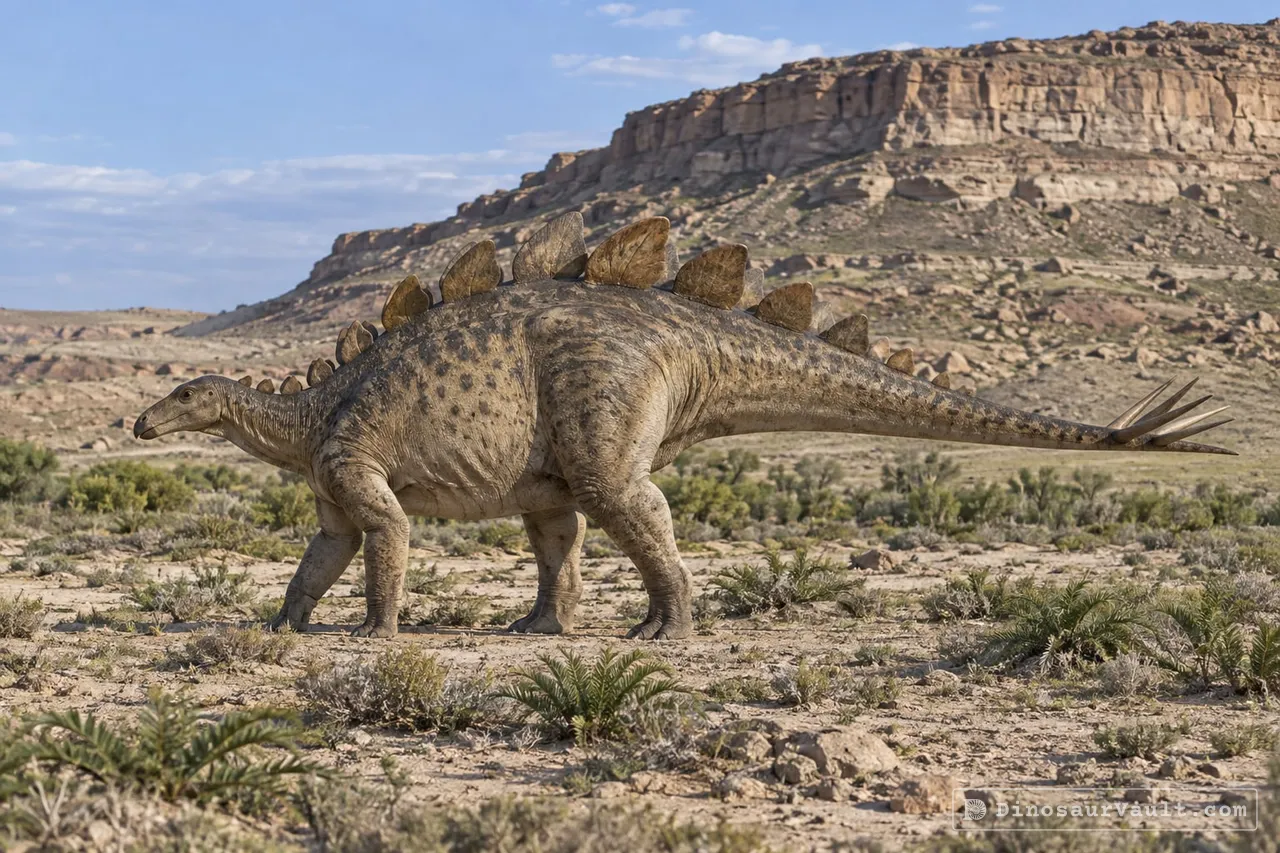
Mongolostegus was a stegosaur, a plant eater with plates and spikes along its back and tail. It is known from only part of a skeleton.
It is one of the last stegosaurs known, from a time when the group was becoming rare.
Its world
It lived in the Early Cretaceous in what is now Mongolia. Its bones come from the Dzunbain Formation, where it shared the land with Psittacosaurus and the armored Shamosaurus.
How it was found
Tumanova and Alifanov named Mongolostegus in 2018. It was the first stegosaur named from Mongolia.
Field gallery
More views of Mongolostegus
Scenes reconstructed from the available fossil evidence.
1 of 3
Lived alongside
Found in the same rock formations


A rock formation can hold fossils laid down millions of years apart, so not every animal here met Mongolostegus.
The evidence
The science behind Mongolostegus
Which parts of the picture come from its own bones, and which come from its relatives.
From its own fossils
- A partial skeleton preserves vertebrae from the base of the tail and bones of the hips.
- The combination of features in its tail vertebrae and pelvis distinguishes it from other stegosaurs.
Borrowed from relatives
- The missing head, limbs and much of the body are restored by comparison with Stegosaurus.
- Plates along the back and spikes near the tail tip follow other stegosaurs, including Stegosaurus.
Still unknown
- The shape and arrangement of its plates and spikes.
- Its skin covering and color.
- Where it belongs among the early branches of the stegosaur family tree.
Discovery timeline
- 2015Close relativeMaidment, Brassey & Barrett
- 2018Named itTumanova & Alifanov
- 2025Family treeSánchez-Fenollosa & Cobos
Key papers
The research behind what we know of Mongolostegus
Close relative
Described a nearly complete Stegosaurus skeleton, providing comparisons for the missing body, feet and armor of Mongolostegus.
The Postcranial Skeleton of an Exceptionally Complete Individual of the Plated Dinosaur Stegosaurus stenops (Dinosauria: Thyreophora) from the Upper Jurassic Morrison Formation of Wyoming, U.S.A. PLOS ONE 10: e0138352
Read the paper : The Postcranial Skeleton of an Exceptionally Complete Individual of the Plated Dinosaur Stegosaurus stenops (Dinosauria: Thyreophora) from the Upper Jurassic Morrison Formation of Wyoming, U.S.A. (opens in a new tab)Named it
Named the first stegosaur from Mongolia using distinctive vertebrae from the base of the tail and pelvic bones.
First Record of Stegosaur (Ornithischia, Dinosauria) from the Aptian–Albian of Mongolia. Paleontological Journal 52: 1771-1779
Read the paper : First Record of Stegosaur (Ornithischia, Dinosauria) from the Aptian–Albian of Mongolia (opens in a new tab)Family tree
An expanded stegosaur family tree found that the fragmentary Mongolostegus could occupy different positions among early branches.
New insights into the phylogeny and skull evolution of stegosaurian dinosaurs: An extraordinary cranium from the European Late Jurassic (Dinosauria: Stegosauria). Vertebrate Zoology 75: 165-189
Read the paper : New insights into the phylogeny and skull evolution of stegosaurian dinosaurs: An extraordinary cranium from the European Late Jurassic (Dinosauria: Stegosauria) (opens in a new tab)
Close relatives
Other members of Stegosauridae


Sources: Wikidata