Probactrosaurus
"before Bactrosaurus"
- Lived
- 121 to 101 million years ago, Early Cretaceous
- Diet
- Herbivore
- Length
- about 6 m (20 ft)
- Group
- Ornithopods
- Found in
- China
- Named by
- Rozhdestvensky 1966
Size comparison
To scale

Scale in metersOutline: typical ornithopod shape
Where its fossils were found
The evidence
Today

110 million years ago
Habitat
Its fossil sites record winding rivers, ponds and a broad floodplain with seed-bearing trees and fern undergrowth. Shaochilong and Gobisaurus are other dinosaurs listed from its wider rock unit in China.
Field notes
About Probactrosaurus
What it was like
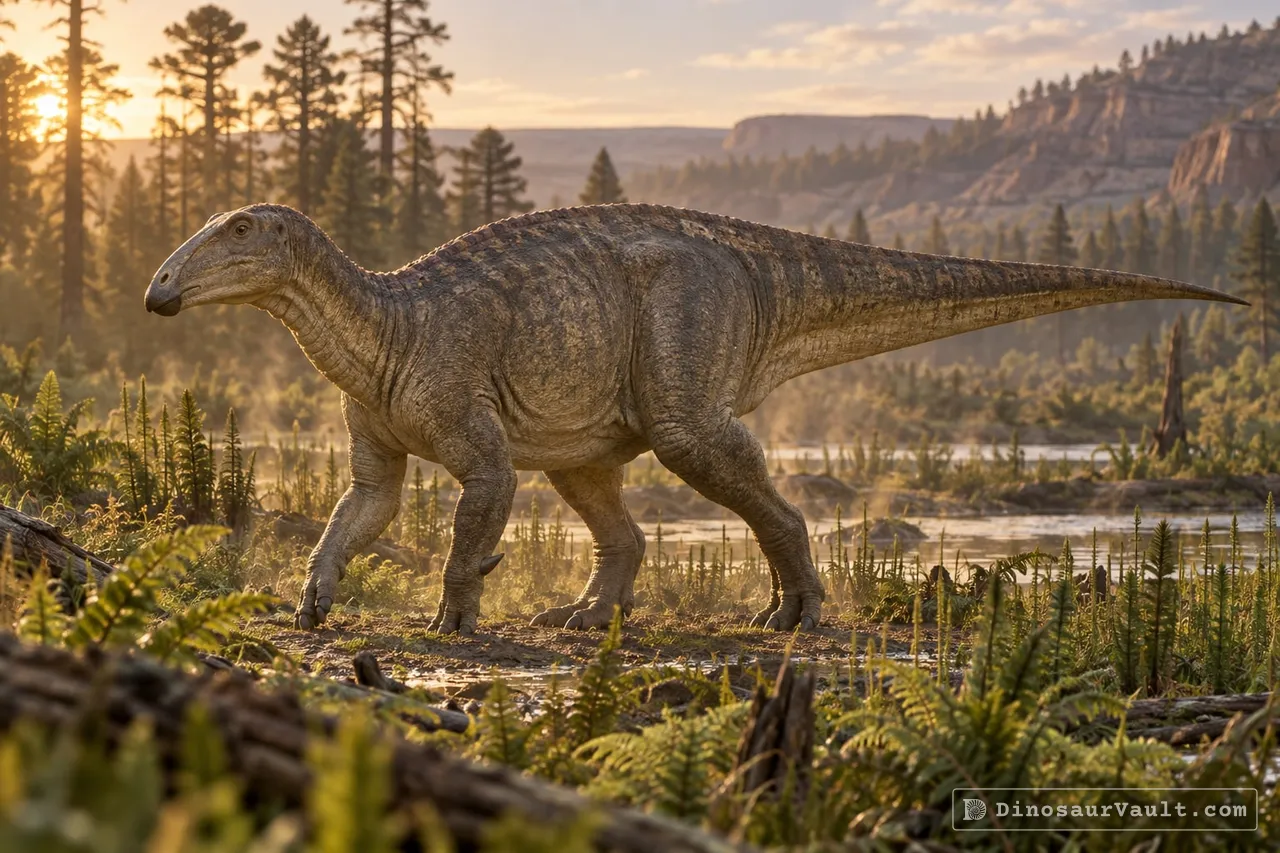
Probactrosaurus was a plant eater about 6 meters (20 feet) long, an early relative of the duck-billed dinosaurs. It had a long, narrow snout and rows of grinding teeth, and it could probably walk on two legs or four.
Its world
It lived in the Early Cretaceous in what is now China. Its bones come from the Miaogou Formation, where it shared the land with the predator Shaochilong and the armored Gobisaurus.
How it was found
Rozhdestvensky named Probactrosaurus in 1966. The name means it came before Bactrosaurus, a later relative.
Field gallery
More views of Probactrosaurus
Scenes reconstructed from the available fossil evidence.
1 of 2
Lived alongside
Found in the same rock formations


A rock formation can hold fossils laid down millions of years apart, so not every animal here met Probactrosaurus.
The evidence
The science behind Probactrosaurus
Which parts of the picture come from its own bones, and which come from its relatives.
From its own fossils
- The type skull shows a crestless head and a downward-curving beak, with closely packed chewing teeth.
- Bones referred to Probactrosaurus include long, slender forearms and closely packed hand bones, with a small, cone-shaped thumb spike.
- A partial skeleton referred to Probactrosaurus preserves long, blunt toe claws.
Borrowed from relatives
- Its skull and much of its skeleton are known from the type and referred specimens; Iguanodon provides a comparison for the missing area around the eyes and the missing finger tips.
Still unknown
- Its skin covering and color, and how it cared for its young.
- How often it walked on its hind legs or on all fours.
- Its complete skull proportions and finger arrangement; the type specimen of alashanicus has not been located.
Discovery timeline
- 1966Named itRozhdestvensky
- 2002Full descriptionNorman
- 2004Its worldVan Itterbeeck, Markevich & Horne
Key papers
The research behind what we know of Probactrosaurus
Named it
Named Probactrosaurus from Chinese fossils as an early relative of the duck-billed dinosaurs.
Novye igyanodonti ie tsentrallinoy Asii. Phillogeneticheskye y taksonomicheskye veaimoothoshenia poednich Iguanodontidae y rannich Hadrosauridae [New iguanodonts from central Asia. Phylogenetic and taxonomic relationships of late Iguanodontidae and early Hadrosauridae]. Paleontologicheskii Zhurnal 1966: 103-116
No link available
Full description
Restudied the skull and skeleton, united the original species and placed Probactrosaurus close to the duck-billed dinosaur family.
On Asian ornithopods (Dinosauria: Ornithischia). 4. ProbactrosaurusRozhdestvensky, 1966. Zoological Journal of the Linnean Society 136: 113-144
Read the paper : On Asian ornithopods (Dinosauria: Ornithischia). 4. ProbactrosaurusRozhdestvensky, 1966 (opens in a new tab)Its world
Used pollen and other tiny fossils to reassess the age of rocks containing Probactrosaurus and describe their wooded river floodplain.
The age of the dinosaur-bearing Cretaceous sediments at Dashuiguo, Inner Mongolia, P.R. China based on charophytes, ostracods and palynomorphs. Cretaceous Research 25: 391-409
Read the paper : The age of the dinosaur-bearing Cretaceous sediments at Dashuiguo, Inner Mongolia, P.R. China based on charophytes, ostracods and palynomorphs (opens in a new tab)
Close relatives
Other members of Hadrosauroidea


Sources: Wikidata