Shaochilong
"shark-toothed dragon"
- Lived
- 121 to 101 million years ago, Early Cretaceous
- Diet
- Carnivore
- Group
- Theropods, Carcharodontosauridae
- Found in
- China
- Named by
- Brusatte et al. 2009
Where its fossils were found
The evidence
Today

110 million years ago
Habitat
It lived on river plains in what is now China. The Miaogou Formation also preserves Gobisaurus and Probactrosaurus.
Field notes
About Shaochilong
What it was like
Shaochilong was a medium-sized meat eater known from pieces of the skull and a few backbones. It is usually placed in the same family as Carcharodontosaurus, big hunters with blade-like teeth, but some studies place it elsewhere among the large theropods.
It was much smaller than the giants of its family.
Its world
It lived in the Cretaceous in what is now northern China. Its bones come from the Miaogou Formation, where it lived alongside the armored Gobisaurus and the plant eater Probactrosaurus.
How it was found
Brusatte and colleagues named Shaochilong in 2009 for bones that had first been placed in a different genus. It showed that relatives of Carcharodontosaurus reached Asia.
Field gallery
More views of Shaochilong
Scenes reconstructed from the available fossil evidence.
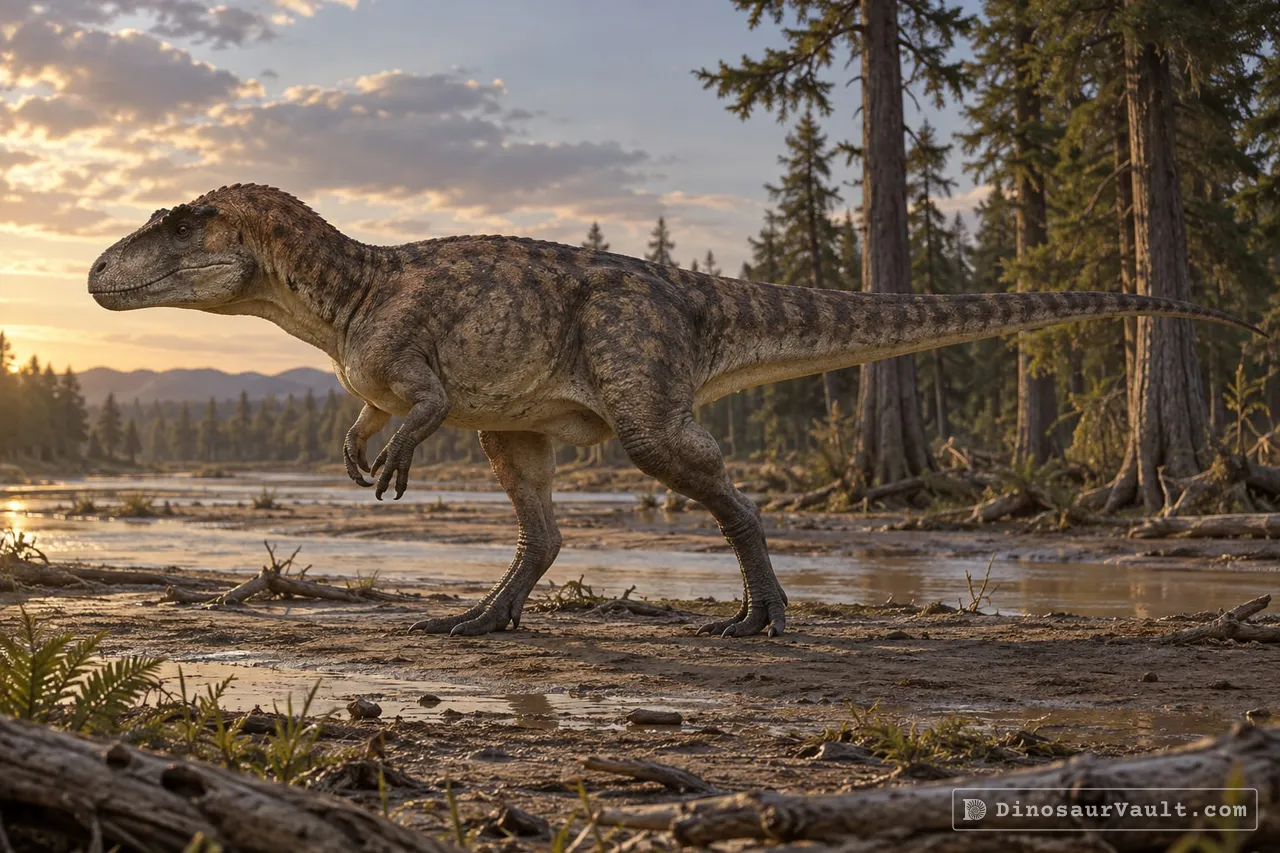
1 of 3
Lived alongside
Found in the same rock formations


A rock formation can hold fossils laid down millions of years apart, so not every animal here met Shaochilong.
The evidence
The science behind Shaochilong
Which parts of the picture come from its own bones, and which come from its relatives.
From its own fossils
- The braincase and joined skull roof preserve a thin bony crest along the middle of the forehead.
- An upper jaw probably belonging to the same animal has a relatively short snout and a mostly smooth outer surface.
Borrowed from relatives
- Acrocanthosaurus guides the missing snout tip and lower jaw, while Shaochilong's own upper jaw sets the shorter face shape.
- The body, arms and feet are restored by comparison with Acrocanthosaurus and other carcharodontosaurids.
Still unknown
- The shape of its body and limbs.
- How the bony skull crest looked beneath its skin.
- Whether the reported tail bones belong to the same animal as the skull.
Often drawn wrong
- Copying the long snout of Acrocanthosaurus loses Shaochilong's relatively short face.
- A tall back ridge like that of Acrocanthosaurus is an unsupported addition.
Discovery timeline
- 2009Named itBrusatte et al.
- 2010Full descriptionBRUSATTE et al.
- 2011Close relativeEddy & Clarke
Key papers
The research behind what we know of Shaochilong
Named it
Gave Shaochilong its own genus and identified it as an Asian member of the carcharodontosaur family.
The first definitive carcharodontosaurid (Dinosauria: Theropoda) from Asia and the delayed ascent of tyrannosaurids. Naturwissenschaften 96: 1051-1058
Read the paper : The first definitive carcharodontosaurid (Dinosauria: Theropoda) from Asia and the delayed ascent of tyrannosaurids (opens in a new tab)Full description
Described the skull and associated bones in detail, showing a relatively short snout and distinctive skull roof.
The osteology of Shaochilong maortuensis, a carcharodontosaurid (Dinosauria: Theropoda) from the Late Cretaceous of Asia. Zootaxa 2334
Read the paper : The osteology of Shaochilong maortuensis, a carcharodontosaurid (Dinosauria: Theropoda) from the Late Cretaceous of Asia (opens in a new tab)Close relative
Described an Acrocanthosaurus skull, providing comparisons for the missing snout tip and lower jaw of Shaochilong.
New Information on the Cranial Anatomy of Acrocanthosaurus atokensis and Its Implications for the Phylogeny of Allosauroidea (Dinosauria: Theropoda). PLoS ONE 6: e17932
Read the paper : New Information on the Cranial Anatomy of Acrocanthosaurus atokensis and Its Implications for the Phylogeny of Allosauroidea (Dinosauria: Theropoda) (opens in a new tab)
Close relatives
Other members of Carcharodontosauridae


Sources: Wikidata