Yuanyanglong
"lovebird dragon"
Type species Yuanyanglong bainian
- Lived
- 121 to 101 million years ago, Early Cretaceous
- Diet
- Omnivore
- Group
- Theropods
- Found in
- China
- Named by
- Hao et al. 2025
Where its fossils were found
The evidence
Today

110 million years ago
Habitat
It lived in northern China, in the landscape recorded by the Miaogou Formation. Its long legs suggest it may have waded in shallow water; Shaochilong, Gobisaurus and Probactrosaurus are known from the same locality.
Field notes
About Yuanyanglong
What it was like
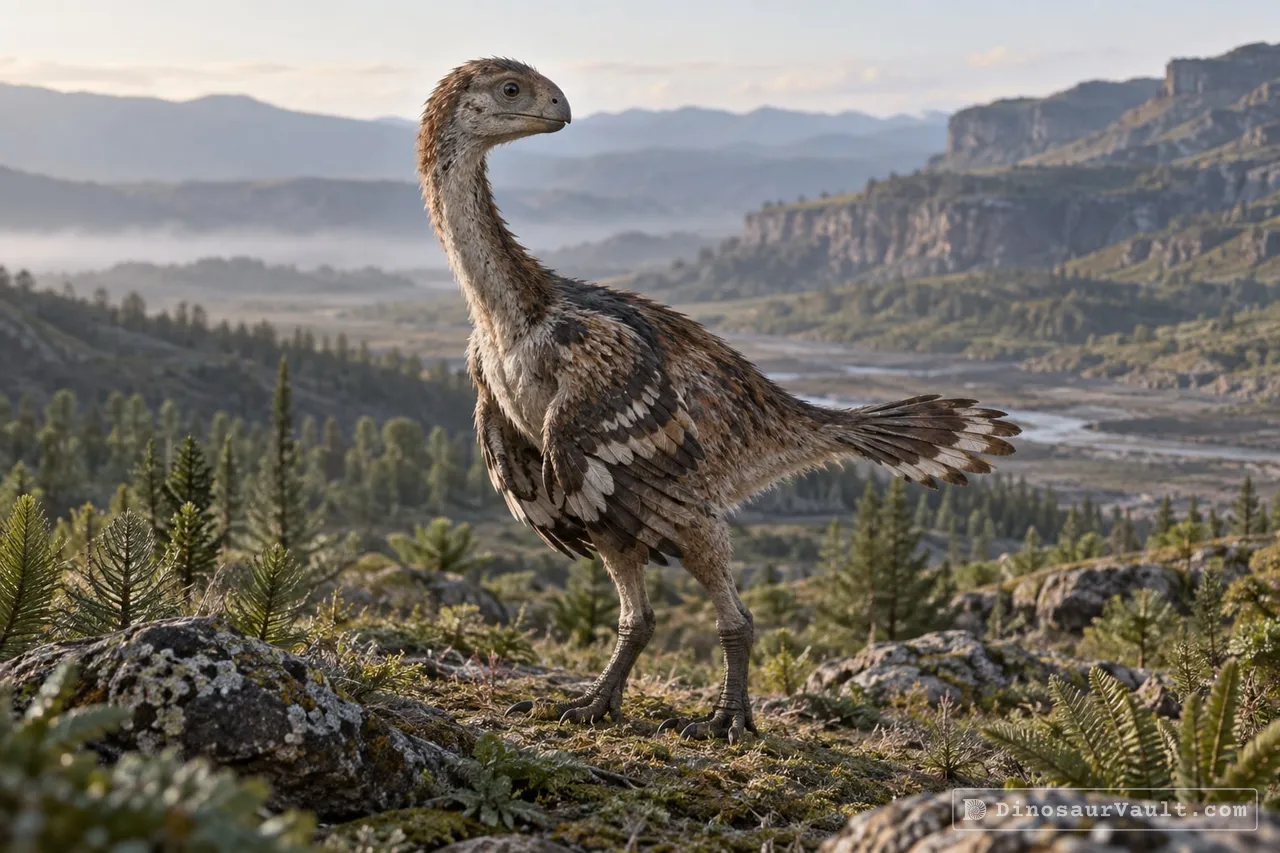
Yuanyanglong was a feathered, beaked dinosaur from the oviraptor group, known from two partial skeletons found together.
Its world
It lived in the Early Cretaceous in what is now northern China. Its bones come from the Miaogou Formation, where it shared the land with the hunter Shaochilong and the armored Gobisaurus.
How it was found
Hao and colleagues named Yuanyanglong in 2025. The two skeletons found side by side gave it the name "lovebird dragon".
Field gallery
More views of Yuanyanglong
Scenes reconstructed from the available fossil evidence.
Lived alongside
Found in the same rock formations


A rock formation can hold fossils laid down millions of years apart, so not every animal here met Yuanyanglong.
The evidence
The science behind Yuanyanglong
Which parts of the picture come from its own bones, and which come from its relatives.
From its own fossils
- Two partial skeletons were buried together in the same block of rock.
- The legs have unusually long lower sections and fused ankle bones, while the hip bone has a very short rear extension.
- Stomach stones were preserved inside the body.
Borrowed from relatives
- Feathers are restored by comparison with Caudipteryx and Protarchaeopteryx, which preserve feathers around their bodies, arms and tails.
Still unknown
- Its feather colors and patterns.
- Whether it regularly waded in shallow water.
- Exactly what it ate.
Discovery timeline
- 1998Close relativeQiang et al.
- 2006How it fedWings & Sander
- 2025Named itHao et al.
Key papers
The research behind what we know of Yuanyanglong
Close relative
Described Caudipteryx and Protarchaeopteryx with preserved feathers, providing a basis for restoring feathers in related oviraptorosaurs.
Two feathered dinosaurs from northeastern China. Nature 393: 753-761
Read the paper : Two feathered dinosaurs from northeastern China (opens in a new tab)How it fed
Compared stomach stones in birds and dinosaurs, supporting a food-grinding role for the stone clusters preserved in Caudipteryx.
No gastric mill in sauropod dinosaurs: new evidence from analysis of gastrolith mass and function in ostriches. Proceedings of the Royal Society B: Biological Sciences 274: 635-640
Read the paper : No gastric mill in sauropod dinosaurs: new evidence from analysis of gastrolith mass and function in ostriches (opens in a new tab)Named it
Described the paired skeletons, unusual hips and long lower legs, and stomach stones that may have helped grind food.
A new oviraptorosaur from the Lower Cretaceous Miaogou Formation of western Inner Mongolia, China. Cretaceous Research 167: 106023
Read the paper : A new oviraptorosaur from the Lower Cretaceous Miaogou Formation of western Inner Mongolia, China (opens in a new tab)
Close relatives
Other members of Oviraptorosauria


Sources: Wikidata