Pneumatoraptor
"air thief"
- Lived
- 86 to 84 million years ago, Late Cretaceous
- Diet
- Carnivore
- Group
- Theropods
- Found in
- Hungary
- Named by
- Osi et al. 2010
Where its fossils were found
The evidence
Today

Habitat
A slow-moving river crossed a broad floodplain in what is now Hungary. Hungarosaurus and Ajkaceratops lived in the same region.
Field notes
About Pneumatoraptor
What it was like
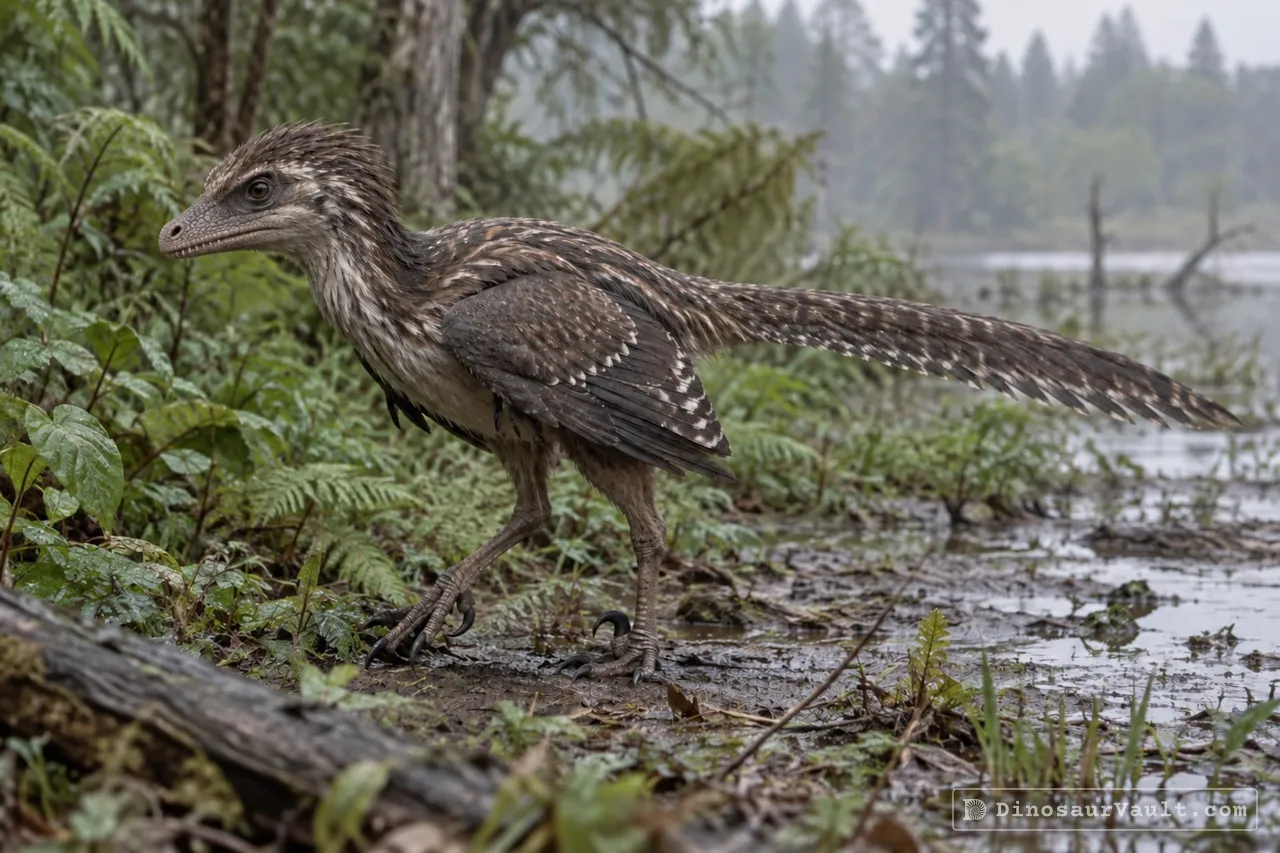
Pneumatoraptor was a small feathered predator, perhaps a relative of the raptors. It is known only from a shoulder bone, which has an opening for an air sac.
Its world
It lived about 86 to 84 million years ago, in the Late Cretaceous, in what is now Hungary. Europe was then a chain of islands. Its bone comes from the Csehbánya Formation, where the armored Hungarosaurus, the small plant eater Mochlodon and the tiny horned Ajkaceratops also lived.
How it was found
Osi and colleagues named it in 2010 from one find.
Field gallery
More views of Pneumatoraptor
Scenes reconstructed from the available fossil evidence.
Lived alongside
Found in the same rock formations


A rock formation can hold fossils laid down millions of years apart, so not every animal here met Pneumatoraptor.
The evidence
The science behind Pneumatoraptor
Which parts of the picture come from its own bones, and which come from its relatives.
From its own fossils
- The named specimen is a left shoulder blade joined to the bone beneath it.
- A large opening connects to a hollow space inside the narrow shoulder blade.
Borrowed from relatives
- The missing head, limbs and tail are restored by comparison with small birdlike theropods such as Sinornithosaurus.
- A feathered covering probably followed that of other birdlike theropods.
Still unknown
- Whether isolated hand and leg bones from the same site belong to Pneumatoraptor.
- Its precise place among raptors and other birdlike dinosaurs.
- Its feather colors and body proportions.
Discovery timeline
- 2010Named itŐsi, Apesteguía & Kowalewski
- 2011New findŐsi & Buffetaut
- 2015Its worldBotfalvai, Ősi & Mindszenty
Key papers
The research behind what we know of Pneumatoraptor
Named it
Named Pneumatoraptor from a small shoulder bone with a distinctive opening into an internal air space.
Non-avian theropod dinosaurs from the early Late Cretaceous of central Europe. Cretaceous Research 31: 304-320
Read the paper : Non-avian theropod dinosaurs from the early Late Cretaceous of central Europe (opens in a new tab)New find
Described isolated hand and lower-leg bones that may belong to Pneumatoraptor, alongside other theropod and bird remains.
Additional non-avian theropod and bird remains from the early Late Cretaceous (Santonian) of Hungary and a review of the European abelisauroid record. Annales de Paléontologie 97: 35-49
Read the paper : Additional non-avian theropod and bird remains from the early Late Cretaceous (Santonian) of Hungary and a review of the European abelisauroid record (opens in a new tab)Its world
Reconstructed a low-gradient river and floodplain, explaining how the local vertebrate bones accumulated and were buried.
Taphonomic and paleoecologic investigations of the Late Cretaceous (Santonian) Iharkút vertebrate assemblage (Bakony Mts, Northwestern Hungary). Palaeogeography, Palaeoclimatology, Palaeoecology 417: 379-405
Read the paper : Taphonomic and paleoecologic investigations of the Late Cretaceous (Santonian) Iharkút vertebrate assemblage (Bakony Mts, Northwestern Hungary) (opens in a new tab)
Close relatives
Other members of Paraves


Sources: Wikidata