Hungarosaurus
"Hungarian lizard"
- Lived
- 86 to 84 million years ago, Late Cretaceous
- Diet
- Herbivore
- Group
- Ankylosaurs, Nodosauridae
- Found in
- Hungary
- Named by
- Osi 2005
Where its fossils were found
The evidence
Today

Habitat
River floodplains on an island in what is now Hungary. Other dinosaurs from the Csehbánya Formation include Mochlodon, Pneumatoraptor and Ajkaceratops.
Field notes
About Hungarosaurus
What it was like
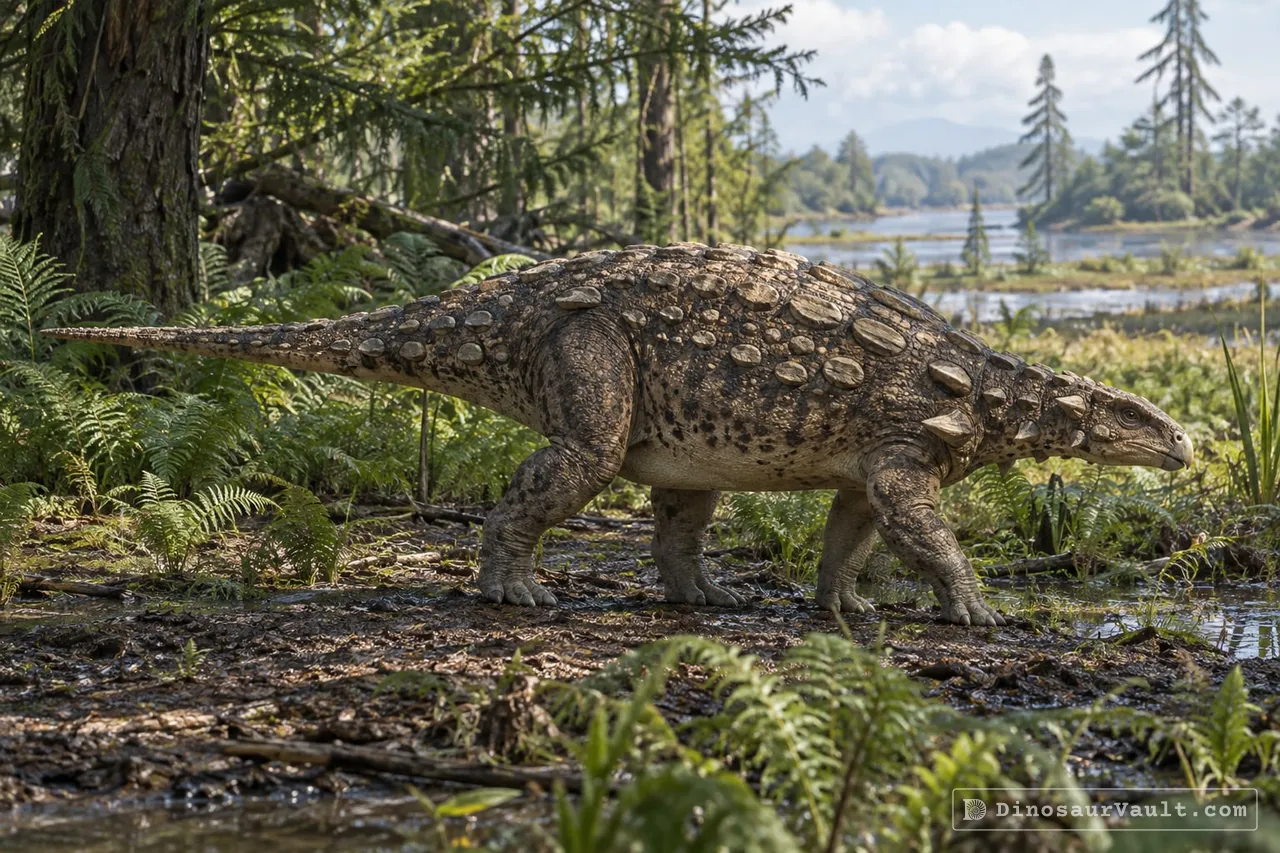
Hungarosaurus was a nodosaur, an armored plant eater without a tail club. Several partial skeletons are known. Its brain case suggests a slightly larger brain than in most ankylosaurs.
Its world
It lived about 86 to 84 million years ago, in the Late Cretaceous, in what is now Hungary. It lived on an island with the small plant eater Mochlodon and the small horned dinosaur Ajkaceratops.
How it was found
Osi named Hungarosaurus in 2005. It is one of the best known dinosaurs from Hungary.
Field gallery
More views of Hungarosaurus
Scenes reconstructed from the available fossil evidence.
1 of 3
Lived alongside
Found in the same rock formations


A rock formation can hold fossils laid down millions of years apart, so not every animal here met Hungarosaurus.
The evidence
The science behind Hungarosaurus
Which parts of the picture come from its own bones, and which come from its relatives.
From its own fossils
- Several partial skeletons preserve skull bones and much of the body skeleton.
- The rough bumps and ridges on its head grew from the skull bones themselves.
- A braincase preserves the shape of an unusually enlarged region involved in coordinating movement.
Borrowed from relatives
- Missing parts of its armor arrangement are restored by comparison with other nodosaurs such as Sauropelta.
Still unknown
- Its color and the complete arrangement of its armor.
- Whether differences in head ornament also reflected sex or individual variation.
- How fast it could move.
Discovery timeline
- 2005Named itŐsi
- 2014SkullOsi, Pereda Suberbiola & Földes
- 2021Growing upŐsi et al.
Key papers
The research behind what we know of Hungarosaurus
Named it
Described several partial skeletons of a new nodosaur from Hungary and distinguished it from Struthiosaurus.
Hungarosaurus tormai, a new ankylosaur (Dinosauria) from the Upper Cretaceous of Hungary. Journal of Vertebrate Paleontology 25: 370-383
Read the paper : Hungarosaurus tormai, a new ankylosaur (Dinosauria) from the Upper Cretaceous of Hungary (opens in a new tab)Skull
Described a partial skull and brain cavity, suggesting unusually developed coordination of posture and movement.
Partial skull and endocranial cast of the ankylosaurian dinosaur Hungarosaurus from the Late Cretaceous of Hungary: implications for locomotion. Palaeontologia Electronica
Read the paper : Partial skull and endocranial cast of the ankylosaurian dinosaur Hungarosaurus from the Late Cretaceous of Hungary: implications for locomotion (opens in a new tab)Growing up
Compared skulls of different sizes and showed that head ornament grew from skull bones and changed during growth.
Cranial ornamentation in the Late Cretaceous nodosaurid ankylosaur Hungarosaurus. PeerJ 9: e11010
Read the paper : Cranial ornamentation in the Late Cretaceous nodosaurid ankylosaur Hungarosaurus (opens in a new tab)
Close relatives
Other members of Nodosauridae


Sources: Wikidata