Ajkaceratops
- Lived
- 86 to 84 million years ago, Late Cretaceous
- Diet
- Herbivore
- Group
- Ceratopsians
- Found in
- Hungary
- Named by
- Osi et al. 2010
Where its fossils were found
The evidence
Today

Habitat
It lived on an island in the chain that covered much of Europe. Hungarosaurus and Pneumatoraptor are known from the same rocks in Hungary.
Field notes
About Ajkaceratops
What it was like
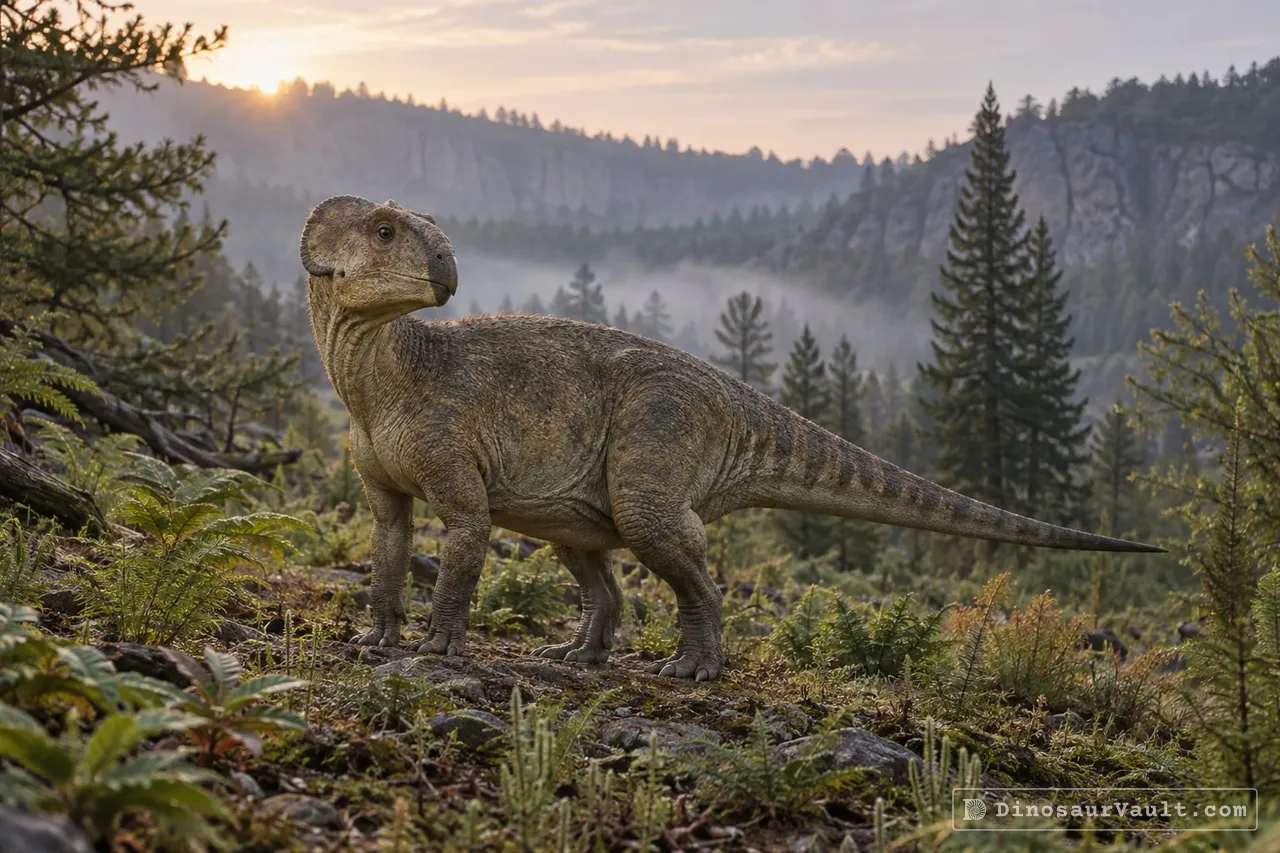
Ajkaceratops was a small horned dinosaur known from part of a skull. It had a parrot-like beak. It is the first horned dinosaur named from Europe.
Its world
It lived about 86 to 84 million years ago, in the Late Cretaceous, in what is now Hungary. It lived on an island with the armored Hungarosaurus. A later study proposed that the Mochlodon species found there belongs to Ajkaceratops. The naming study linked Ajkaceratops to Asian horned dinosaurs, suggesting its ancestors crossed between islands.
How it was found
Osi and colleagues named Ajkaceratops in 2010.
Field gallery
More views of Ajkaceratops
Scenes reconstructed from the available fossil evidence.
Lived alongside
Found in the same rock formations


A rock formation can hold fossils laid down millions of years apart, so not every animal here met Ajkaceratops.
The evidence
The science behind Ajkaceratops
Which parts of the picture come from its own bones, and which come from its relatives.
From its own fossils
- The type preserves a hooked upper jaw tip with a rounded cross-section. Separately found bones from the front of the lower jaw were referred to it.
- A later study of a more complete upper skull, referred to it, concluded that it belongs among the horned dinosaurs.
Borrowed from relatives
- The naming study compared the missing parts of its skull with another horned dinosaur.
Still unknown
- The shape and proportions of its body, and the back of its skull, including any frill.
- Its skin covering and color.
- How it grew from a hatchling to an adult.
Discovery timeline
- 2010Named itŐsi, Butler & Weishampel
- 2024RedescriptionCzepiński & Madzia
- 2026New findMaidment et al.
Key papers
The research behind what we know of Ajkaceratops
Named it
Named a small beaked dinosaur from jaw fragments in Hungary and compared it with horned dinosaurs from Asia.
A Late Cretaceous ceratopsian dinosaur from Europe with Asian affinities. Nature 465: 466-468
Read the paper : A Late Cretaceous ceratopsian dinosaur from Europe with Asian affinities (opens in a new tab)Redescription
Restudied the jaw fragments and questioned whether their unusual anatomy securely identified a horned dinosaur.
Osteology, phylogenetic affinities, and palaeobiogeographic significance of the bizarre ornithischian dinosaur Ajkaceratops kozmai from the Late Cretaceous European archipelago. Zoological Journal of the Linnean Society 202
Read the paper : Osteology, phylogenetic affinities, and palaeobiogeographic significance of the bizarre ornithischian dinosaur Ajkaceratops kozmai from the Late Cretaceous European archipelago (opens in a new tab)New find
New skull material and family-tree analyses supported Ajkaceratops as a horned dinosaur and revealed overlooked horned dinosaurs in Europe.
A hidden diversity of ceratopsian dinosaurs in Late Cretaceous Europe. Nature 651: 397-403
Read the paper : A hidden diversity of ceratopsian dinosaurs in Late Cretaceous Europe (opens in a new tab)
Close relatives
Other members of Ceratopsia


Sources: Wikidata