Plesiohadros
"near hadrosaurs"
- Lived
- 86 to 72 million years ago, Late Cretaceous
- Diet
- Herbivore
- Group
- Ornithopods
- Found in
- Mongolia
- Named by
- Tsogtbaatar et al. 2014
Where its fossils were found
The evidence
Today

80 million years ago
Habitat
Sandy rivers split into channels across a floodplain with temporary lakes in the Alagteeg Formation. Its neighbors included the armored Pinacosaurus and the long-necked Abdarainurus.
Field notes
About Plesiohadros
What it was like
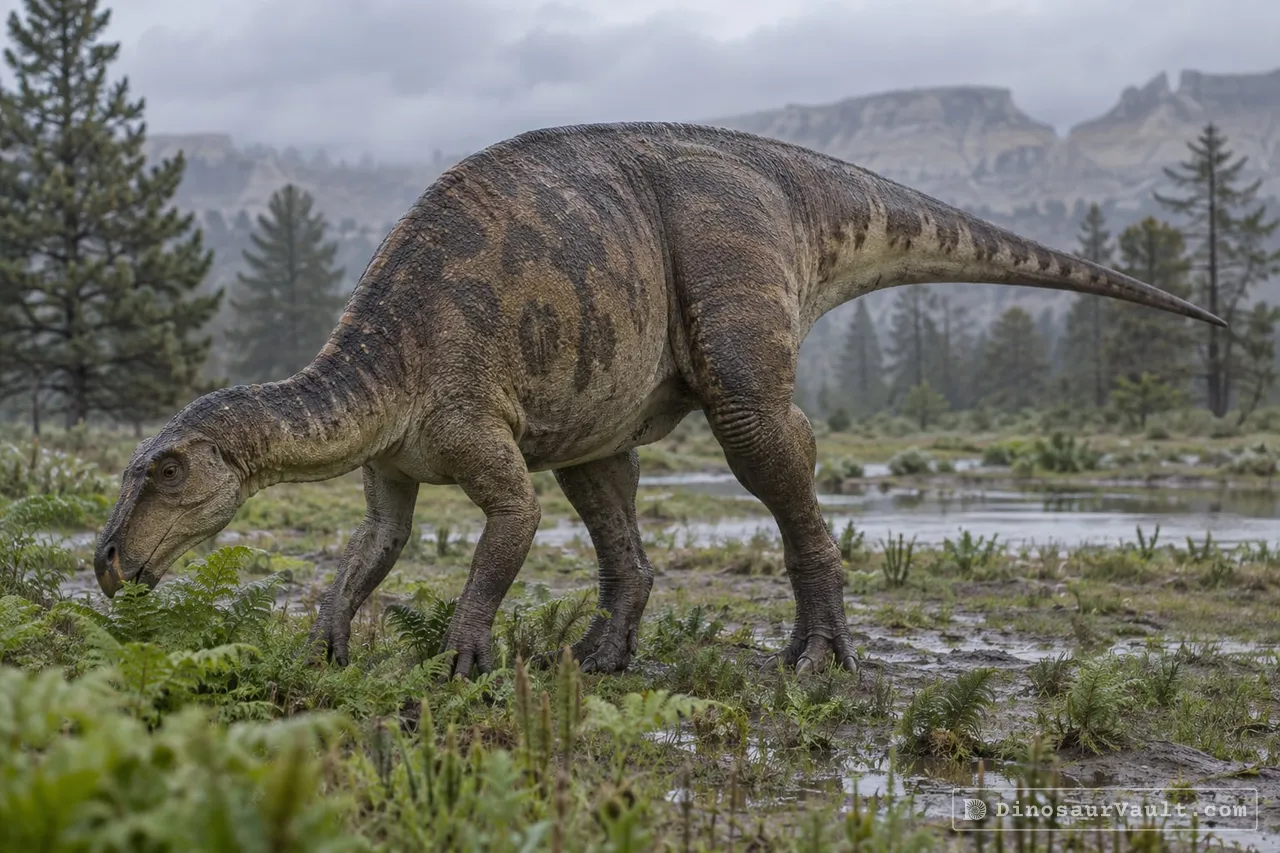
Plesiohadros was a plant eater, an early relative of the duck-billed dinosaurs, known from a partial skeleton with a skull.
Its world
It lived in the Late Cretaceous in what is now southern Mongolia. Its bones come from the Alagteeg Formation, where it shared the land with the armored Pinacosaurus and the long-necked Abdarainurus.
How it was found
Tsogtbaatar and colleagues named Plesiohadros in 2014, from a single find.
Field gallery
More views of Plesiohadros
Scenes reconstructed from the available fossil evidence.
Lived alongside
Found in the same rock formations


A rock formation can hold fossils laid down millions of years apart, so not every animal here met Plesiohadros.
The evidence
The science behind Plesiohadros
Which parts of the picture come from its own bones, and which come from its relatives.
From its own fossils
- The type skeleton preserves a partial skull, jaws, the first neck vertebra, throat bones and hand bones. A separate foot was referred to Plesiohadros from the same locality.
- The front of the lower jaw was broad, supporting a wide beak; the toothless front of the jaw bends downward. The upper beak bones have an outward-turned rim.
- A bone at the upper front of the eye socket flares outward into a rough, winglike rim.
Borrowed from relatives
- Gobihadros provides comparisons for the missing connections around the nostrils and eye sockets, and for the neck.
Still unknown
- Its complete body proportions and finger anatomy. A later family-tree study treated the thumb as lost, but the original hand description says it was not preserved.
- Its skin texture and color.
- How its young differed from adults.
Discovery timeline
- 2009Its worldHasegawa et al.
- 2014Named itTsogtbaatar et al.
- 2015Same rocksBurns, Tumanova & Currie
- 2019Family treeTsogtbaatar et al.
Key papers
The research behind what we know of Plesiohadros
Its world
Distinguished the river and floodplain deposits of the Alagteeg Formation from the drier dune deposits above them.
Lithostratigraphy and depositional environments of the Upper Cretaceous Djadokhta Formation, Ulan Nuur basin, southern Mongolia, and its paleoclimatic implication. Journal of Asian Earth Sciences 35: 13-26
Read the paper : Lithostratigraphy and depositional environments of the Upper Cretaceous Djadokhta Formation, Ulan Nuur basin, southern Mongolia, and its paleoclimatic implication (opens in a new tab)Named it
Named Plesiohadros from an associated partial skull and skeleton, and referred a separate foot from the same locality.
A new hadrosaurid (Plesiohadros djadokhtaensis) from the Late Cretaceous Djadokhtan Fauna of southern Mongolia. Hadrosaurs.
No link available
Same rocks
Studied young Pinacosaurus from the same formation and showed that their forelimbs became sturdier as they grew.
Postcrania of juvenilePinacosaurus grangeri(Ornithischia: Ankylosauria) from the Upper Cretaceous Alagteeg Formation, Alag Teeg, Mongolia: implications for ontogenetic allometry in ankylosaurs. Journal of Paleontology 89: 168-182
Read the paper : Postcrania of juvenilePinacosaurus grangeri(Ornithischia: Ankylosauria) from the Upper Cretaceous Alagteeg Formation, Alag Teeg, Mongolia: implications for ontogenetic allometry in ankylosaurs (opens in a new tab)Family tree
Compared Gobihadros with other duck-bill relatives and kept Plesiohadros in a poorly resolved group of advanced hadrosauroids.
A new hadrosauroid (Dinosauria: Ornithopoda) from the Late Cretaceous Baynshire Formation of the Gobi Desert (Mongolia). PLOS ONE 14: e0208480
Read the paper : A new hadrosauroid (Dinosauria: Ornithopoda) from the Late Cretaceous Baynshire Formation of the Gobi Desert (Mongolia) (opens in a new tab)
Close relatives
Other members of Hadrosauroidea


Sources: Wikidata