Abdarainurus
"Abdrant Nuru tail"
Type species Abdarainurus barsboldi
- Lived
- 86 to 72 million years ago, Late Cretaceous
- Diet
- Herbivore
- Group
- Sauropods
- Found in
- Mongolia
- Named by
- Averianov and Lopatin 2020
Where its fossils were found
The evidence
Today

80 million years ago
Habitat
Sandy rivers crossed floodplains with temporary lakes in what is now Mongolia. The Alagteeg Formation also preserves Pinacosaurus and Plesiohadros.
Field notes
About Abdarainurus
What it was like
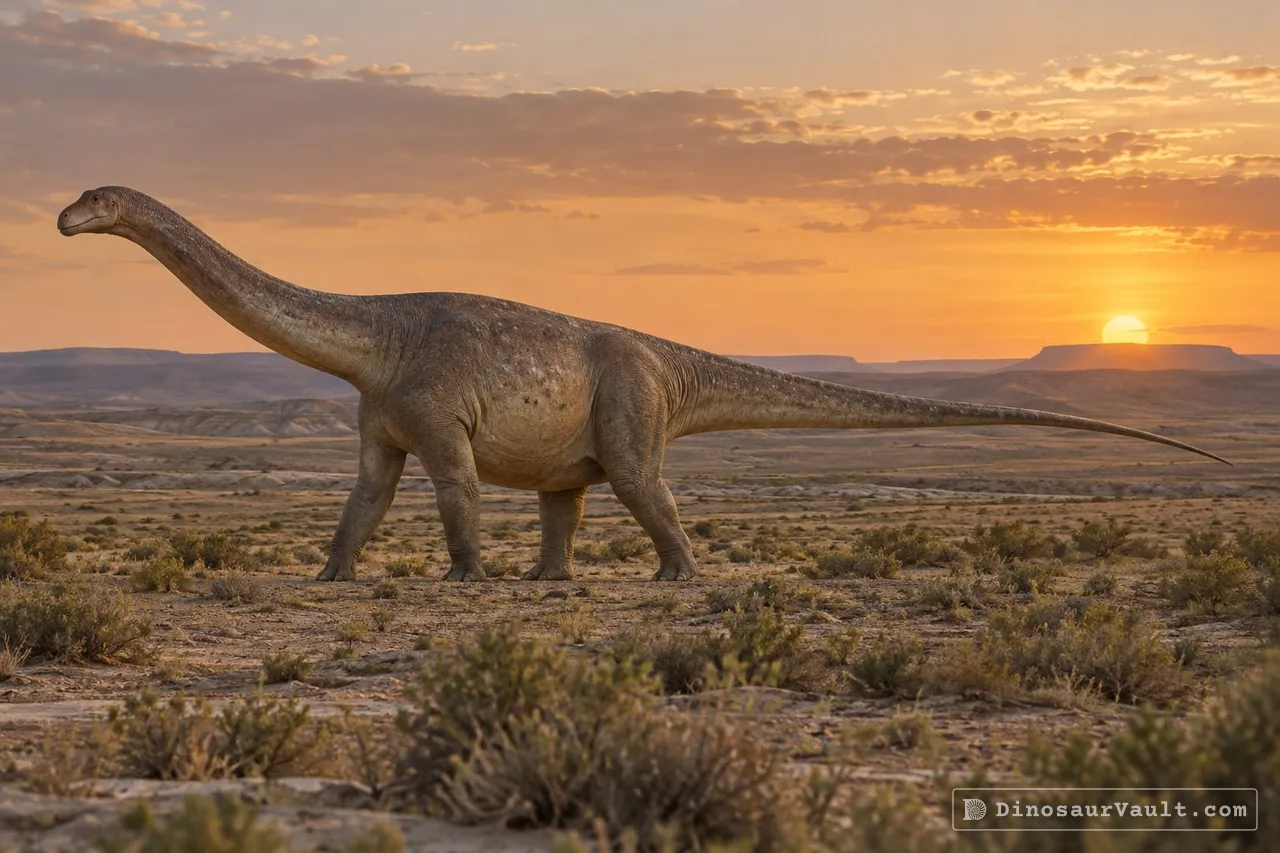
Abdarainurus was a long-necked plant eater known only from part of its tail. Its tail bones have an unusual shape, which suggests it came from a line of sauropods not seen elsewhere in Asia.
Its world
It lived in the Late Cretaceous in what is now Mongolia. Its bones come from the Alagteeg Formation, where it shared the land with the armored Pinacosaurus and the plant eater Plesiohadros.
How it was found
Averianov and Lopatin named Abdarainurus barsboldi in 2020, from a single find.
Field gallery
More views of Abdarainurus
Scenes reconstructed from the available fossil evidence.
1 of 3
Lived alongside
Found in the same rock formations


A rock formation can hold fossils laid down millions of years apart, so not every animal here met Abdarainurus.
The evidence
The science behind Abdarainurus
Which parts of the picture come from its own bones, and which come from its relatives.
From its own fossils
- Tail vertebrae and the bones hanging beneath the tail are its only known remains.
- The main bodies of its tail vertebrae have rounded front ends and hollow rear ends.
- The upper parts of the tail vertebrae have deep pockets and tall bony ridges.
Borrowed from relatives
- The missing head, long neck, trunk and limbs are restored by comparison with early titanosaurs such as Andesaurus and Gandititan.
Still unknown
- Its body size and overall proportions.
- Its skull shape, skin texture and color.
- Its exact position among the early titanosaurs.
Discovery timeline
- 2009Its worldHasegawa et al.
- 2020Named itAverianov & Lopatin
- 2024Family treeHan et al.
Key papers
The research behind what we know of Abdarainurus
Its world
Separated the river and floodplain deposits of the Alagteeg Formation from younger deposits formed among dunes.
Lithostratigraphy and depositional environments of the Upper Cretaceous Djadokhta Formation, Ulan Nuur basin, southern Mongolia, and its paleoclimatic implication. Journal of Asian Earth Sciences 35: 13-26
Read the paper : Lithostratigraphy and depositional environments of the Upper Cretaceous Djadokhta Formation, Ulan Nuur basin, southern Mongolia, and its paleoclimatic implication (opens in a new tab)Named it
Named Abdarainurus from unusually shaped tail bones and proposed that it belonged to a specialized Asian sauropod lineage.
An unusual new sauropod dinosaur from the Late Cretaceous of Mongolia. Journal of Systematic Palaeontology 18: 1009-1032
Read the paper : An unusual new sauropod dinosaur from the Late Cretaceous of Mongolia (opens in a new tab)Family tree
Placed Gandititan beside Abdarainurus in an early branch of the titanosaur family tree.
A new titanosaurian sauropod, Gandititan cavocaudatus gen. et sp. nov., from the Late Cretaceous of southern China. Journal of Systematic Palaeontology 22
Read the paper : A new titanosaurian sauropod, Gandititan cavocaudatus gen. et sp. nov., from the Late Cretaceous of southern China (opens in a new tab)
Close relatives
Other members of Titanosauria


Sources: Wikidata