Phuwiangosaurus
"Phu Wiang lizard"
- Lived
- 126 to 121 million years ago, Early Cretaceous
- Diet
- Herbivore
- Group
- Sauropods, Euhelopodidae
- Found in
- Thailand
- Named by
- Martin et al. 1994
Where its fossils were found
The evidence
Today

125 million years ago
Habitat
A floodplain crossed by large winding rivers, with freshwater lakes between them. Siamotyrannus, Phuwiangvenator and Kinnareemimus lived in the same region.
Field notes
About Phuwiangosaurus
What it was like
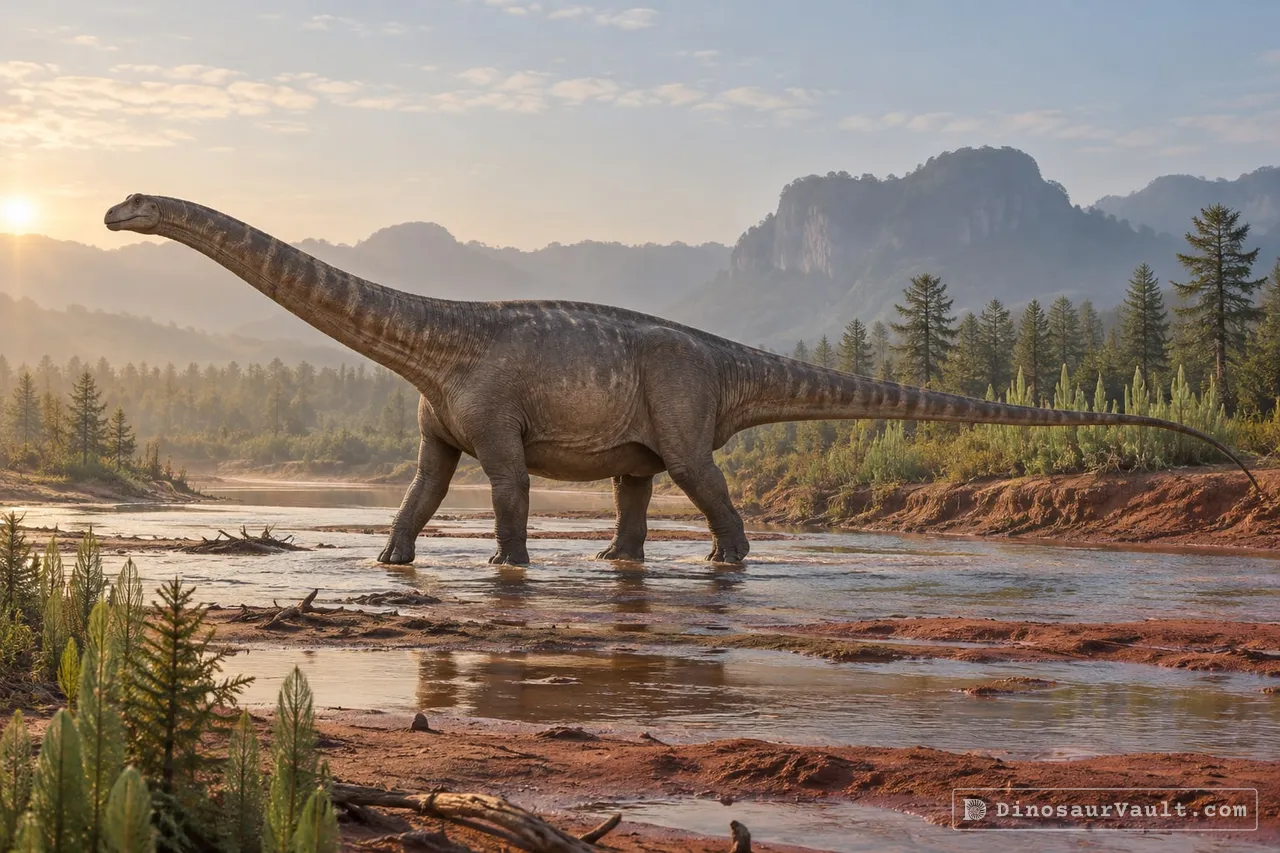
Phuwiangosaurus was a long-necked, four-legged plant eater, a relative of Euhelopus from China. It had a long neck with wide, flat backbones.
Its world
It lived in the Early Cretaceous in what is now Thailand. Its bones come from the Sao Khua Formation, where it shared the land with the hunters Siamotyrannus and Phuwiangvenator and the ostrich-like Kinnareemimus.
How it was found
Martin and colleagues named Phuwiangosaurus in 1994, honoring a princess of Thailand in its species name. With 12 finds, including young and adult animals, it is the best known dinosaur from Thailand.
Field gallery
More views of Phuwiangosaurus
Scenes reconstructed from the available fossil evidence.
Lived alongside
Found in the same rock formations


A rock formation can hold fossils laid down millions of years apart, so not every animal here met Phuwiangosaurus.
The evidence
The science behind Phuwiangosaurus
Which parts of the picture come from its own bones, and which come from its relatives.
From its own fossils
- Associated skeletons preserve neck and back vertebrae, shoulder blades, limb bones and parts of the pelvis.
- A more complete skeleton includes bones from the back of the skull and a tooth.
- Long shoulder blades and elongated bony spines on the rear back vertebrae help identify it.
Borrowed from relatives
- Euhelopus provides a comparison for the missing front of the head.
- Brachiosaurus and Rapetosaurus help restore the supporting hands and curved claws of the hind feet.
Still unknown
- The complete shape of its snout and the arrangement of its toes.
- Exactly where it belongs within the titanosauriform family tree.
- Its skin covering and color.
Discovery timeline
- 1994Named itMartin, Buffetaut & Suteethorn
- 2009New findSuteethorn et al.
- 2013SkullPoropat & Kear
Key papers
The research behind what we know of Phuwiangosaurus
Named it
Named a long-necked plant eater from an incomplete skeleton found in Thailand.
A new genus of sauropod dinosaur from the Sao Khua Formation (Late Jurassic or Early Cretaceous) of northeastern Thailand. Compte Rendus de l'Academie des Sciences, Paris, série IIa 319: 1085-1092
No link available
New find
Described a more complete skeleton with skull bones, expanding the known anatomy beyond the original body skeleton.
A new skeleton of Phuwiangosaurus sirindhornae (Dinosauria, Sauropoda) from NE Thailand. Geological Society, London, Special Publications 315: 189-215
Read the paper : A new skeleton of Phuwiangosaurus sirindhornae (Dinosauria, Sauropoda) from NE Thailand (opens in a new tab)Skull
Detailed the skull of Euhelopus, providing a comparison for the missing front of the Phuwiangosaurus head.
Photographic Atlas and Three-Dimensional Reconstruction of the Holotype Skull of Euhelopus zdanskyi with Description of Additional Cranial Elements. PLoS ONE 8: e79932
Read the paper : Photographic Atlas and Three-Dimensional Reconstruction of the Holotype Skull of Euhelopus zdanskyi with Description of Additional Cranial Elements (opens in a new tab)
Close relatives
Other members of Euhelopodidae


Sources: Wikidata