Tambatitanis
"Tamba titan"
- Lived
- 113 to 110 million years ago, Early Cretaceous
- Diet
- Herbivore
- Group
- Sauropods, Euhelopodidae
- Found in
- Japan
- Named by
- Saegusa and Ikeda 2014
Where its fossils were found
The evidence
Today

110 million years ago
Habitat
It lived in a river landscape in what is now Japan. Sasayamagnomus and Hypnovenator also lived in the region recorded by the Ohyamashimo Formation.
Field notes
About Tambatitanis
What it was like
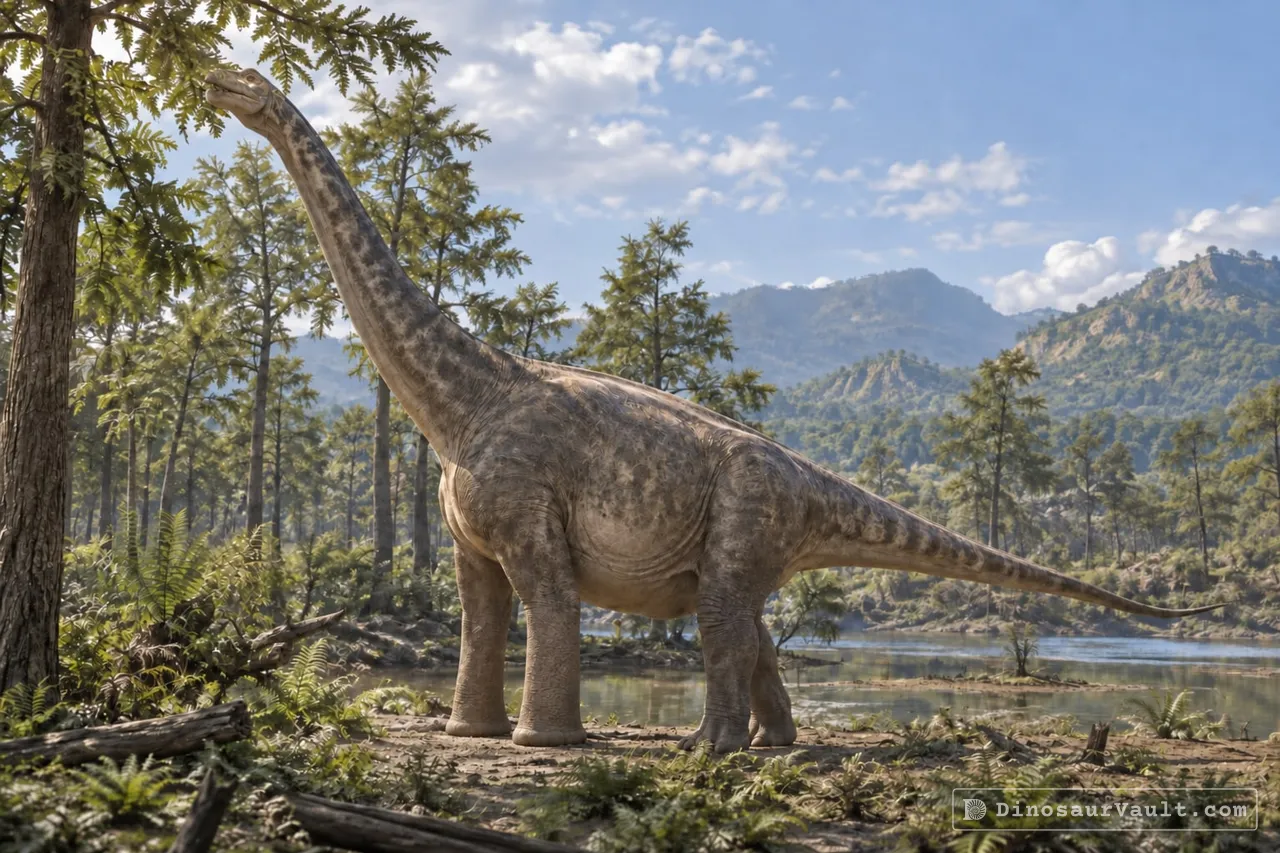
Tambatitanis was a long-necked sauropod known from a partial skeleton, including backbones, ribs, hips and parts of the skull. It was related to Euhelopus.
Its world
It lived about 113 to 110 million years ago, in the Early Cretaceous, in what is now Japan. Its bones come from the Ohyamashimo Formation, where the small horned Sasayamagnomus also lived.
How it was found
Saegusa and Ikeda named it in 2014. Its bones were found by two amateur collectors.
Field gallery
More views of Tambatitanis
Scenes reconstructed from the available fossil evidence.
Lived alongside
Found in the same rock formations


A rock formation can hold fossils laid down millions of years apart, so not every animal here met Tambatitanis.
The evidence
The science behind Tambatitanis
Which parts of the picture come from its own bones, and which come from its relatives.
From its own fossils
- A partial skeleton preserves parts of the skull, backbones, ribs and hips.
- The front tail backbones have strongly curved, bow-shaped spines with rounded tops.
- The bones hanging beneath the front of the tail are unusually long.
Borrowed from relatives
- Missing parts of its body are restored from other titanosauriform sauropods, including comparisons with Euhelopus.
Still unknown
- The complete shape and length of its neck.
- Its exact position among titanosauriform sauropods.
- Its skin texture and color.
Discovery timeline
- 2014Named itSAEGUSA & IKEDA
- 2024Same rocksTanaka et al.
Key papers
The research behind what we know of Tambatitanis
Named it
Described Tambatitanis from a partial skeleton with distinctive tail backbones, bones beneath the tail and a braincase.
A new titanosauriform sauropod (Dinosauria: Saurischia) from the Lower Cretaceous of Hyogo, Japan. Zootaxa 3848
Read the paper : A new titanosauriform sauropod (Dinosauria: Saurischia) from the Lower Cretaceous of Hyogo, Japan (opens in a new tab)Same rocks
Described Sasayamagnomus, a small relative of horned dinosaurs from the same formation as Tambatitanis.
A new neoceratopsian (Ornithischia, Ceratopsia) from the Lower Cretaceous Ohyamashimo Formation (Albian), southwestern Japan. Papers in Palaeontology 10
Read the paper : A new neoceratopsian (Ornithischia, Ceratopsia) from the Lower Cretaceous Ohyamashimo Formation (Albian), southwestern Japan (opens in a new tab)
Close relatives
Other members of Euhelopodidae


Sources: Wikidata