Phuwiangvenator
"Phu Wiang hunter"
- Lived
- 126 to 121 million years ago, Early Cretaceous
- Diet
- Carnivore
- Group
- Theropods
- Found in
- Thailand
- Named by
- Samathi et al. 2019
Where its fossils were found
The evidence
Today

125 million years ago
Habitat
A floodplain with winding rivers and freshwater lakes. Phuwiangosaurus, Siamotyrannus and Kinnareemimus lived in the same region.
Field notes
About Phuwiangvenator
What it was like
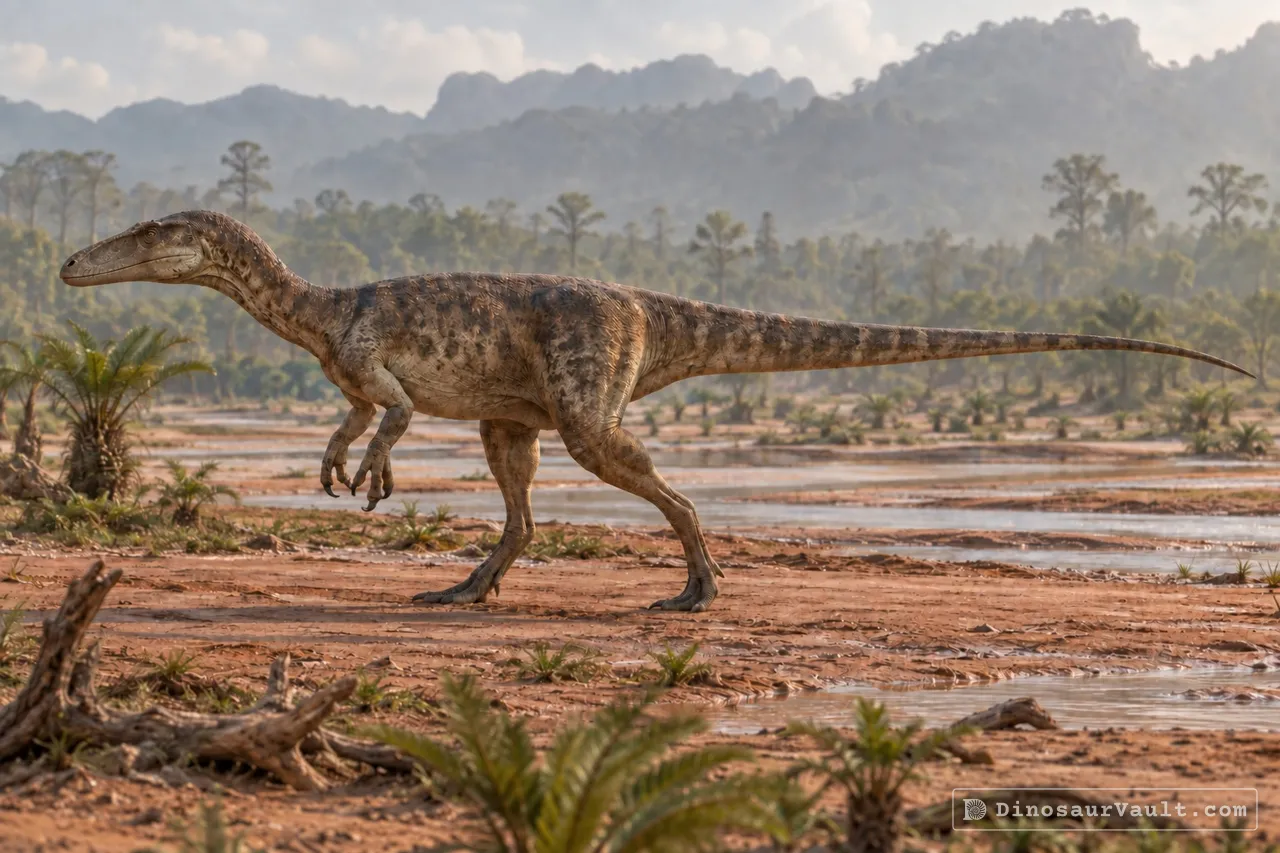
Phuwiangvenator was a medium-sized meat eater from the megaraptors, a group of hunters with big claws on their hands. It is known from parts of the backbone, hips, legs and feet.
Its long, slender legs suggest it was a fast runner.
Its world
It lived in the Early Cretaceous in what is now Thailand. Its bones come from the Sao Khua Formation, where it shared the land with the hunter Siamotyrannus, the long-necked Phuwiangosaurus and the ostrich-like Kinnareemimus.
How it was found
Samathi and colleagues named Phuwiangvenator in 2019, from two finds. It is one of the oldest known megaraptors.
Field gallery
More views of Phuwiangvenator
Scenes reconstructed from the available fossil evidence.
1 of 3
Lived alongside
Found in the same rock formations


A rock formation can hold fossils laid down millions of years apart, so not every animal here met Phuwiangvenator.
The evidence
The science behind Phuwiangvenator
Which parts of the picture come from its own bones, and which come from its relatives.
From its own fossils
- Its partial skeleton includes vertebrae, hand bones, lower legs and parts of the feet.
- The thumb claw was substantial, the next claw was also large, and the outer hand claw was much smaller.
- Additional foot bones show a relatively short central metatarsal, unlike those of more specialized megaraptorans.
Borrowed from relatives
- Murusraptor provides a comparison for a long, low head.
- Australovenator helps restore missing hand segments and claw tips, with inward-facing palms.
Still unknown
- The shape of its skull and the proportions of its complete body.
- Its skin covering and color.
- How it used its large hand claws.
Often drawn wrong
- Its large claws belonged on the hands, rather than forming the raised sickle toe of a dromaeosaur.
- Its thumb claw should not be enlarged to match the more extreme claws of Megaraptor.
Discovery timeline
- 2016Close relativeCoria & Currie
- 2019Named itSamathi, Chanthasit & Sander
- 2022New findSamathi et al.
Key papers
The research behind what we know of Phuwiangvenator
Close relative
Described Murusraptor, whose partial skull provides a comparison for the missing head of Phuwiangvenator.
A New Megaraptoran Dinosaur (Dinosauria, Theropoda, Megaraptoridae) from the Late Cretaceous of Patagonia. PLOS ONE 11: e0157973
Read the paper : A New Megaraptoran Dinosaur (Dinosauria, Theropoda, Megaraptoridae) from the Late Cretaceous of Patagonia (opens in a new tab)Named it
Named Phuwiangvenator and Vayuraptor from partial skeletons, identifying Phuwiangvenator as an early member of the megaraptoran group.
Two new basal coelurosaurian theropod dinosaurs from the Early Cretaceous Sao Khua Formation of Thailand. Acta Palaeontologica Polonica 64
Read the paper : Two new basal coelurosaurian theropod dinosaurs from the Early Cretaceous Sao Khua Formation of Thailand (opens in a new tab)New find
Added lower-leg and foot bones to the known skeleton and clarified its early position in megaraptoran evolution.
New material of Phuwiangvenator yaemniyomi (Dinosauria: Theropoda) from the type locality: Implications for the early evolution of Megaraptora. Cretaceous Research 131: 105093
Read the paper : New material of Phuwiangvenator yaemniyomi (Dinosauria: Theropoda) from the type locality: Implications for the early evolution of Megaraptora (opens in a new tab)
Close relatives
Other members of Megaraptora


Sources: Wikidata