Euhelopus
yoo-HEL-oh-pus
"good marsh foot"
- Lived
- 143 to 133 million years ago, Early Cretaceous
- Diet
- Herbivore
- Length
- about 10 m (33 ft)
- Group
- Sauropods, Euhelopodidae
- Found in
- China
- Named by
- Romer 1956
Size comparison
To scale


Scale in metersOutline: typical sauropod shape
Where its fossils were found
The evidence
Today

140 million years ago
Habitat
The Mengyin Formation preserves rivers and lakes in what is now China, with fish and freshwater turtles.
Field notes
About Euhelopus
What it was like
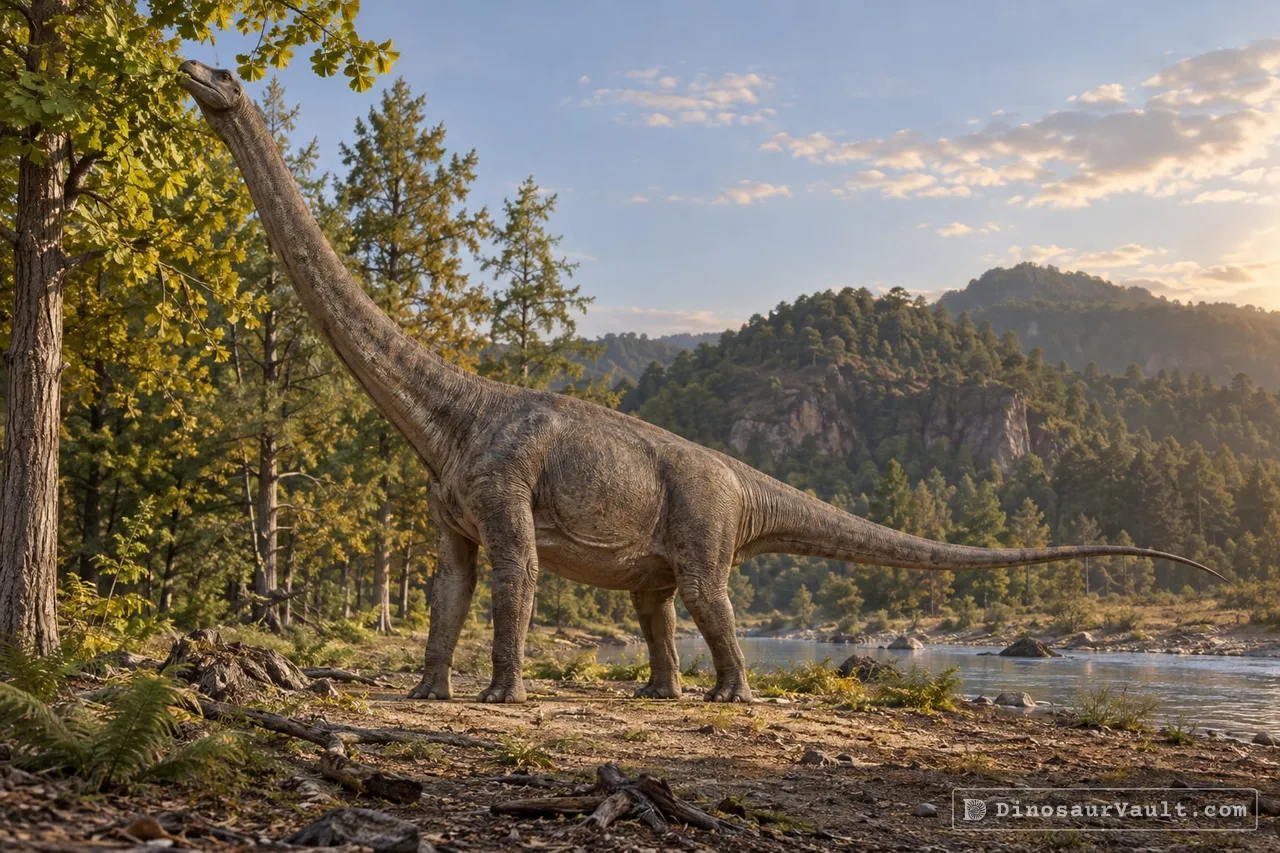
Euhelopus was a long-necked sauropod about 10 meters (33 feet) long. Its front legs were longer than its back legs, so its back sloped down from the shoulders, a little like a giraffe. Its neck was very long, with many bones.
Its world
It lived about 143 to 133 million years ago, in the Early Cretaceous, in what is now China. Its bones come from the Mengyin Formation.
How it was found
It was first given a different name, which turned out to be taken by another animal, and Romer renamed it Euhelopus in 1956. It was the first sauropod studied scientifically from China.
Field gallery
More views of Euhelopus
Scenes reconstructed from the available fossil evidence.
1 of 3
The evidence
The science behind Euhelopus
Which parts of the picture come from its own bones, and which come from its relatives.
From its own fossils
- Skull bones preserve broad teeth with thickened edges and worn chewing surfaces.
- The long neck has vertebrae hollowed by air spaces and long ribs running beneath it.
- Air spaces extend through the backbone into the hip bones.
Borrowed from relatives
- Its skull and much of its body are known from its own bones; restorations fill missing parts by comparison with other sauropods such as Erketu.
Still unknown
- Its skin color and pattern.
- Exactly how high it usually held its head.
- Which plants made up most of its diet.
Discovery timeline
- 1956Named itRomer
- 2009Full descriptionWilson & Upchurch
- 2010PostureChristian
- 2013SkullPoropat & Kear
Key papers
The research behind what we know of Euhelopus
Named it
Introduced Euhelopus as a replacement for an earlier name that was already taken.
Osteology of the Reptiles, University of Chicago Press.
No link available
Full description
Restudied the skull and body bones and placed Euhelopus close to titanosaurs rather than the long-necked Jurassic sauropods of China.
Redescription and reassessment of the phylogenetic affinities of euhelopus zdanskyi (Dinosauria: Sauropoda) from the early cretaceous of China. Journal of Systematic Palaeontology 7: 199-239
Read the paper : Redescription and reassessment of the phylogenetic affinities of euhelopus zdanskyi (Dinosauria: Sauropoda) from the early cretaceous of China (opens in a new tab)Posture
Calculated stresses along the neck and found support for an inclined posture and feeding high above the ground.
Some sauropods raised their necks—evidence for high browsing in Euhelopus zdanskyi. Biology Letters 6: 823-825
Read the paper : Some sauropods raised their necks—evidence for high browsing in Euhelopus zdanskyi (opens in a new tab)Skull
Used scans to rebuild the skull and described additional bones, revealing teeth suited to cropping tough vegetation.
Photographic Atlas and Three-Dimensional Reconstruction of the Holotype Skull of Euhelopus zdanskyi with Description of Additional Cranial Elements. PLoS ONE 8: e79932
Read the paper : Photographic Atlas and Three-Dimensional Reconstruction of the Holotype Skull of Euhelopus zdanskyi with Description of Additional Cranial Elements (opens in a new tab)
Close relatives
Other members of Euhelopodidae


Sources: Wikidata