Tangvayosaurus
"Tang Vay lizard"
- Lived
- 121 to 101 million years ago, Early Cretaceous
- Diet
- Herbivore
- Group
- Sauropods, Euhelopodidae
- Found in
- Laos
- Named by
- Allain et al. 1999
Where its fossils were found
The evidence
Today

110 million years ago
Habitat
Its bones were buried in red mud and silt on a river floodplain in what is now Laos. Other dinosaurs recorded from these rocks include Ichthyovenator and Mandschurosaurus.
Field notes
About Tangvayosaurus
What it was like
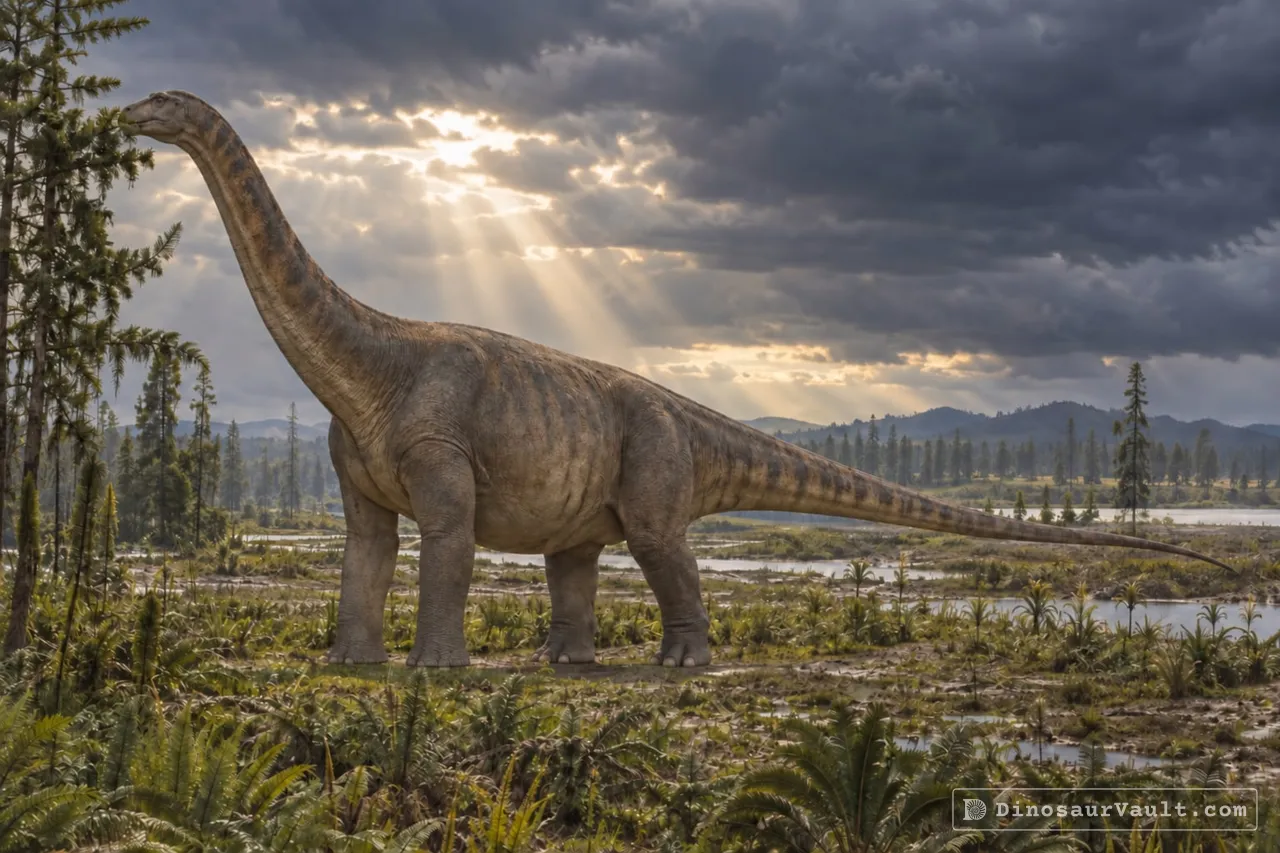
Tangvayosaurus was a long-necked sauropod known from part of the hips, backbone and limbs. It was related to Euhelopus and Phuwiangosaurus.
Its world
It lived in the Early Cretaceous, in what is now Laos. It comes from the Grès supérieurs Formation, where the spinosaur Ichthyovenator has also been found.
How it was found
Allain and colleagues named Tangvayosaurus in 1999.
Field gallery
More views of Tangvayosaurus
Scenes reconstructed from the available fossil evidence.
Lived alongside
Found in the same rock formations

A rock formation can hold fossils laid down millions of years apart, so not every animal here met Tangvayosaurus.
The evidence
The science behind Tangvayosaurus
Which parts of the picture come from its own bones, and which come from its relatives.
From its own fossils
- Partial skeletons preserve hip bones, back and tail vertebrae, ribs and parts of the limbs.
- Its thigh bone bends inward near the hip, and its tail vertebrae have hollowed ends on both sides.
Borrowed from relatives
- The missing head and much of the neck are restored using related sauropods such as Euhelopus and Phuwiangosaurus.
Still unknown
- The shape of its skull and teeth.
- The full length and posture of its neck.
- Its skin texture and color.
Discovery timeline
- 1999Named itAllain et al.
- 2012Family treeD'EMIC
- 2013Family treeMannion et al.
Key papers
The research behind what we know of Tangvayosaurus
Named it
Named Tangvayosaurus from partial skeletons and compared its hip and limb bones with Phuwiangosaurus.
Un nouveau genre de dinosaure sauropode de la formation des Grès supérieurs (Aptien-Albien) du Laos. Comptes Rendus de l'Académie des Sciences - Series IIA - Earth and Planetary Science 329: 609-616
Read the paper : Un nouveau genre de dinosaure sauropode de la formation des Grès supérieurs (Aptien-Albien) du Laos (opens in a new tab)Family tree
Placed Tangvayosaurus in an Asian sauropod family with Euhelopus and Phuwiangosaurus, separate from titanosaurs.
The early evolution of titanosauriform sauropod dinosaurs. Zoological Journal of the Linnean Society 166: 624-671
Read the paper : The early evolution of titanosauriform sauropod dinosaurs (opens in a new tab)Family tree
Compared Tangvayosaurus with other early titanosauriforms and found that its closest relatives changed with different ways of analyzing the bones.
Osteology of the Late Jurassic Portuguese sauropod dinosaurLusotitan atalaiensis(Macronaria) and the evolutionary history of basal titanosauriforms. Zoological Journal of the Linnean Society 168: 98-206
Read the paper : Osteology of the Late Jurassic Portuguese sauropod dinosaurLusotitan atalaiensis(Macronaria) and the evolutionary history of basal titanosauriforms (opens in a new tab)
Close relatives
Other members of Euhelopodidae


Sources: Wikidata