Vayuraptor
"wind thief"
- Lived
- 126 to 121 million years ago, Early Cretaceous
- Diet
- Carnivore
- Group
- Theropods
- Found in
- Thailand
- Named by
- Samathi et al. 2019
Where its fossils were found
The evidence
Today

125 million years ago
Habitat
A floodplain crossed by winding rivers in the Sao Khua Formation of Thailand. Phuwiangosaurus, Siamotyrannus and Kinnareemimus also come from these rocks.
Field notes
About Vayuraptor
What it was like
Vayuraptor was a two-legged predator known from a lower leg and ankle. Its long shin suggests it was a fast runner. It may be related to the megaraptors, a group of predators with big hand claws.
Its world
It lived about 126 to 121 million years ago, in the Early Cretaceous, in what is now Thailand. Its bones come from the Sao Khua Formation, where it lived alongside the sauropod Phuwiangosaurus, the predator Siamotyrannus and the small ostrich-like Kinnareemimus.
How it was found
Samathi and colleagues named it in 2019 from one find.
Field gallery
More views of Vayuraptor
Scenes reconstructed from the available fossil evidence.
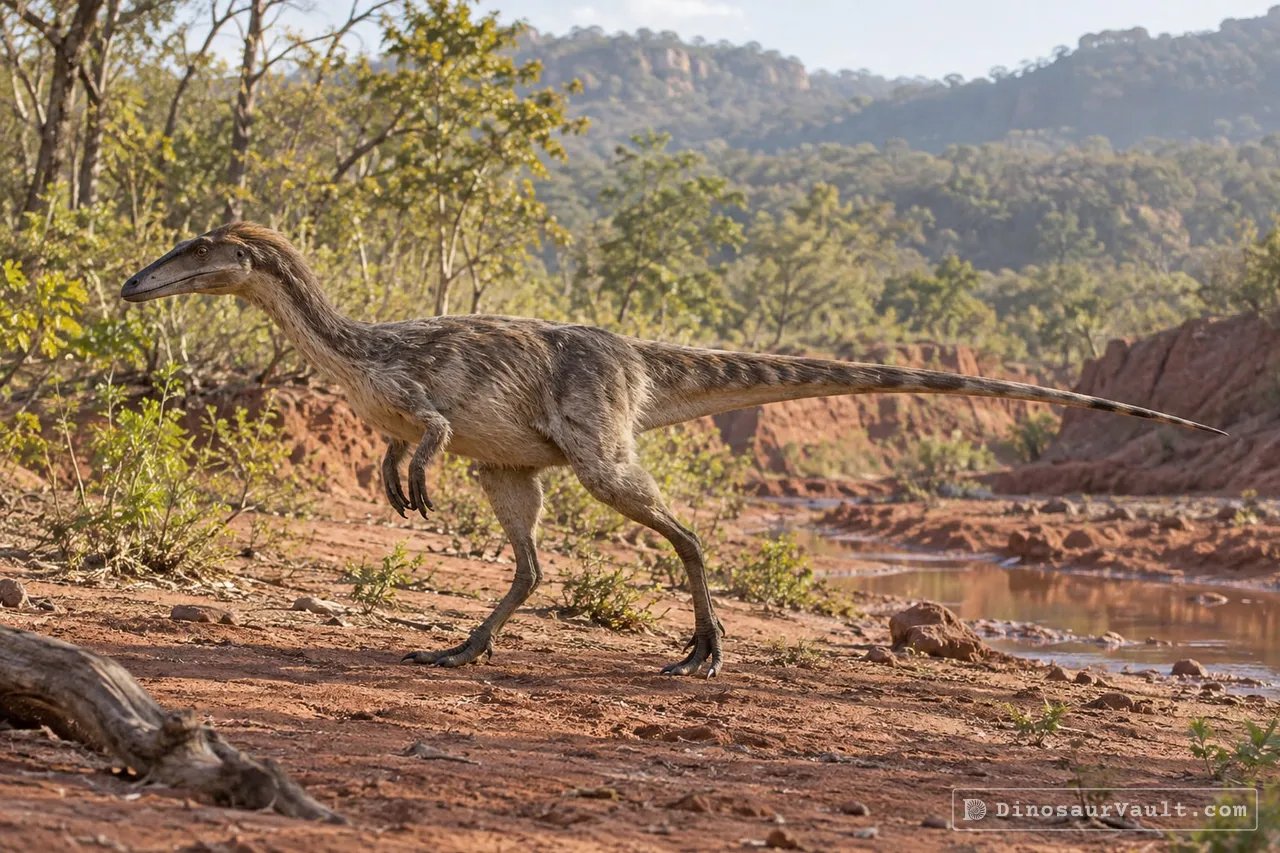
1 of 3
Lived alongside
Found in the same rock formations


A rock formation can hold fossils laid down millions of years apart, so not every animal here met Vayuraptor.
The evidence
The science behind Vayuraptor
Which parts of the picture come from its own bones, and which come from its relatives.
From its own fossils
- The original find includes a long, slender shinbone and its ankle bones.
- Other bones assigned to Vayuraptor include parts of the shoulder, a rib and finger and toe bones.
Borrowed from relatives
- The missing skull and most of the body are restored by comparison with other early coelurosaurs.
- Its ankle resembles those of Fukuiraptor and Australovenator, possible guides to its overall build.
Still unknown
- The shape of its skull and the size of its hand claws.
- Whether it belonged within the megaraptor group.
- Its skin covering and color.
Discovery timeline
- 2019Named itSamathi, Chanthasit & Sander
- 2019Its worldSamathi, Chanthasit & Sander
- 2024Fossil sitesSamathi et al.
Key papers
The research behind what we know of Vayuraptor
Named it
Named Vayuraptor and Phuwiangvenator from fragmentary skeletons and compared their limbs with those of other early coelurosaurs.
Two new basal coelurosaurian theropod dinosaurs from the Early Cretaceous Sao Khua Formation of Thailand. Acta Palaeontologica Polonica 64
Read the paper : Two new basal coelurosaurian theropod dinosaurs from the Early Cretaceous Sao Khua Formation of Thailand (opens in a new tab)Its world
Reviewed the region's predators and found broad similarities between Early Cretaceous theropods in Thailand, China and Japan.
A review of theropod dinosaurs from the Late Jurassic to mid-Cretaceous of Southeast Asia. Annales de Paléontologie 105: 201-215
Read the paper : A review of theropod dinosaurs from the Late Jurassic to mid-Cretaceous of Southeast Asia (opens in a new tab)Fossil sites
Reviewed dinosaur sites in the region where Vayuraptor was found, documenting diverse sauropods, predators and freshwater animals.
Dinosaur fauna from the Lower Cretaceous of Phu Kao-Phu Phan Kham, northeastern Thailand: a review and update. Palaeoworld 33: 420-438
Read the paper : Dinosaur fauna from the Lower Cretaceous of Phu Kao-Phu Phan Kham, northeastern Thailand: a review and update (opens in a new tab)
Close relatives
Other members of Megaraptora


Sources: Wikidata