Kinnareemimus
"Kinnaree mimic"
- Lived
- 126 to 121 million years ago, Early Cretaceous
- Diet
- Omnivore
- Group
- Theropods
- Found in
- Thailand
- Named by
- Buffetaut et al. 2009
Where its fossils were found
The evidence
Today

125 million years ago
Habitat
A floodplain crossed by rivers in what is now Thailand. Phuwiangosaurus, Siamotyrannus and Phuwiangvenator are also known from the Sao Khua Formation.
Field notes
About Kinnareemimus
What it was like
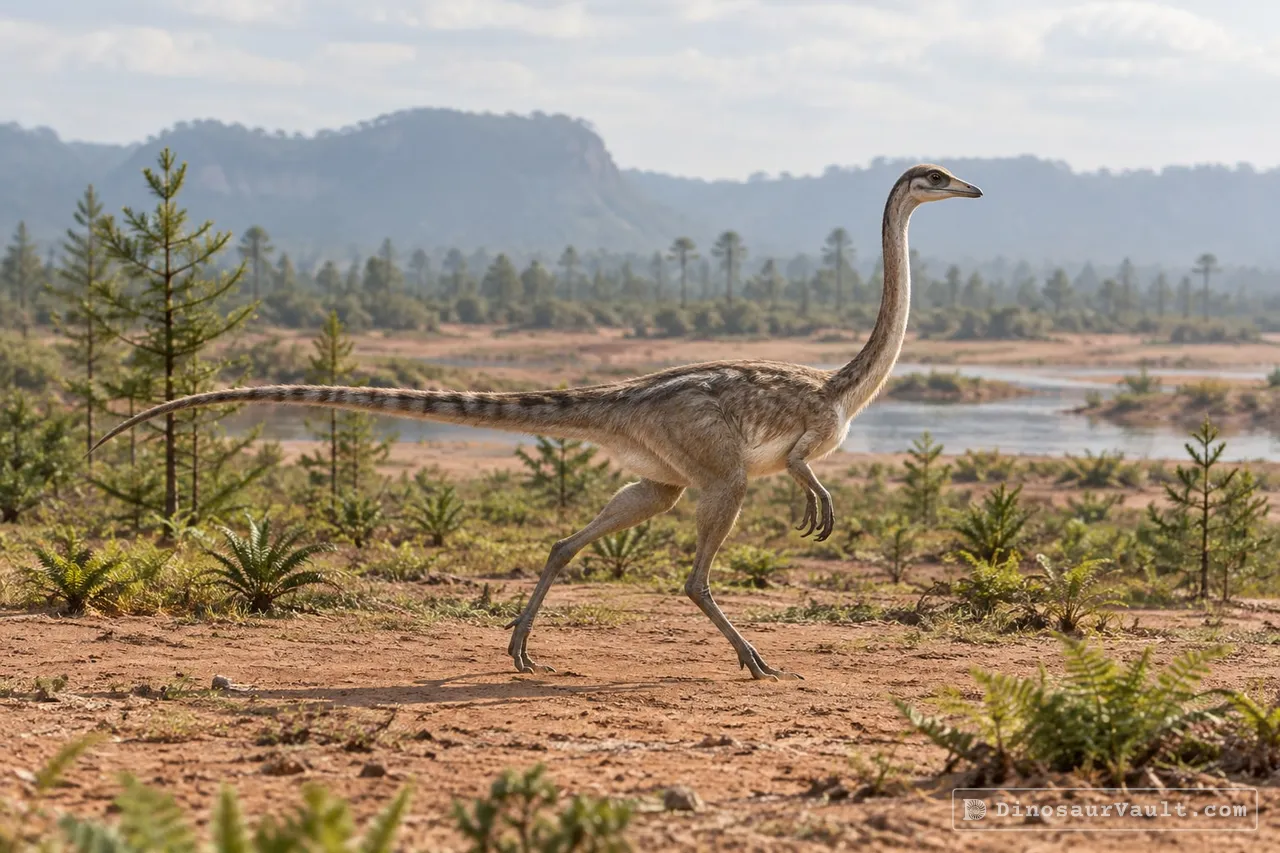
Kinnareemimus was an early ostrich-like dinosaur, known from a few bones including parts of the foot. It was small and light, with long feet suited to running.
Its world
It lived about 126 to 121 million years ago, in the Early Cretaceous, in what is now Thailand. Its bones come from the Sao Khua Formation, where it lived alongside the sauropod Phuwiangosaurus and the predator Siamotyrannus.
How it was found
Buffetaut and colleagues named it in 2009. Its name comes from a half-bird creature of local legend.
Field gallery
More views of Kinnareemimus
Scenes reconstructed from the available fossil evidence.
1 of 3
Lived alongside
Found in the same rock formations


A rock formation can hold fossils laid down millions of years apart, so not every animal here met Kinnareemimus.
The evidence
The science behind Kinnareemimus
Which parts of the picture come from its own bones, and which come from its relatives.
From its own fossils
- Scattered bones include vertebrae, parts of the pelvis, lower legs, foot bones and toes.
- The middle long bone of the foot narrows between its neighbors while remaining visible near the ankle.
- The shin and calf bones share features with the group that includes Deinocheirus.
Borrowed from relatives
- The missing head, arms and much of the body are restored by comparison with early ornithomimosaurs such as Harpymimus and Garudimimus.
Still unknown
- Whether it had teeth or a toothless beak.
- Its exact place among the ornithomimosaurs.
- Its body covering and color.
Discovery timeline
- 2009Named itBuffetaut, Suteethorn & Tong
- 2019Family treeHartman et al.
- 2024Family treeSAMATHI
Key papers
The research behind what we know of Kinnareemimus
Named it
Described scattered bones of a small ostrich-like dinosaur and identified an unusual narrowing of the middle foot bone.
An early 'ostrich dinosaur' (Theropoda: Ornithomimosauria) from the Early Cretaceous Sao Khua Formation of NE Thailand. Geological Society, London, Special Publications 315: 229-243
Read the paper : An early 'ostrich dinosaur' (Theropoda: Ornithomimosauria) from the Early Cretaceous Sao Khua Formation of NE Thailand (opens in a new tab)Family tree
A broad theropod analysis placed Kinnareemimus among tyrannosaur relatives, illustrating how its incomplete bones can yield different family trees.
A new paravian dinosaur from the Late Jurassic of North America supports a late acquisition of avian flight. PeerJ 7: e7247
Read the paper : A new paravian dinosaur from the Late Jurassic of North America supports a late acquisition of avian flight (opens in a new tab)Family tree
Recovered Kinnareemimus as an early ornithomimosaur or a member of the group containing Deinocheirus, depending on the analysis.
Phylogenetic position of Kinnareemimus khonkaenensis (Dinosauria: Theropoda: Ornithomimosauria) from the Lower Cretaceous of Thailand. Zootaxa 5448: 67-84
Read the paper : Phylogenetic position of Kinnareemimus khonkaenensis (Dinosauria: Theropoda: Ornithomimosauria) from the Lower Cretaceous of Thailand (opens in a new tab)
Close relatives
Other members of Ornithomimosauria


Sources: Wikidata