Tyrannotitan
tie-RAN-oh-TIE-tan
"tyrant titan"
- Lived
- 113 to 101 million years ago, Early Cretaceous
- Diet
- Carnivore
- Length
- about 13 m (43 ft)
- Group
- Theropods, Carcharodontosauridae
- Found in
- Argentina
- Named by
- Novas et al. 2005
Size comparison
To scale


Scale in metersOutline: typical theropod shape
Where its fossils were found
The evidence
Today

105 million years ago
Habitat
River floodplains formed part of the landscape recorded in the Cerro Barcino Formation. Neighbors included Patagotitan, Chubutisaurus and Genyodectes.
Field notes
About Tyrannotitan
What it was like
Tyrannotitan was one of the largest meat eaters of its time, about 13 meters (43 feet) long. It belonged to the same family as Giganotosaurus and Carcharodontosaurus, huge hunters with long skulls and blade-like teeth.
It is known from parts of the skull, backbone, hips and legs of two animals.
Its world
It lived in the Early Cretaceous in what is now Argentina. Its bones come from the Cerro Barcino Formation, where it shared the land with the giant titanosaur Patagotitan and the long-necked Chubutisaurus. Big plant eaters like these may have been its prey.
How it was found
Novas and colleagues named Tyrannotitan in 2005. Two finds are known.
Field gallery
More views of Tyrannotitan
Scenes reconstructed from the available fossil evidence.
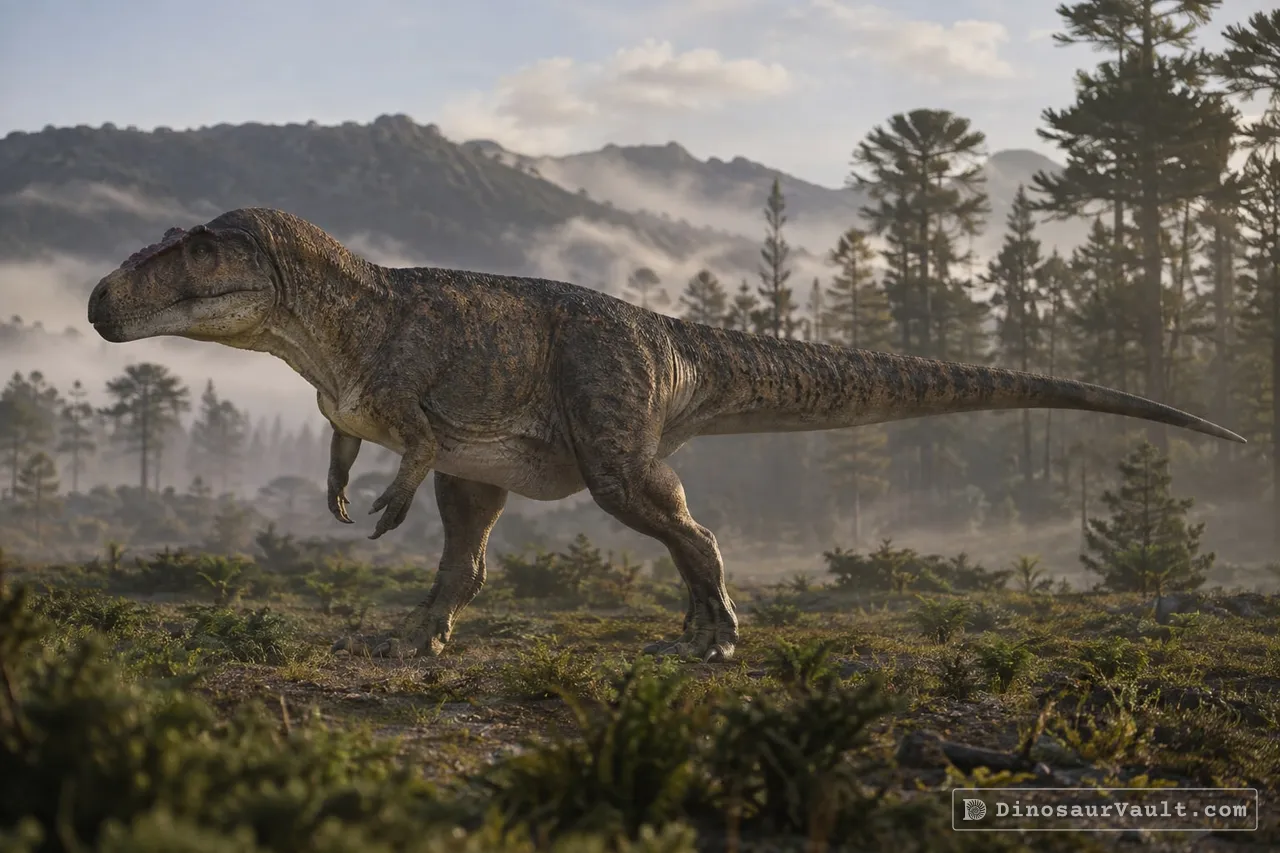
1 of 2
Lived alongside
Found in the same rock formations


A rock formation can hold fossils laid down millions of years apart, so not every animal here met Tyrannotitan.
The evidence
The science behind Tyrannotitan
Which parts of the picture come from its own bones, and which come from its relatives.
From its own fossils
- The type and a separate second skeleton preserve lower jaws, backbone, shoulder, arm, hip and leg bones.
- Teeth in its jaws and referred isolated teeth are flattened from side to side with serrated edges.
- Its thigh bones were robust. The type preserves only the lower half of an upper arm and a short, curved radius once identified as an ulna.
Borrowed from relatives
- Missing parts of the upper skull are compared with Meraxes, with the snout tip compared with Sinraptor.
- Its shoulder bones resemble those of Giganotosaurus and Mapusaurus.
Still unknown
- Its skin covering and color.
- Whether it hunted alone or in groups.
- The complete shape of its skull.
Discovery timeline
- 2005Named itNovas et al.
- 2014Full descriptionCanale, Novas & Pol
- 2017Same rocksCarballido et al.
- 2022Family treeCanale et al.
Key papers
The research behind what we know of Tyrannotitan
Named it
Named a giant meat eater from partial skeletons and placed it in the same family as Giganotosaurus and Carcharodontosaurus.
A large Cretaceous theropod from Patagonia, Argentina, and the evolution of carcharodontosaurids. Naturwissenschaften 92: 226-230
Read the paper : A large Cretaceous theropod from Patagonia, Argentina, and the evolution of carcharodontosaurids (opens in a new tab)Full description
Described the bones, corrected arm and foot bone identifications, and placed Tyrannotitan with Giganotosaurus and Mapusaurus in one family-tree analysis.
Osteology and phylogenetic relationships ofTyrannotitan chubutensisNovas, de Valais, Vickers-Rich and Rich, 2005 (Theropoda: Carcharodontosauridae) from the Lower Cretaceous of Patagonia, Argentina. Historical Biology 27: 1-32
Read the paper : Osteology and phylogenetic relationships ofTyrannotitan chubutensisNovas, de Valais, Vickers-Rich and Rich, 2005 (Theropoda: Carcharodontosauridae) from the Lower Cretaceous of Patagonia, Argentina (opens in a new tab)Same rocks
Named Patagotitan from the same formation and described its burial on a river floodplain.
A new giant titanosaur sheds light on body mass evolution among sauropod dinosaurs. Proceedings of the Royal Society B: Biological Sciences 284: 20171219
Read the paper : A new giant titanosaur sheds light on body mass evolution among sauropod dinosaurs (opens in a new tab)Family tree
The nearly complete arms of Meraxes showed how short forelimbs evolved among giant carcharodontosaurids.
New giant carnivorous dinosaur reveals convergent evolutionary trends in theropod arm reduction. Current Biology 32: 3195-3202.e5
Read the paper : New giant carnivorous dinosaur reveals convergent evolutionary trends in theropod arm reduction (opens in a new tab)
Close relatives
Other members of Carcharodontosauridae


Sources: Wikidata