Chubutisaurus
"Chubut lizard"
- Lived
- 120 to 110 million years ago, Early Cretaceous
- Diet
- Herbivore
- Length
- about 23 m (75 ft)
- Group
- Sauropods
- Found in
- Argentina
- Named by
- del Corro 1975
Size comparison
To scale


Scale in metersOutline: typical sauropod shape
Where its fossils were found
The evidence
Today

115 million years ago
Habitat
Winding rivers crossed a plain receiving volcanic ash. The Cerro Barcino Formation also preserves Patagotitan and Tyrannotitan.
Field notes
About Chubutisaurus
What it was like
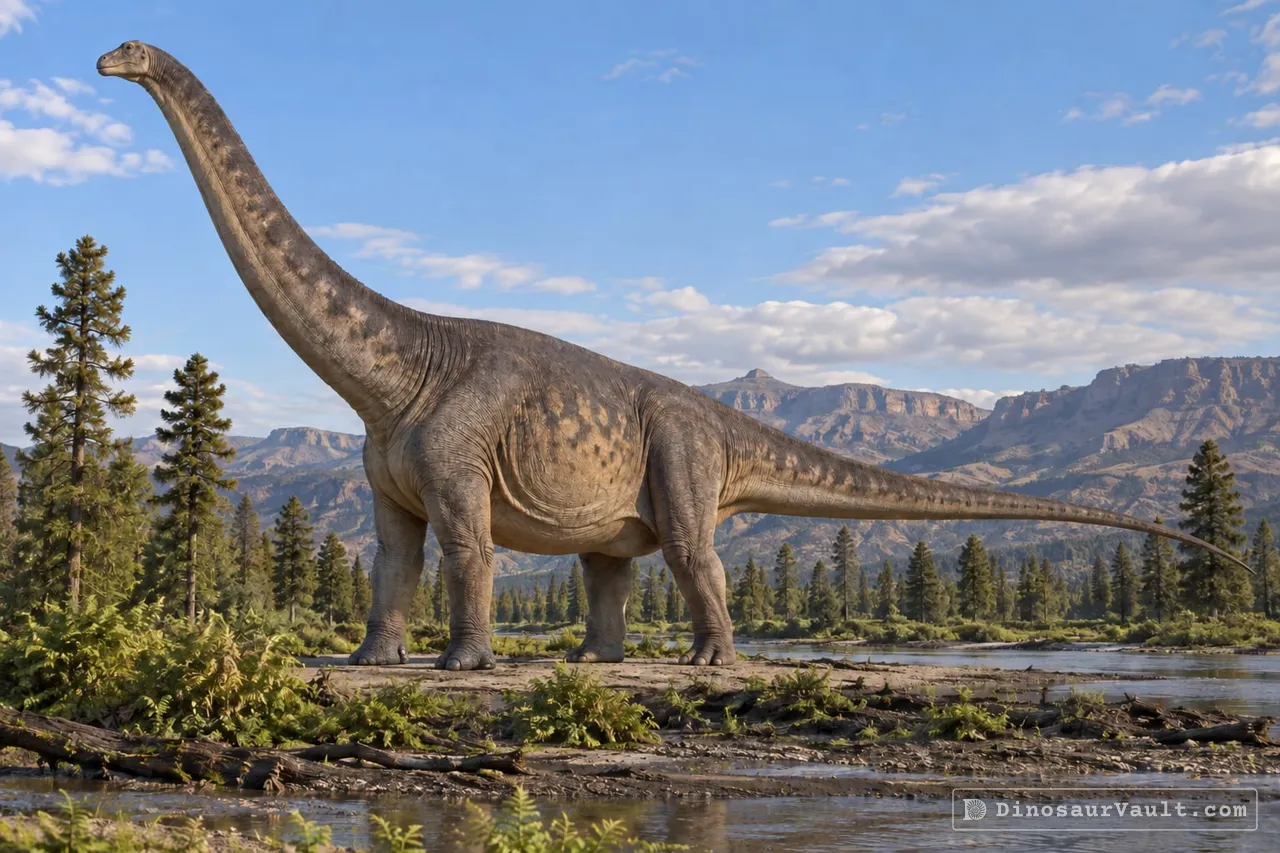
Chubutisaurus was a large long-necked plant eater, known from part of a skeleton. It may have reached about 23 meters (75 feet) long, though estimates vary.
It belonged to the same wide group of sauropods as the titanosaurs, but outside them.
Its world
It lived in the Cretaceous in what is now Argentina. Its bones come from the Cerro Barcino Formation, where it shared the land with the giant titanosaur Patagotitan and the big hunter Tyrannotitan.
How it was found
Del Corro named Chubutisaurus in 1975, from a single find. Teeth of a large hunter were found with the bones, so its body may have been scavenged.
Field gallery
More views of Chubutisaurus
Scenes reconstructed from the available fossil evidence.
1 of 2
Lived alongside
Found in the same rock formations


A rock formation can hold fossils laid down millions of years apart, so not every animal here met Chubutisaurus.
The evidence
The science behind Chubutisaurus
Which parts of the picture come from its own bones, and which come from its relatives.
From its own fossils
- A partial skeleton preserves back and tail vertebrae, ribs, shoulder blades, bones of the arm and hand, part of the hips, a thigh bone, a shin bone and a single foot bone. Bones collected later from the quarry are thought to be from the same animal, since none repeat and they match in size.
- Its upper arm bone and radius are slender while the ulna is robust, and its shin bone is straight.
- Deep cavities in the back vertebrae lightened the backbone, and the outer layer of its thigh bone shows that the animal had reached its full size.
Borrowed from relatives
- The missing head is restored after Euhelopus, and the neck, body, feet and end of the tail by comparison with Mnyamawamtuka.
- The hands follow the general sauropod hand known from Camarasaurus and Apatosaurus.
Still unknown
- The shape of its skull, the length of its neck and the shape of its feet. No skull or neck bones were found with the skeleton.
- Its skin texture and color.
- Whether its growth slowed during particular seasons.
Discovery timeline
- 1975Named itCorro
- 2011Full descriptionCarballido et al.
- 2020Fossil sitesKrause et al.
Key papers
The research behind what we know of Chubutisaurus
Named it
Named a large sauropod from vertebrae and limb bones found in Argentina.
Un nuevo sauropodo del Cretácico Superior. Actas del Primer Congreso Argentino de Paleontologia y Bioestratigrafia 2: 229-240
No link available
Full description
Described additional bones from the original skeleton, gave it a revised diagnosis and placed Chubutisaurus near the early branches leading to titanosaurs.
The osteology ofChubutisaurus insignisdel Corro, 1975 (Dinosauria: Neosauropoda) from the ‘middle’ Cretaceous of central Patagonia, Argentina. Journal of Vertebrate Paleontology 31: 93-110
Read the paper : The osteology ofChubutisaurus insignisdel Corro, 1975 (Dinosauria: Neosauropoda) from the ‘middle’ Cretaceous of central Patagonia, Argentina (opens in a new tab)Fossil sites
Dated volcanic rocks and traced river deposits to improve the ages and relationships of dinosaur-bearing layers in the Cerro Barcino Formation.
High-resolution chronostratigraphy of the Cerro Barcino Formation (Patagonia): Paleobiologic implications for the mid-cretaceous dinosaur-rich fauna of South America. Gondwana Research 80: 33-49
Read the paper : High-resolution chronostratigraphy of the Cerro Barcino Formation (Patagonia): Paleobiologic implications for the mid-cretaceous dinosaur-rich fauna of South America (opens in a new tab)
Close relatives
Other members of Somphospondyli


Sources: Wikidata