Genyodectes
"jaw biter"
- Lived
- 113 to 101 million years ago, Early Cretaceous
- Diet
- Carnivore
- Group
- Theropods
- Found in
- Argentina
- Named by
- Woodward 1901
Where its fossils were found
The evidence
Today

105 million years ago
Habitat
The Cerro Barcino Formation preserves river channels and floodplains with conifers, in a landscape that received volcanic ash. Patagotitan, Chubutisaurus and Tyrannotitan are also recorded from these rocks.
Field notes
About Genyodectes
What it was like
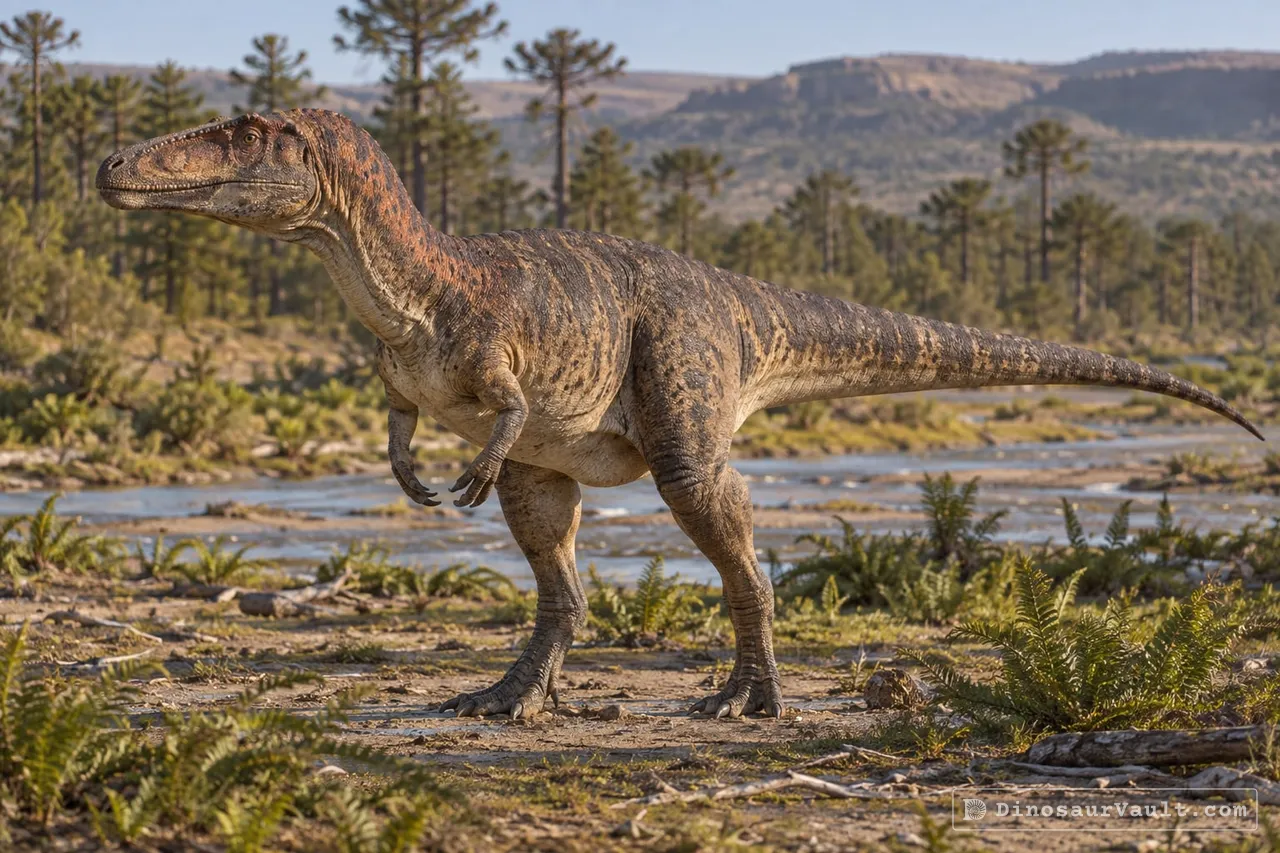
Genyodectes was a meat-eating dinosaur known from a snout and parts of the jaws, full of long, blade-like teeth. It seems to be a ceratosaur, perhaps close to Ceratosaurus.
Its world
It lived in the Early Cretaceous in what is now Argentina. Its bones come from the Cerro Barcino Formation, where the giant titanosaur Patagotitan and the predator Tyrannotitan also lived.
How it was found
Woodward named Genyodectes in 1901 from one poorly preserved find. It was one of the first dinosaurs named from Argentina.
Field gallery
More views of Genyodectes
Scenes reconstructed from the available fossil evidence.
1 of 3
Lived alongside
Found in the same rock formations


A rock formation can hold fossils laid down millions of years apart, so not every animal here met Genyodectes.
The evidence
The science behind Genyodectes
Which parts of the picture come from its own bones, and which come from its relatives.
From its own fossils
- Parts of the upper and lower jaws preserve a broad, strongly built snout.
- The upper jaw carried unusually large, blade-like teeth with flattened crowns.
Borrowed from relatives
- The teeth suggest a relationship with Ceratosaurus, which provides a model for the missing rear skull, limbs and tail.
- Short arms and inward-facing palms follow comparisons with other ceratosaurs.
Still unknown
- The shape of the back of its skull and whether it had horns.
- Its body size, limb proportions and skin covering.
- The precise age and original location of the jaw fossils.
Often drawn wrong
- Giving it the nose and brow horns of Ceratosaurus turns a comparison into an invented feature.
- Its huge teeth probably fitted beneath lips when its mouth was closed, rather than jutting out like saber teeth.
Discovery timeline
- 1901Named itWoodward
- 2004RedescriptionRauhut
- 2018Close relativeDal Sasso, Maganuco & Cau
Key papers
The research behind what we know of Genyodectes
Named it
Named Genyodectes from parts of the jaws bearing large teeth.
On some Extinct Reptiles from Patagonia, of the Genera Miolania, Dinilysia, and Genyodectes. Proceedings of the Zoological Society of London 70: 169-184
Read the paper : On some Extinct Reptiles from Patagonia, of the Genera Miolania, Dinilysia, and Genyodectes (opens in a new tab)Redescription
Restudied the jaws, supported Genyodectes as a distinct genus and found dental features suggesting a relationship with Ceratosaurus.
Provenance and anatomy ofGenyodectes serus, a large-toothed ceratosaur (Dinosauria: Theropoda) from Patagonia. Journal of Vertebrate Paleontology 24: 894-902
Read the paper : Provenance and anatomy ofGenyodectes serus, a large-toothed ceratosaur (Dinosauria: Theropoda) from Patagonia (opens in a new tab)Close relative
Described Saltriovenator and traced changes in ceratosaur hands, providing a comparison for the missing arms of Genyodectes.
The oldest ceratosaurian (Dinosauria: Theropoda), from the Lower Jurassic of Italy, sheds light on the evolution of the three-fingered hand of birds. PeerJ 6: e5976
Read the paper : The oldest ceratosaurian (Dinosauria: Theropoda), from the Lower Jurassic of Italy, sheds light on the evolution of the three-fingered hand of birds (opens in a new tab)
Close relatives
Other members of Ceratosauria


Sources: Wikidata