Nanshiungosaurus
"Nanxiong lizard"
Type species Nanshiungosaurus brevispinus
- Lived
- 101 to 66 million years ago, Late Cretaceous
- Diet
- Herbivore
- Length
- about 4.4 m (14 ft)
- Group
- Theropods, Therizinosauridae
- Found in
- China
- Named by
- Dong 1979
Size comparison
To scale

Scale in metersOutline: typical theropod shape
Where its fossils were found
The evidence
Today

80 million years ago
Habitat
It lived in southern China, in a landscape recorded by red mudstone and siltstone. Other dinosaurs from southern China include Shixinggia and Qianzhousaurus.
Field notes
About Nanshiungosaurus
What it was like
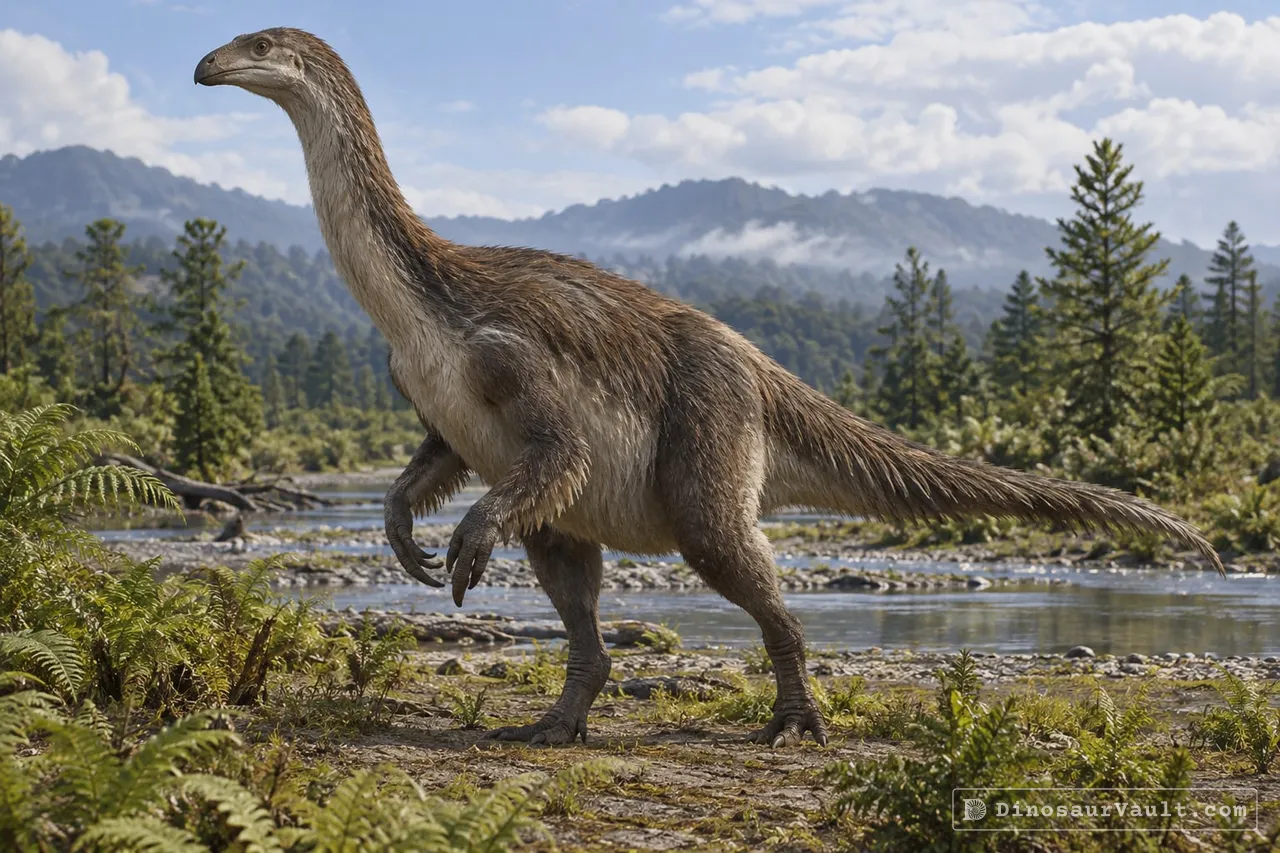
Nanshiungosaurus was a therizinosaur about 4.4 meters (14 feet) long, a plant eater with a long neck, a small head and long claws. It is known from most of the backbone and the hips, but no skull.
Its world
It lived in the Late Cretaceous in what is now southern China. Its bones come from the Yuanpu Formation.
How it was found
Dong named Nanshiungosaurus in 1979. A second species from northwestern China was later added, but many scientists think it belongs elsewhere.
Field gallery
More views of Nanshiungosaurus
Scenes reconstructed from the available fossil evidence.
1 of 3
The evidence
The science behind Nanshiungosaurus
Which parts of the picture come from its own bones, and which come from its relatives.
From its own fossils
- The type skeleton preserves connected neck, back and hip vertebrae, together with part of the pelvis.
- Its neck and back vertebrae have low, broad bony spines.
Borrowed from relatives
- The missing limbs, hands and feet are restored from better-known therizinosaurs such as Nothronychus.
- The missing head follows Erlikosaurus, while feathers in Beipiaosaurus suggest it may have carried a coat of filaments.
Still unknown
- The shape of its skull, hands and feet.
- Its skin covering and color.
- Which features best distinguish it from other therizinosaurs, because its damaged pelvis needs reassessment.
Often drawn wrong
- A tall sail along the back conflicts with its low, broad vertebral spines.
Discovery timeline
- 1979Named itDong
- 2009Close relativeXu, Zheng & You
- 2010Family treeZanno
- 2015Close relativeHedrick et al.
Key papers
The research behind what we know of Nanshiungosaurus
Named it
Named Nanshiungosaurus from a backbone and partial pelvis, initially interpreting it as a sauropod.
Cretaceous dinosaurs of Hunan, China. Mesozoic and Cenozoic Red Beds of South China: Selected Papers from the "Cretaceous-Tertiary Workshop", Institute of Vertebrate Paleontology and Paleoanthropology & Nanjing Institute of Paleontology (eds.), Science Press, Nanxiong, China.
No link available
Close relative
Found simple filament feathers in Beipiaosaurus, supporting a possible feather covering in other therizinosaurs, including Nanshiungosaurus.
A new feather type in a nonavian theropod and the early evolution of feathers. Proceedings of the National Academy of Sciences 106: 832-834
Read the paper : A new feather type in a nonavian theropod and the early evolution of feathers (opens in a new tab)Family tree
Retained the type species among therizinosaurs and treated bohlini separately, while identifying problems with the damaged pelvis and original diagnosis.
A taxonomic and phylogenetic re-evaluation of Therizinosauria (Dinosauria: Maniraptora). Journal of Systematic Palaeontology 8: 503-543
Read the paper : A taxonomic and phylogenetic re-evaluation of Therizinosauria (Dinosauria: Maniraptora) (opens in a new tab)Close relative
Described Nothronychus hands, feet and body bones, providing comparisons for the missing limbs of Nanshiungosaurus.
The Slothful Claw: Osteology and Taphonomy of Nothronychus mckinleyi and N. graffami (Dinosauria: Theropoda) and Anatomical Considerations for Derived Therizinosaurids. PLOS ONE 10: e0129449
Read the paper : The Slothful Claw: Osteology and Taphonomy of Nothronychus mckinleyi and N. graffami (Dinosauria: Theropoda) and Anatomical Considerations for Derived Therizinosaurids (opens in a new tab)
Close relatives
Other members of Therizinosauridae


Sources: Wikidata