Qunkasaura
Type species Qunkasaura pintiquiniestra
- Lived
- 84 to 66 million years ago, Late Cretaceous
- Diet
- Herbivore
- Group
- Sauropods, Saltasauridae
- Found in
- Spain
- Named by
- Mocho et al. 2024
Where its fossils were found
The evidence
Today

75 million years ago
Habitat
It lived on a muddy coastal floodplain crossed by sandy channels, with periods of flooding and drying. The Villalba de la Sierra Formation also preserves Lohuecotitan and Rhabdodon.
Field notes
About Qunkasaura
What it was like
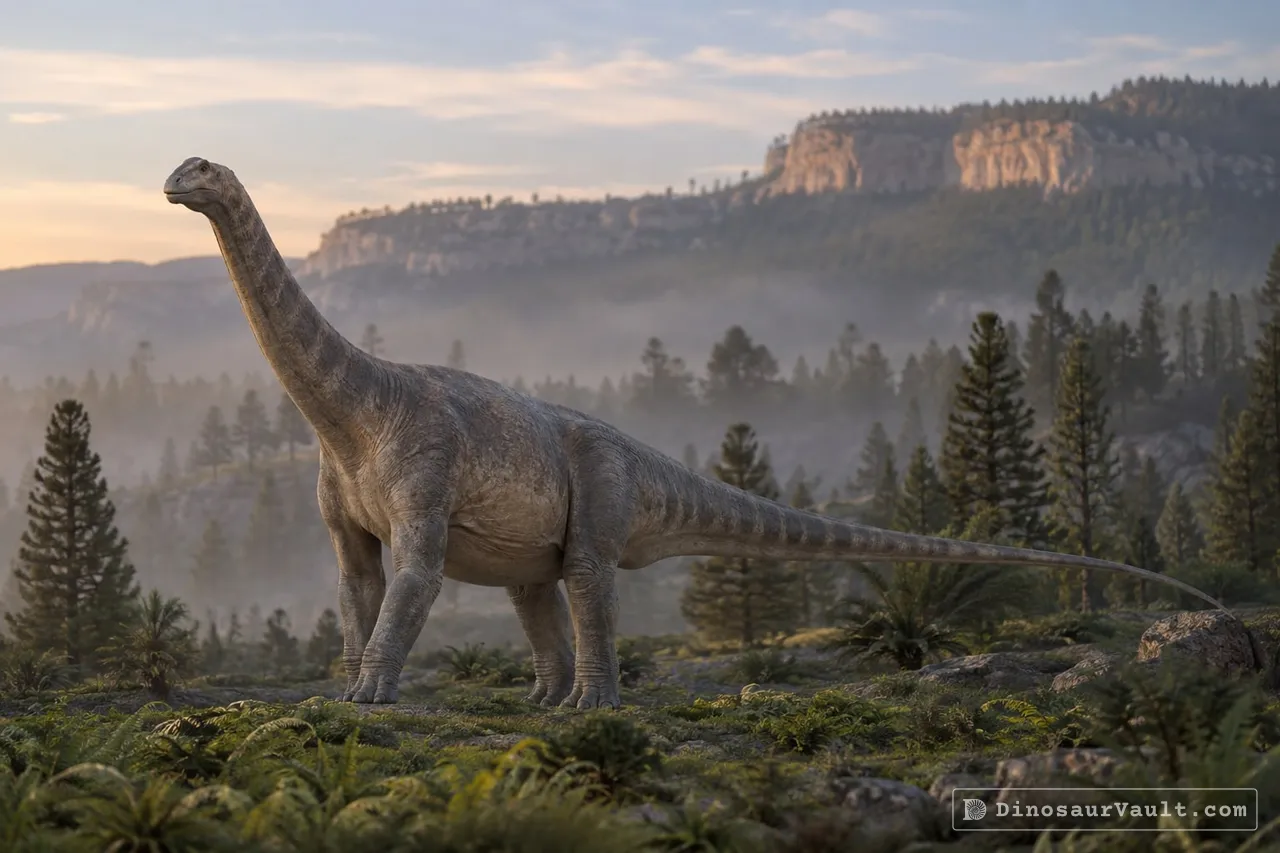
Qunkasaura was a titanosaur, a long-necked, four-legged plant eater, known from a partial skeleton. It was related to Saltasaurus and Alamosaurus.
Its world
It lived in the Late Cretaceous in what is now central Spain. Its bones come from the Villalba de la Sierra Formation, at a rich fossil site that also produced the titanosaur Lohuecotitan and the plant eater Rhabdodon.
How it was found
Mocho and colleagues named Qunkasaura in 2024. Its name comes from an old name for the region.
Field gallery
More views of Qunkasaura
Scenes reconstructed from the available fossil evidence.
Lived alongside
Found in the same rock formations


A rock formation can hold fossils laid down millions of years apart, so not every animal here met Qunkasaura.
The evidence
The science behind Qunkasaura
Which parts of the picture come from its own bones, and which come from its relatives.
From its own fossils
- A partial skeleton preserves much of the back, the fused backbone at the hips, the base of the tail, the pelvis and parts of the limbs.
- The tail vertebrae have forward-leaning spines and distinctive bony ridges around their joints.
- The neck and back bones have a honeycomb of small internal air spaces.
Borrowed from relatives
- The missing skull and most of the neck are restored using other titanosaurs.
- Its bones place it close to Abditosaurus and among relatives of Alamosaurus and Opisthocoelicaudia.
Still unknown
- The shape of its skull and the full length of its neck.
- Its color and pattern of scales.
- Whether it carried bony skin armor.
Discovery timeline
- 2015Its worldOrtega et al.
- 2016Same rocksDíez Díaz et al.
- 2024Named itMocho et al.
Key papers
The research behind what we know of Qunkasaura
Its world
Reconstructed a coastal floodplain with sandy channels, flooding and drying, and described its plants, turtles, crocodile relatives and dinosaurs.
The biota of the Upper Cretaceous site of “Lo Hueco” (Cuenca, Spain). Journal of Iberian Geology 41
Read the paper : The biota of the Upper Cretaceous site of “Lo Hueco” (Cuenca, Spain) (opens in a new tab)Same rocks
Named Lohuecotitan from another partial skeleton at the same fossil site, revealing a different kind of titanosaur.
A new titanosaur (Dinosauria, Sauropoda) from the Upper Cretaceous of Lo Hueco (Cuenca, Spain). Cretaceous Research 68: 49-60
Read the paper : A new titanosaur (Dinosauria, Sauropoda) from the Upper Cretaceous of Lo Hueco (Cuenca, Spain) (opens in a new tab)Named it
Described a well-preserved partial skeleton with a distinctive tail and identified separate titanosaur lineages living in Europe.
A Spanish saltasauroid titanosaur reveals Europe as a melting pot of endemic and immigrant sauropods in the Late Cretaceous. Communications Biology 7
Read the paper : A Spanish saltasauroid titanosaur reveals Europe as a melting pot of endemic and immigrant sauropods in the Late Cretaceous (opens in a new tab)
Close relatives
Other members of Saltasauridae


Sources: Wikidata