Kiyacursor
"Kiya runner"
Type species Kiyacursor longipes
- Lived
- 121 to 113 million years ago, Early Cretaceous
- Diet
- Carnivore
- Group
- Theropods, Noasauridae
- Found in
- Russia
- Named by
- Averianov et al. 2024
Where its fossils were found
The evidence
Today

115 million years ago
Habitat
It lived in the region preserved by the Ilek Formation in Russia, alongside Psittacosaurus and Sibirotitan. Salamanders, small mammals and crocodile relatives also inhabited this region.
Field notes
About Kiyacursor
What it was like
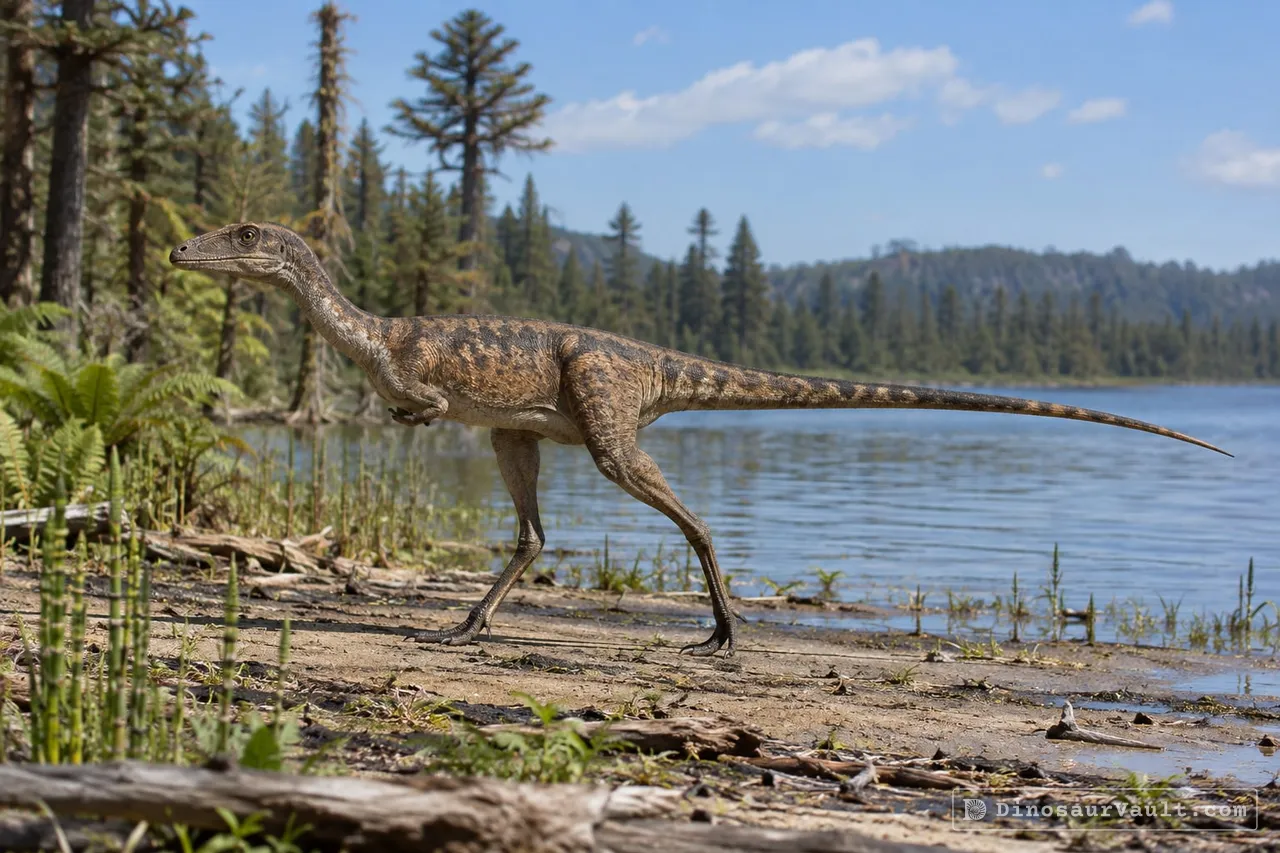
Kiyacursor was a small, fast meat eater from the noasaurs, a family of light, slender hunters. It is known from part of a skeleton with long legs, and its species name means "long feet".
Its world
It lived in the Early Cretaceous in what is now Russia. Its bones come from the Ilek Formation, where it shared the land with Psittacosaurus and the long-necked Sibirotitan.
How it was found
Averianov and colleagues named Kiyacursor in 2024. It was the first noasaur found in Asia from the Early Cretaceous.
Field gallery
More views of Kiyacursor
Scenes reconstructed from the available fossil evidence.
1 of 2
Lived alongside
Found in the same rock formations


A rock formation can hold fossils laid down millions of years apart, so not every animal here met Kiyacursor.
The evidence
The science behind Kiyacursor
Which parts of the picture come from its own bones, and which come from its relatives.
From its own fossils
- The partial skeleton includes neck and tail vertebrae, shoulder bones, upper arms and long hind legs.
- Its foot has a large central bone and a much smaller bone on the inner side, a pattern associated with fast running.
- Bone tissue shows that the known animal was still growing when it died.
Borrowed from relatives
- Elaphrosaurus and Limusaurus have similar neck and hind-leg proportions and guide restoration of the missing body parts.
Still unknown
- The shape of its skull and teeth.
- Its full adult size.
- Its skin covering and color.
Discovery timeline
- 2016Close relativeRauhut & Carrano
- 2020Close relativePoropat et al.
- 2024Named itAverianov et al.
Key papers
The research behind what we know of Kiyacursor
Close relative
Redescribed Elaphrosaurus, showing the long neck and slender legs later compared with those of Kiyacursor.
The theropod dinosaurElaphrosaurus bambergiJanensch, 1920, from the Late Jurassic of Tendaguru, Tanzania. Zoological Journal of the Linnean Society 178: 546-610
Read the paper : The theropod dinosaurElaphrosaurus bambergiJanensch, 1920, from the Late Jurassic of Tendaguru, Tanzania (opens in a new tab)Close relative
Described an Australian neck vertebra later compared with Kiyacursor, broadening the record of small, long-necked ceratosaurs.
First elaphrosaurine theropod dinosaur (Ceratosauria: Noasauridae) from Australia — A cervical vertebra from the Early Cretaceous of Victoria. Gondwana Research 84: 284-295
Read the paper : First elaphrosaurine theropod dinosaur (Ceratosauria: Noasauridae) from Australia — A cervical vertebra from the Early Cretaceous of Victoria (opens in a new tab)Named it
Described a long-legged noasaur with a specialized running foot and used bone tissue to identify a partly grown individual.
The last ceratosaur of Asia: a new noasaurid from the Early Cretaceous Great Siberian Refugium. Proceedings of the Royal Society B: Biological Sciences 291
Read the paper : The last ceratosaur of Asia: a new noasaurid from the Early Cretaceous Great Siberian Refugium (opens in a new tab)
Close relatives
Other members of Noasauridae


Sources: Wikidata