Sibirotitan
"Siberian titan"
Type species Sibirotitan astrosacralis
- Lived
- 126 to 113 million years ago, Early Cretaceous
- Diet
- Herbivore
- Group
- Sauropods
- Found in
- Russia
- Named by
- Averianov et al. 2018
Where its fossils were found
The evidence
Today

120 million years ago
Habitat
A landscape crossed by rivers in what is now Russia. The Ilek Formation also preserves Psittacosaurus and Kiyacursor.
Field notes
About Sibirotitan
What it was like
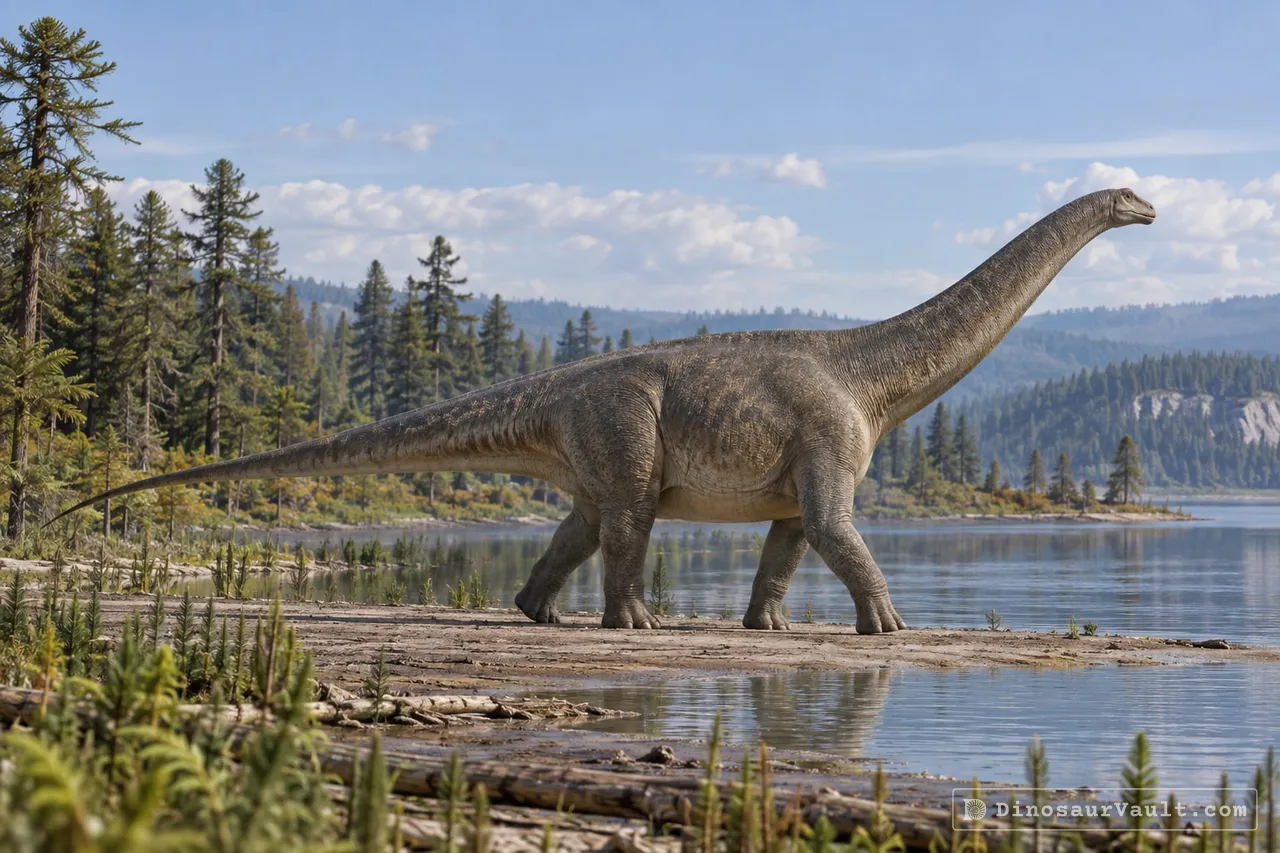
Sibirotitan was a sauropod, a long-necked plant eater. It is known from back bones, a tooth and a hip area with bones fused in a star-like pattern.
Its world
It lived in the Early Cretaceous, in what is now Russia. It comes from the Ilek Formation, where it shared the land with the parrot-beaked Psittacosaurus.
How it was found
Averianov and colleagues named Sibirotitan in 2018. The type species is Sibirotitan astrosacralis.
Field gallery
More views of Sibirotitan
Scenes reconstructed from the available fossil evidence.
Lived alongside
Found in the same rock formations


A rock formation can hold fossils laid down millions of years apart, so not every animal here met Sibirotitan.
The evidence
The science behind Sibirotitan
Which parts of the picture come from its own bones, and which come from its relatives.
From its own fossils
- The type specimen is a single back vertebra. Neck and back vertebrae, fused hip vertebrae whose ribs spread in a star-like pattern, and isolated teeth from the same area are assigned to it.
- Bones of a left foot, found close together but not joined, are assigned to it. The first and second toe claws are deep, narrow sickles flattened from side to side; the first is slightly larger and the second more pointed.
- Later studies referred to it a damaged second neck vertebra, with a flat underside and deep hollows beside the passage for the spinal cord, and tail vertebrae from a second site.
Borrowed from relatives
- The missing skull is restored from Euhelopus, and the rest of the body and tail from Mnyamawamtuka.
- The front feet are restored from Camarasaurus and Apatosaurus.
- Its star-like arrangement of hip ribs resembles that of Euhelopus.
Still unknown
- Its skull and the length of its neck.
- Whether all the bones from the first site belonged to one individual, as one study suggested.
- Where it sits among sauropods. It was first placed among titanosauriforms outside the titanosaurs, and a later study found different positions depending on how the fossils were grouped.
Discovery timeline
- 2018Named itAverianov et al.
- 2020Same rocksAverianov, Ivantsov & Skutschas
- 2022New findAverianov & Lopatin
- 2023New findAverianov et al.
Key papers
The research behind what we know of Sibirotitan
Named it
Described teeth, backbone and foot bones, and placed Sibirotitan among titanosauriform sauropods outside the titanosaurs.
A new sauropod dinosaur from the Lower Cretaceous Ilek Formation, Western Siberia, Russia. Geobios 51: 1-14
Read the paper : A new sauropod dinosaur from the Lower Cretaceous Ilek Formation, Western Siberia, Russia (opens in a new tab)Same rocks
Identified titanosaur tail bones from the Ilek Formation, showing that other kinds of sauropods lived in the region as well as Sibirotitan.
Caudal vertebrae of titanosaurian sauropod dinosaurs from the Lower Cretaceous Ilek Formation in Western Siberia, Russia. Cretaceous Research 107: 104309
Read the paper : Caudal vertebrae of titanosaurian sauropod dinosaurs from the Lower Cretaceous Ilek Formation in Western Siberia, Russia (opens in a new tab)New find
Described a neck bone with a flat underside and deep hollows that help distinguish Sibirotitan from other sauropods.
New Data on Sibirotitan, a Titanosauriform Sauropod from the Early Cretaceous of Western Siberia. Doklady Earth Sciences 506: 650-653
Read the paper : New Data on Sibirotitan, a Titanosauriform Sauropod from the Early Cretaceous of Western Siberia (opens in a new tab)New find
Referred tail bones from a second site to Sibirotitan and tested its place in the sauropod family tree, with results that changed between analyses.
First sauropod dinosaur remains from the Early Cretaceous Shestakovo 3 locality, Western Siberia, Russia. Biological Communications 68
Read the paper : First sauropod dinosaur remains from the Early Cretaceous Shestakovo 3 locality, Western Siberia, Russia (opens in a new tab)
Close relatives
Other members of Somphospondyli


Sources: Wikidata